Skip to content

Boston

ON MAKERSPACES AND SOCIAL RESPONSIBILITY


Making can be cool, but conscious making is cooler


December 19, 2017

BY JASON PRAMAS @JASONPRAMAS


For many of us living in and around Boston in recent years, it has become common to see lots of communications from makerspaces around holiday time. Which is totally understandable. Such creative centers produce neat things year-round, so it’s only natural that their members would turn to producing gifts like busy elves (and holding workshops about how to produce gifts like… um… smart busy elves) as fall turns to winter.


However, if you’re someone who thinks critically about social institutions and their interaction with technology, then you might join me in feeling some concern about the trajectory of these spaces. Which boils down to this: Do makers and the makerspaces they found think about why they make, and for whom they make? Obviously, it varies from maker to maker and space to space, but my observation has been that the maker movement could do much better on that front. So I thought I would run through some of my apprehensions on that theme and make some suggestions for reform. In the spirit of holiday giving and all that.


There’s no question that makerspaces have been a boon to society in many different ways. Described by the Somerville nonprofit makerspace Artisan’s Asylum as “community centers with tools,” these logical outgrowths of the hacker and DIY cultures—and the older crafter culture, amateur radio culture, and cultures around magazines like Popular Electronics and Popular Mechanics—have grown to become a significant social force in the last decade. Particularly in places like the Boston area that have lots of colleges producing lots of engineers, scientists, and artists.


But it’s important to remember that—as with science, technology, and art in general—there is a problem with pushing “making” in the abstract without thinking about its social and political consequences. Because tools and techniques may be inherently neutral, but people and the institutions we create are not.


Including makerspaces. So it’s worth being aware that, according to PandoDaily, in early 2012 O’Reilly Media’s MAKE division —publisher of Make magazine, perhaps the best known popularizer of the maker movement—announced that it had won a grant from the Pentagon’s Defense Advanced Research Projects Agency (DARPA) to participate in the agency’s Manufacturing Experimentation and Outreach (or MENTOR) program. The money was to be used to start 1,000 makerspaces in high schools around the country.


Now DARPA may be most famous as the super clever agency that brought us the Internet. But it worked on that project in part—protestations from its fans and allies taken as given—to help solve the insoluble problem of how to keep America’s military, research, and control centers in communication with each other after an all-out nuclear war. And somehow help our government survive the unsurvivable.


It is also the super clever agency that has brought us an array of very nasty war machines in the last six decades. Notably, according to Air & Space magazine, the Predator drones that have killed hundreds of innocent people around the world—including many children—in recent years at the behest of presidents from Bush to Obama to Trump. Because they’re just not as accurate as our military and political leaders would have us believe. And because those leaders don’t really care about what they call “collateral damage” when they’re prosecuting what human rights groups like the American Civil Liberties Union and the Center for Constitutional Rights claim are extralegal assassination campaigns.


As it turned out, the DARPA MENTOR high school program never really got off the ground because it lost its budget in President Obama’s big “Sequestration” budget cut of March 2013. And it’s certainly worth mentioning that the program sparked protests from within the maker community.


But DARPA continues to participate in a variety of science and technology events aimed at high school kids—notably the young robotics crowd that overlaps with makerspaces.


And DARPA is also aiming events squarely at makerspaces… and some makerspaces are definitely participating. For example, according to the DARPA website, this November the agency held the DARPA Bay Area Software Defined Radio (SDR) Hackfest at NASA Ames Conference Center in Moffett Field, California. The relevant webpage explains that “Teams from across the country will come together to explore the cyber-physical interplay of SDR and unmanned aerial vehicles, or UAVs, during the Hackfest.”


“Unmanned aerial vehicles” is another term for drones. Two of the eight teams invited to participate along with teams from military contractors like Raytheon were the Fat Cat Flyers from Fat Cat Fab Lab, a volunteer-run makerspace in New York City, and Team Fly-by-SDR from Hacker DoJo, a nonprofit community of hackers and startups in Silicon Valley… which is also a makerspace.


Whatever you in the viewing audience think about the Pentagon in particular and the American military in general, we can all agree that there are moral, ethical, social, and political questions that must be asked in a democratic society about the intersection of maker culture and makerspaces with those institutions.


For that reason, I think it’s critical that makerspaces raise and address such questions on an ongoing basis. That they maintain a scrupulous policy of transparency regarding who they work with and why. And that they hold classes and public forums on the moral, ethical, social and political dimensions of why makers make and for whom they make. Something you really don’t see much of at makerspaces at present. But should.


Anyhow, I’m keen to engage with the maker community on this topic and flesh these ideas out more. Folks interested in discussing the issues I’m raising at more length can drop me a line at execeditor@digboston.com.


A shorter version of this column was originally written for the Beyond Boston regional news digest show—co-produced by the Boston Institute for Nonprofit Journalism and several area public access television stations.


Apparent Horizon is syndicated by the Boston Institute for Nonprofit Journalism. Jason Pramas is BINJ’s network director, and executive editor and associate publisher of DigBoston. Copyright 2017 Jason Pramas. Licensed for use by the Boston Institute for Nonprofit Journalism and media outlets in its network.

TOWNIE: CORPORATE TAX FABLES AND COMMUNITARIAN KIDDIE TABLES

CORPORATE TAX FABLES AND COMMUNITARIAN KIDDIE TABLES


December 12, 2017

BY JASON PRAMAS @JASONPRAMAS


Big local corps quiet about huge profits to come from Repub tax scheme… except GE

An interesting WBUR article, “Largest Mass. Companies Are Mostly Silent On GOP Tax Plans,” asked the top 12 corporations in the Commonwealth to comment on the recently passed Republican scheme to transfer vast amounts of money from the working and middle classes to the rich and the corporations they control—euphemistically called “tax reform” in most of the major news media. Unsurprisingly, Bay State business leaders didn’t want to take time away from rubbing their hands together and cackling with glee about all the free money they’re going to get—choosing instead to remain mum for the moment.


But WBUR did get a statement out of General Electric after the Senate vote on the tax plan:


GE commends Congress and the White House for their commitment to comprehensive tax reform. GE supports the Senate tax reform plan because it would upgrade the U.S. to a territorial tax system, bring rates in line with other countries, and allow U.S. businesses and workers to compete fairly around the world, so it’s the quality of our products that determine whether we win global deals, and not tax differences.


No surprise GE would say that, since it will benefit tremendously from the drop in federal corporate tax from 35 percent to only 20 percent. But it will also get to repatriate as much of the lucre it’s been offshoring as it would like at a one-time tax rate of merely 12 percent. And now that the feds are “upgrading” to a “territorial tax system,” the company will make even more money. Why? Because a territorial tax system means that all the profits multinationals sock away in offshore tax havens will be taxed at a rate of zero percent. You read that correctly. Nada. No taxes at all on foreign profits.


Currently, companies like GE stash profits in other countries because, although they have been technically taxed on all profits—foreign and domestic—at the base 35 percent rate (basically a total joke since there are so many corporate tax loopholes that big companies like GE actually end up with a negative tax rate some years, but let’s play along for the purpose of this explanation), they are only required to pay those taxes when they “repatriate” the money back to the US. Which has often been never thanks to a complicated system called “transfer pricing” where corporations book profits in low tax countries, and take deductions in the US and other higher tax countries. And then borrow cheap money on the strength of their foreign bank accounts to make more profits.


The result will be even more offshoring of both money and jobs by megacorps. Because why would a company like GE not move more of both away from the US if foreign profits are  tax free—without nearly as much of the tricky accounting that’s currently needed to play the transfer pricing game? Just really bad news for Mass workers. And for boosters of the GE Boston deal. And anyone who thinks big companies like Amazon are going to have much incentive to add lots of jobs anywhere in the US going forward.


BPDA “PLAN: Glover’s Corner” protested in Dorchester

As the neoliberal capture of the government and the public sector continues apace, earnest technocrats at the Boston Planning and Development Agency (BPDA, formerly known as the BRA) still find it necessary to play the communitarian “public meeting” game when trying to sell bad deals that advance corporate interests to the working families who are all too often the targets of such deals.


Communitarianism being the decades-old fad where institutions representing the rich and powerful work hard to make sure that “every constituency has a seat at the table” when they want to do something that will harm those constituencies. But, of course, the power relations remain unchanged. The rich and powerful remain rich and powerful. Everyone else does not. And “the table” isn’t the real table—where bankers, CEOs, and top government leaders meet to make policy decisions happen. Usually behind closed doors. It’s basically a kiddie table where regular people can pretend they have some impact on a process that’s over before it begins.


Which is why it’s nice to see that housing activists with the Dorchester Not For Sale coalition decided to crash a recent BPDA transit-oriented public meeting on its “PLAN: Glover’s Corner”—which is slated, among other things, to add hundreds of units of housing that will be mostly unaffordable to current Dot residents.


According to the Bay State Banner and the Dorchester Reporter, the Dorchester activists are taking a page from JP and Roxbury housing activists with the Keep It 100% for Egleston coalition who protested the larger BPDA PLAN: JP/Rox—which might ultimately involve thousands of units of new housing—until the city relented and mandated that 36 percent of the new units (and 40 percent overall, including units currently permitted for construction) must be affordable.


The definition of “affordable” for the JP/Rox plan area is pegged to percentages of the average median income of the Boston region set by the US Department of Housing and Urban Development (HUD). So, for example, according to an August Spare Change News article, some “affordable” units being rented and sold as part of the 3200 Washington complex are being offered to households making 70 percent of the region’s average median income, and some to households making 100 percent.


But JP and Roxbury advocates have continued to protest PLAN: JP/Rox even after it was made official because its definition of “affordable” remains too high.


Spare Change continues, “For the Boston metropolitan region, the average median income is just over $100,000, and according to the U.S. Census Bureau, the average household income for all of Jamaica Plain is $76,968. However, households within the plan’s range have an average income of just over $50,000.”


According to a March Bay State Banner article, activists three goals for the plan are “to deepen the affordability level on designated affordable housing units so that they are attainable by households making less than $35,000 per year; increase goals for the portion of new housing that’s designated as affordable from 36 percent to 55 percent; and require the conversion of 250 market-rate units into affordable units..”


So while their activism raised the amount of “affordable” housing the BPDA planned to offer in the deal from 30 percent to 36 percent, it’s not going to help many people currently living in or near the affected neighborhoods to stay in the area unless the definition of affordable is changed to reflect economic reality. Given that fact, Mayor Marty Walsh’s much-vaunted progress on getting more affordable housing built on his watch is based largely on smoke and mirrors because much of it remains unaffordable to the people who need it most.


The Dorchester activists, meanwhile, are demanding that the BPDA accept a six-month moratorium on PLAN: Glover’s Corner, use the extra time to provide more data to the community on the plan, and do things like provide childcare at public meetings to allow more locals to attend.


Thus far, the BPDA is blowing off such demands and trying to plow forward without significant changes to its plan. Boston City Councilor Frank Baker, who attended the Glover’s Corner meeting, agreed with the BPDA in a recent Spare Change article, saying “As far as I’m concerned, it’s not a valid request.”


Seems the fight for housing justice is far from over in Dorchester.


Townie (a worm’s eye view of the Mass power structure) is syndicated by the Boston Institute for Nonprofit Journalism. Jason Pramas is BINJ’s network director, and executive editor and associate publisher of DigBoston. Copyright 2017 Jason Pramas. Licensed for use by the Boston Institute for Nonprofit Journalism and media outlets in its network.

EVERSOURCE SCREWS MASS CONSUMERS

EVERSOURCE SCREWS MASS CONSUMERS


With a little help from its friends, the “regulators” at the Department of Public Utilities


December 5, 2017

BY JASON PRAMAS @JASONPRAMAS


It is perhaps understandable that one of the most important Massachusetts news stories of the year was buried in the avalanche of reports coming out of Washington last week. But Eversource Energy, a large investor-owned utility serving much of Connecticut, New Hampshire, and Massachusetts, just got a big rate hike approved by the Commonwealth’s Department of Public Utilities Commission. This despite strong opposition from Mass Attorney General Maura Healey—who believes the company should be forced to cut its rates, rather than being allowed to needlessly accumulate more profits on the backs of consumers.


According to Commonwealth magazine, “Eversource Energy won approval to hike power rates $36.9 million a year for its 1.4 million electricity customers, a slimmed-down boost from the company that initially requested a $96 million increase.” A situation the company had the temerity to complain about when it has already been making solid profits under the rate system that has been in place since 2005. The new rates—which will slam Western Mass especially hard—are slated to go into effect on Jan 1 and last until 2022.


Healey, for her part, said the 10 percent shareholder return the rate increase includes is “one of the highest in the country” for a publicly regulated utility, according to the Boston Herald. And Eversource has some serious rate-related skeletons in its closet, it seems. Even as its rent-seeking drama played out at the DPU, the AG started looking into recent allegations by the Environmental Defense Fund that the Eversource and fellow regional utility Avangrid, Inc. rigged gas pipeline reservations on frigid winter days to artificially drive up electric and gas prices to its customers. Then, according to The Republican, shortly after that charge was leveled several New England residents, represented by Hagens Berman Sobol Shapiro LLP, filed a related class action suit against Eversource and Avangrid for using the pipeline scheme to cause “electricity consumers to incur overcharges of $3.6 billion in a years-long scheme that impacted six states and affected 14.7 million people.”


There is much that can be said about how problematic it is to have former energy industry lawyers like DPU Commission Chair Angela M. O’Connor and DPU Commissioner Cecile M. Fraser—both appointed by Gov. Charlie Baker (Fraser only in July with the Eversource rate hike vote looming)—playing the role of corporate foxes guarding the chicken coop of the public trust. It’s also worth mentioning that the third commissioner, Robert Hayden, was a longtime DPU staffer—and ran for the Mass 10th Congressional seat as a conservative Republican in 2010 on a “small government” platform, according to the Barnstable Patriot. So don’t expect much consumer protection to come from his corner either. But even if the three-person DPU Commission was all pro-consumer, we’d still have to deal with the structural crisis of energy conglomerates using their money and political clout to continue to make state government dance to whatever tune they care to play.


For example, Eversource and other investor-owned utilities have remained extremely hostile to the new wave of renewable energy options. Especially solar, which they have consistently lobbied heavily and successfully against to prevent it from becoming widespread enough to potentially break their regional monopolies.


Reining in such entrenched corporate utilities will take a long, hard fight by a broad coalition of consumers and local governments. But there is one seemingly small change to state law that would go a long way toward winning such a conflict. A group called the Massachusetts Alliance for Municipal Electric Choice (MAMEC), led by Lexington resident Patrick Mehr, got state legislators to file an important “muni choice” bill with significant support from dozens of cities, towns, and major stakeholder organizations around the state no less than eight times in 16 years between 2000 and 2016. If passed, it would have struck language from state law that gives investor-owned utilities like Eversource veto power over the establishment of new municipal electric utilities in the Commonwealth. It was shot down all eight times by the cheap and oft-used device of sending each attempt into “study.” Basically the same thing as killing the bill without as much PR blowback for state pols in the pocket of major corporations.


Turns out that 41 cities and towns in Massachusetts already have municipal—that is, publicly owned and managed—utilities. And advocates like MAMEC say they provide generally better service and, more to the point, significantly cheaper rates than energy corporations like Eversource. Sadly, the last new muni utility came online in 1926. It will take passage of a muni choice bill to allow more cities and towns to exercise that option.


MAMEC and its allies may have lost many battles against powerful, well-connected foes. But that doesn’t mean the idea of expanding the number of muni utilities is a bad one. Far from it. Because every new muni that comes online is another stake in the heart of the greedy, environmentally destructive, investor-owned utilities that will keep taking Mass consumers for a ride until they are brought to heel. Failing that, consumers can expect to get spanked with regular and ever more painful rate hikes for the foreseeable future.


So, I encourage readers to get active in the fight for a more fair, democratic, and environmentally conscious regional energy system. Working to get more public-spirited DPU commissioners seated is certainly a good interim goal. But creating a larger network of publicly owned and managed municipal energy utilities will go further down the road toward extricating us from the structural mess we’re in thanks to the big investor-owned utilities like Eversource. Though even that won’t solve all the myriad problems with our current byzantine system of electricity generation and distribution.


Regardless, check out MAMEC at massmunichoice.org. Patrick Mehr told me that the group remains active, and it seems like a good starting place for those of you who don’t want to continue to take rate hikes lying down.


Frankly, increased public pressure on Eversource and other investor-owned utilities in our region cannot come soon enough. Turns out the recent rate hikes are only the first part of the DPU order relating to Eversource. The second part is being released on Dec 31, according to a DPU press release, and advocates are warning that even worse rate shenanigans are in the works. So, find a good group working for utility reform and join it, or start your own utility reform group… or continue to be a victim of price gouging by investor-owned utilities. Those are your options. Choose wisely.


Apparent Horizon is syndicated by the Boston Institute for Nonprofit Journalism. Jason Pramas is BINJ’s network director, and executive editor and associate publisher of DigBoston. Copyright 2017 Jason Pramas. Licensed for use by the Boston Institute for Nonprofit Journalism and media outlets in its network.

TOWNIE: UMB DRUBBING, PAWSOX GRUBBING

UMB DRUBBING, PAWSOX GRUBBING


University cuts and a (possible) corporate scam just in time for the holidays


November 27, 2017

BY JASON PRAMAS @JASONPRAMAS


UMass Boston admin lays off more staff, unions push back

The neoliberal war on public higher education continues unabated in Massachusetts as the UMass Boston administration announced the layoff of 36 personnel last week, and a reduction in hours for seven more. According to the Boston Globe, all of them are “staff who clean the school, help run academic programs, work in the student health office, or in other ways support the daily operations of the university. Some have worked there more than 30 years.” UMB had 2,095 employees in 2016, but has cut 130 jobs so far this year. The university serves over 16,000 students.


As of this writing, campus unions are planning protests. Hopefully, such actions will ultimately build a political movement capable of operationalizing the prescriptions of the fine report a coalition of UMB “students, staff unions, and faculty” released in September. Entitled “Crumbling Public Foundations: Privatization and UMass Boston’s Financial Crisis,” it lays the responsibility for the budget crisis currently engulfing the university at the feet of the UMB administration, the UMass Board of Trustees, and the state legislature.


As well it should. The legislature has been slashing the state higher ed budget since the 1980s. The board keeps raising the tuition and fees paid by students and families to cover the resulting gap. And the UMB administration continues increasing the number of high-level administrators with questionable job descriptions and fat paychecks who somehow rarely face layoffs—despite costing the school far more per capita than each of the low-level employees who keep getting axed of late. All while expanding the campus in ways that don’t always benefit the urban students that institution was built to serve… running up unsustainable debt loads in the process.


The report calls for five major reforms that its authors believe would set the campus to rights:


  1. UMass Boston should not be required to show a positive net income in its budget. Instead, it should be allowed to make debt payments using the reserves it’s been forced to build up for the last few years—and the Board of Trustees should “release Central Office reserves” to help with those payments. Rather than compelling students and their families to shoulder such costs through ever-increasing tuition and fees.
  2. The UMB administration should engage in an open and transparent planning process with faculty, staff, and students that will “ensure that the campus can continue to provide an affordable and diverse education along with appropriate support services to its students,” review interest and principal payments, and review the rapid increase in high-level administrator expenses.
  3. The UMass Board of Trustees should endorse the Fair Share Amendment that will levy an additional 4 percent income tax on millionaires and spend the money on public higher education, pre-K-12 education, and transportation if passed by binding statewide referendum next year.
  4. The Mass Legislature should cover the cost of rebuilding crumbling campus infrastructure.
  5. The Mass Legislature should annually increase appropriations for public higher education until we are at least on par with the national average based on our state’s wealth.  The Commonwealth is presently at the bottom of the pack for state appropriations for public higher ed.


The white paper concludes with a visionary sentiment that’s worth reprinting in full: “In considering these recommendations, we ask that we all—members of the Massachusetts legislature, the UMass Board of Trustees, UMass Boston’s administration, and the larger community of Boston—remember the purpose with which we are tasked. Chancellor John W. Ryan, at UMass Boston’s 1966 Founding Day Convocation, reminded those gathered that ‘we have an obligation to see that the opportunities we offer… are indeed equal to the best that private schools have to offer.’ This is the expectation that the citizens of our Commonwealth have for themselves and their family members when they come to UMass Boston. This is the responsibility that UMB staff, faculty, and administrators take on each day on behalf of our students. This should be what guides the decision of the Board of Trustees and the Mass legislature as we work to address the crisis at UMB.”


PawSox Worcester visit: boondoggle in the making?

Meanwhile, in faraway central Mass, my Worcester Magazine colleague Bill Shaner is tracking what could be another big giveaway of local and state money. Seems that the Pawtucket Red Sox—the BoSox Triple A affiliate team—have been courting Worcester for a few months and might be looking to move there in exchange for lashings of public lucre. Shaner reports that multiple sources said that Jay Ash, secretary of Gov. Baker’s Executive Office of Housing and Economic Development, attended a meeting last week between Worcester officials and PawSox bigs. Though “City and PawSox officials both declined to comment on the meeting, or whether or not it took place.” While “Ash’s staff confirmed he was in Worcester Monday but couldn’t say what for.” All I can say for now is that, like some capitalist Santa Claus, whenever Ash appears corporate leaders can virtually always expect a yuuuuge present from the Bay State and any municipal government in range in the near future. So this nascent Woo-town deal is definitely worth watching.


Townie (a worm’s eye view of the Mass power structure) is syndicated by the Boston Institute for Nonprofit Journalism. Jason Pramas is BINJ’s network director, and executive editor and associate publisher of DigBoston. Copyright 2017 Jason Pramas. Licensed for use by the Boston Institute for Nonprofit Journalism and media outlets in its network.

GENERAL ELECTRIC FAIL


Conglomerate’s woes throw Boston HQ deal contradictions into bold relief


November 15, 2017

BY JASON PRAMAS @JASONPRAMAS


What a surprise. General Electric is tanking, and the scheme to bring the multinational’s headquarters to Boston is looking worse by the day. And whom shall the public blame if that once-secret deal cut by Gov. Charlie Baker and Mayor Marty Walsh in January 2016 goes south? Potentially tossing away millions in tax breaks and direct aid to a company that has already done massive damage to the Bay State over the past few decades? Readers of the dozen columns I’ve written criticizing the boondoggle will already know the answer to that question. But for those of you who have made the mistake of believing all the massive amounts of PR bullshit that the Boston Globe and other area press have been tossing around about the affair since that time, here’s a bit of a recap.


Where to begin? So, the governments of Boston and Massachusetts agreed to shovel tens of millions of dollars at GE in “exchange” for “800 jobs” in a new corporate headquarters campus in the Fort Point district of the Hub. Many of which would simply be transferred from the old headquarters, and most of which would be executive level jobs that will not help Boston’s struggling, underemployed working class.


Now there’s a problem. GE’s been losing money all year. According to the New York Times, its stock price had already dropped by 35 percent since January. Then, according to CNBC, the company’s share value dropped another 13 percent this week as of this writing after new CEO John Flannery announced a restructuring initiative—including the one thing investors hate most of all: dividend cuts. Only the second for GE since the Great Depression. So the knives are coming out around the beleaguered behemoth, and it remains to be seen whether some internal reorganization (doubtless costing legions of employees their jobs) and some belt-tightening by its execs will be enough to stop investors from moving to carve the conglomerate up like a Thanksgiving turkey. But let’s not assume the worst just yet.


Funny thing about that belt-tightening, though. According to the Boston Herald, cuts are now in store for GE’s still-small local workforce, and construction of the new Fort Point headquarters building was already pushed back two years from 2019 to 2021 in August. The plan is to make do with the two old Necco buildings already being refurbished on the site at first. The PILOT (payment in lieu of taxes) agreement signed by the Boston Planning and Development Agency (formerly the Boston Redevelopment Authority) and the city of Boston guarantees up to $25 million in tax breaks to GE if it provides the much-ballyhooed 800 full-time jobs. But by what date?


The discussion around GE moving its HQ to Boston has focused on the corporation creating those jobs by 2024. Herein, then, lies the rub about the PILOT deal: The agreement is framed around GE hiring “approximately 800 employees at the Headquarters Building and the Necco Buildings within eight years of the Occupancy Date.” But that occupancy date is explicitly defined as “the date upon which the Company initially occupies the Headquarters Building.” Which has now been pushed back from 2019 to 2021, according to the Boston Business Journal. So 2024 cannot be the year that GE will need to have 800 employees on its new campus. 2027 would have been the earliest it had to meet that target. And now that’s been pushed back to 2029, given the delay with the headquarters building.


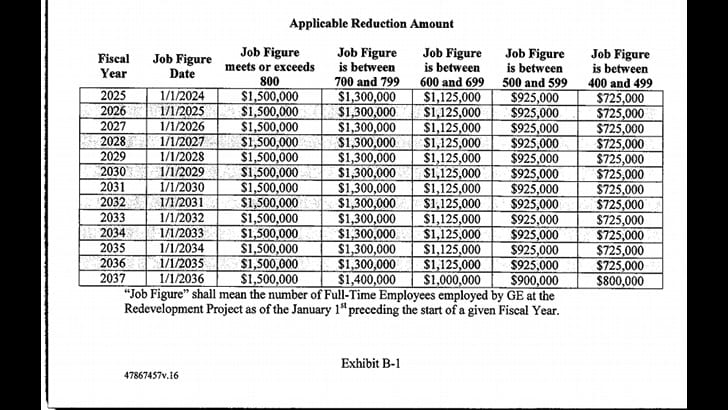
Yet it turns out that the PILOT agreement doesn’t actually require 800 jobs to be created. Remember, it starts by stating GE will employ “approximately” 800 people on the Fort Point campus. But further down in the document, in a table explaining the specific tax break the city will actually give the company during each year of the deal, it allows for the creation of as few as 400 jobs in a chart with five tax break tiers between “Job Figure is between 400 and 499” and “Job Figure meets or exceeds 800.” Keeping in mind that the agreement also specifies a “stabilization” period of seven years between 2018 and 2024, during which GE gets $5.5 million in tax breaks no matter what and isn’t required to provide any jobs at all for the first six years. GE is then only required to provide between 400 and 800 jobs from 2024 until the agreement ends in 2037.


Job figure table from the GE Boston PILOT agreement


What’s super puzzling is that agreement first requires the company to start providing annual job figures “from and after” the aforementioned occupancy date. But the agreement already established that it only really has to start meeting any job targets as far out as eight years from the date it occupies its headquarters building. Making the job target requirement trigger as late as 2029, according to current plans. Despite the tax break table in the PILOT agreement using job targets to calculate tax breaks beginning in 2025 based on the 2024 job count.


The state, for its part, committed a total of about $120 million to the project. Late last year, GE spent $25.6 million to buy 2.5 acres on the Fort Point Channel that includes the land the existing buildings sit on and the land the new headquarters building will (perhaps) one day occupy from Procter & Gamble. MassDevelopment, part of the Commonwealth’s economic development apparatus, took out a $90 million loan from Citizens Bank—an interesting maneuver worth looking into—using $57.4 million to purchase the two old Necco buildings on the site from P&G, and the rest to refurbish the buildings. The remainder of the state’s “investment” is slated to go to fixing up the area around the site.


So, GE is getting basically free rent on the Necco buildings plus free upgrades on abutting public land courtesy of the state. And a big chunk of the taxes it would normally pay over the next 20 years is coming free from the city. Without any real requirement that it actually provide any jobs in Boston for many years, and then only (maybe) 400 jobs by 2029—assuming the headquarters building is built in 2021.


Which is the problem with all such erstwhile “economic development” deals in the Bay State. From their origin as a way to help encourage investment in areas of the state that were down on their luck precisely because GE and companies like it moved their manufacturing operations away from cities like Pittsfield, Lynn, and Fitchburg to places without the decent labor and environmental regulation that was in place by the 1970s, they have become yet another way for rich and powerful corporations to get richer and more powerful. Worst of all, such corporations hold all the cards in the deals. If they don’t get lavished with free public money, they can refuse to move their operations here or can leave if they’re already operating in the area. Once they get the cash they’re looking for, they can basically pull out at any time. Or as is the case with GE, they can “alter” the deal Darth Vader-style, leaving our local “Lando Calrissians” like Baker and Walsh to “pray” the deal is not altered “any further.”


The Boston Business Journal was correct to point out that GE will get $2.1 million in tax breaks on the Fort Point Complex by 2021—the year that the company now claims it’ll be completing its new 12-story headquarters building on the site. But what if it doesn’t build the new structure at all? It’s not clear. Because the PILOT agreement is pegged to job creation starting as far out as eight years after the headquarters building is built, and then allows for the company providing as few as 400 jobs between 2024 and 2037 rather than the 800 everyone’s been assuming. While not actually demanding any job creation until as late as 2029, making it unclear how the tax break will be calculated between 2025 and 2029 should GE drag its feet for the full eight years. The conditions for the company defaulting on the agreement are also pegged to job creation. Not to the construction of the headquarters building. Oh, and by the way, the PILOT deal only covers the headquarters building and the land the company purchased under and just around it (which the agreement calls the “Headquarters Project”). Not the Necco buildings, now owned by the state. Also, there’s no word about what happens if the company has less than 400 workers in Boston at any point from 2024 to 2037. Do these curious contradictions amount to loopholes for GE to bag the whole deal? It certainly looks that way.


The minimum GE will get in tax breaks from the city of Boston over 20 years is $5.5 million by 2024 plus whatever breaks it qualifies for between 2025 and 2037. However, the amount the company actually puts out in annual PILOT payments after 2024 is calculated by a complicated formula based on the taxes that would have been assessed without the PILOT agreement. And the assessed value of the relevant property could change from current projections. So it’s hard to know what the total value of the PILOT deal will ultimately be to GE, other than that it will be a bunch of money… however many jobs it actually creates.


But why exactly are Boston and Massachusetts giving a huge company that’s still profitable any money at all? And what happens if GE bails on the scheme by hook (simply running and fighting its PILOT default in court with its vast legal department) or by crook (not building the headquarters building at Fort Point and possibly getting away with delaying the job creation target trigger until the deal ends in 2037)? And what happens if worse comes to worst for GE, and the company actually does collapse?


These remain my central questions. And I continue to encourage all of you to ask those and related questions to every Boston and Massachusetts politician you can find. And ask the Globe while you’re at it. They’ve got a loooot of ’splaining to do about their cheap boosterism… which they’ve become awfully quiet about of late. Preferring, it seems, to focus on the next giant company that’s demanding public bribes to come to town, Amazon.


A shorter version of this column appears in this week’s DigBoston print edition.


Apparent Horizon is syndicated by the Boston Institute for Nonprofit Journalism. Jason Pramas is BINJ’s network director, and executive editor and associate publisher of DigBoston. Copyright 2017 Jason Pramas. Licensed for use by the Boston Institute for Nonprofit Journalism and media outlets in its network.
DIGBOSTON SEEKS LOCAL TALENT

Photos of Boston by Olivia Falcigno for DigBoston


Boston townies, take your best shot!


November 6, 2017

BY JASON PRAMAS @JASONPRAMAS


Good journalists typically have four attributes: an ability to communicate information about the world around them to other people, training in the conventions of journalism, compassion for their fellow human beings, and deep knowledge of the areas they specialize in (which we call “beats” in the journalism trade). DigBoston, like any news outlet, obviously needs good journalists. And we’re constantly recruiting new talent. Yet as a city newspaper with a mission to provide the people of Boston’s many neighborhoods with useful information about their hometown, we need more than that. We need native Bostonians working for us.


More to the point, we need working-class native Bostonians. People with deep knowledge of the streets they grew up on. Because we’re very serious about our mission to cover ALL of Boston’s neighborhoods—not just the rich ones. But there’s a problem: Most of the people who want to work for us as reporters—and who know enough to think that there’s even a possibility of them doing so—have just three of the four attributes we’re looking for. They can communicate well, they are compassionate at some level, and they have journalism training. What they don’t have is deep local knowledge. Nor do they necessarily care much about all of Boston’s neighborhoods. Only the ones they hang out in.


These people who apply in droves to work at publications like DigBoston—and indeed all area news outlets that can pay something—are generally middle- or upper-middle-class folks in their 20s from outside of Boston that got degrees in journalism (or communications or literature or business or art and design) at one of our many area colleges. And that’s fine. They have every right to do so, and some of them end up working for us and doing a great job. But only after, and this is key, we help them learn more about the city they’re covering.


If we’re willing to work with people who have three of four qualities that make a good journalist out of the gate, then it’s only fair that we should go the extra mile and recruit local talent that has the other combination of three attributes: ability to communicate, compassion, and deep local knowledge. Because those candidates can definitely be trained in the conventions of journalism.


Readers may not realize it, but journalists did not traditionally go to college to learn their trade until recent decades. Journalists learned journalism by doing it. By becoming, essentially, apprentices to experienced journalists. Which worked well since journalism is many things, but it is not rocket science. It’s a way of collecting and presenting information. Once you learn its conventions, then you can be a working journalist.


So, are you a smart, compassionate, talkative person from one of Boston’s working-class neighborhoods? Can you put words in rows, and maybe take some pictures on your phone? Do you want to learn to be a journalist? Do you want to tell the world about the place you grew up? About its problems and its successes? About its corruption and its virtue? Its shame and its glory?


Then drop me a line at execeditor@digboston.com. Let’s talk. You, too, could make shit money and help save the world.


Jason Pramas is executive editor and associate publisher of DigBoston. He’s a townie, and his training in journalism was, shall we say, idiosyncratic.

THE VERTEX SHELL GAME

Vertex Headquarters. Photo ©2015 Derek Kouyoumjian

Vertex Headquarters. Photo ©2015 Derek Kouyoumjian

Pharma’s Donation to Boston, Other Cities Converts Public Funds to PR Gold

October 24, 2017

BY JASON PRAMAS @JASONPRAMAS


Vertex Pharmaceuticals made a big PR splash last week with an announcement of a significant donation to Boston and other cities where it does business. The Boston-based company, best known for its cystic fibrosis meds, has pledged to “spend $500 million on charitable efforts, including workforce training, over the next 10 years,” according to the Boston Globe, and “much of the money will go toward boosting education in science and math fields as well as the arts.” The company “also wants to set aside money for grants to help young scientists and researchers.”

Well isn’t that nice. Over 10 years, $500 million works out to about $50 million a year. Sounds quite generous, yes? John Barros, Mayor Marty Walsh’s chief of economic development, certainly thinks so: “The establishment of a Vertex foundation is a long-term investment in the people of Boston and the neighborhoods of Boston … That’s ultimately what we hope for when corporations move their headquarters to the city.”

But sharp-eyed locals would disagree. We’ve seen this gambit many times before in the Bay State—most recently when General Electric played it last year: A big business that has gotten bad press for various kinds of questionable behavior and/or outright malfeasance decides it needs to improve its image. And it does so by the simple device of expanding its advertising budget in the form of “charity.”

The important thing to remember with such “donations” is that the corporations in question often get far more money from government at all levels than they ever give back to society. So it’s not really charity at all. It’s just public relations by other means. Aimed at being able to continue to dip from the great public money river largely unnoticed by everyone but the few investigative reporters managing to ply their trade in this age of corporate clickbait.

To that point, let’s look at four ways that Vertex has benefitted from public support. Then reconsider its most excellent announcement in that light.

1) Tax breaks and direct aid

Readers might remember Vertex as the company that got $10 million in state life science tax incentives between 2010 and 2014 and $12 million in tax breaks from the city of Boston—both in exchange for adding 500 local jobs to their existing staff of 1,350 by 2015 and, quixotically, for moving their headquarters from Cambridge to Boston. According to the Globe, the Commonwealth also took out a $50 million loan to pay for “new roads and other improvements” to the new HQ’s Fan Pier site.

Why? As is often the case in the wonderful world of corporate finance, Vertex told then-Gov. Patrick that it might leave the state if it didn’t get the appropriate… um… “incentives.” So that apparently played a role in getting state and local government in gear. The deal was based on the expected performance of Vertex’s blockbuster new hepatitis C drug, Incivek. But things didn’t go as planned. According to MassLive, when the company pulled the plug on Incivek in 2013 after being outgunned by another company’s hep C med, it agreed to pay back $4.4 million of the state money. In 2015, according to the Boston Business Journal, after Vertex failed to meet its job creation target, the city reduced its tax breaks to $9 million—but didn’t ask the company to pay anything back and will keep its deal in place until 2018. Leaving Vertex reaping a windfall of almost $17 million in state and local tax breaks. Oh, and that sweet loan, too.

2) Gouging public health programs

With the release of two major successful cystic fibrosis meds and more new related meds set to breeze through the FDA drug approval process, the company is starting to expand. And how could it not? In July 2017 it raised the price of its newer med, Orkambi, by 5 percent to $273,000 per patient per year, according to the Boston Business Journal. A product that did $980 million in sales in 2016 before the price increase. In 2013, the company had already raised the price of its first major med, Kalydeco, from $294,000 to $307,000 per patient per year. With some patients paying as much as $373,000 per year, according to an October 2013 Milwaukee Journal Sentinel/MedPage Today article. Cystic fibrosis doctors and researchers have strongly protested, but to no avail.

It’s true that most patients don’t pay anywhere near that amount of money for the meds—because public and private insurance eat the lion’s share of the still-outrageous cost. But the final sticker price remains tremendously high. And the company doesn’t say much about who does pay a big chunk of the bill: the government, and therefore the public at large. Stick a pin in that. Vertex, like virtually every other drug company, has a business model based on gouging the public with ridiculously high prices that various government insurance programs are mandated to pay.

Programs like, in this case, federal Children’s Health Insurance Program (CHIP). As an Oct 4 letter from the Cystic Fibrosis Foundation (whose eminently questionable role in the funding and development of Vertex’s cystic fibrosis meds will likely be the subject of a future column) to the Senate Finance Committee explained, about half of all cystic fibrosis patients—who used to die young before the new treatments came online—are under 18 years old. So they’re generally covered by CHIP. That program, sadly, was defunded on Sept 27 by our psychotic Congress as part of the Republican Party’s crusade against Obamacare. Most states will run out of their 2017 CHIP money early next year, and unless they find money in their own budget to replace it or Congress manages to do the right thing, over 4 million kids—including thousands of cystic fibrosis patients—are in danger of losing their health coverage.

Vertex is not directly to blame for that crisis, but the situation does make its promise that some of its $500 million donation “will be spent helping cystic fibrosis patients get access to Vertex drugs that help them breathe easier and live a more normal life” look even more ridiculous than it otherwise would. Because Vertex and other pharmas certainly have no plans to lower the outrageous prices of their top meds for any reason. They’ll give some destitute patients “access” to their drugs. But everyone else pays—primarily through government insurance, often in tandem with private insurance. After what the pharma industry terms “discounts”… that still result in usurious prices. So even if one takes whatever portion of the donation actually goes to helping patients get cheaper meds as an inadvertent giveback of some of the lucre they’ve leeched off the government, it’s going to be even less helpful than it otherwise would have been if half the patients on those meds lose their insurance next year.

But Vertex isn’t content with just draining funds out of the US federal and state governments. According to Forbesit’s pioneering ways to suck public funds out of countries with national health services. “Vertex seems to have finally cracked a long-festering problem: selling its expensive drugs in European markets, which are tougher at negotiating prices. Ireland recently agreed to give Vertex a flat, undisclosed annual payment; in return, all patients who need the drug will get access … other countries outside the U.S. will make similar deals … new CF drugs, including discounts, will cost $164,000 per patient in the U.S., where a fragmented health care system allows for less tough negotiation, and $133,000 in other countries. With almost all of the 75,000 CF patients in those countries treated, that would be an $8.5 billion market.”

3) Government-backed monopolies

Moving on, there’s another key way that Vertex makes bucketloads of money with government help: gaming the Orphan Drug Act. Passed in 1983, it was meant to create a strong incentive for pharmas to research drugs that treated conditions suffered by less than 200,000 patients. In practice, it’s become a standard way for pharmas to get a seven-year monopoly on many of their meds. And while it’s certainly true that cystic fibrosis afflicts about 30,000 people in the US—well below the 200,000 patient threshold—it’s also true that it’s no accident that Vertex chose to focus on the disease. Because, according to its 2016 10-K annual report filing to the Securities and Exchange Commission, the company has won orphan drug status for both Kalydeco and Orkambi. Guaranteeing it seven years of monopoly production and distribution of both of the desperately needed and wildly overpriced meds. And 10 years in the European Union, under similar laws.

As Johns Hopkins University School of Medicine researchers commented in the American Journal of Clinical Oncology in November 2015, such monopolies make “it’s hardly surprising that the median cost for orphan drugs is more than $98,000 per patient per year, compared with a median cost of just over $5,000 per patient per year for non-orphan status drugs.” The same study demonstrated that “44 percent of drugs approved by the FDA [in 2012] qualified as orphan drugs.” So winning orphan drug status is one structural mechanism that makes it possible for pharmas like Vertex to charge crazy high prices for many meds.

A recent article by Harvard Business Review adds that pharmas enjoy monopolies on many other meds thanks to the 1984 Drug Price Competition and Patent Term Restoration Act—which allows them to enjoy “patent protection to effectively monopolize the market” for new meds. Once that protection expires, the field is then supposed to be open to other pharmas to produce far cheaper generic versions. Which is doubtless what Vertex CEO Jeffrey Leiden was referring to in a June Globe piece when he defended the company’s sky-high drug prices, saying “‘This is a system that actually works. It rewards innovation and stimulates it. And then after the period of [market] exclusivity is over, it actually makes these innovations free’ for future patients.”

What he doesn’t mention, however, is that pharmas routinely lobby and litigate to extend their monopolies on meds, and actually pay off potential generic producers to not manufacture generics. Delaying the cheaper meds’ arrival on the market and costing public insurance programs like Medicare, Medicaid, the VA system, and CHIP huge amounts of extra money. Which then flows into corporate coffers. All the more so because the Affordable Care Act (“Obamacare”) did not finally give the government the power to negotiate with pharmas to rein in drug prices, according to Morning Consult. The HBR story also notes that generic companies themselves often obtain exclusive monopolies for shorter periods of time and that their products are sometimes substandard—resulting in recalls. All these delays can keep cheaper meds off the market for years.

4) Public science, private profit

Finally, there’s the fact that much of the basic research that allows pharmas to exist is done by the federal government through the National Institutes of Health. In the case of Vertex, a direct connection has already been demonstrated. A May 2013 article by Milwaukee Journal Sentinel/MedPage Today explains that the company’s first cystic fibrosis med, Kalydeco, was only possible thanks to “a hefty investment from taxpayers through grants from the National Institutes of Health, which underwrote the cost of early research, which identified the gene that the drug targets.”

If one were to put a price tag on all the basic science Vertex uses to develop its cystic fibrosis meds—and other meds—that comes straight from the NIH, what would it be worth? Tens of millions? Hundreds of millions? It would be a great research project to estimate the total, but suffice to say that it would be a great deal of money. Money that Vertex could never have leveraged on its own back in 1989 when it was a startup.

Conclusion: the racket and the damage done

Add it all up: tax breaks, direct aid, profits from price gouging CHIP and other public insurance programs, profits from orphan drug status, and profits based on research directly attributable to NIH research. How much money will Vertex ultimately get from government at all levels? A hell of a lot more than that $500 million it proposes to give back to communities like Boston—mostly in ways that either benefit the company directly by providing it with a new generation of trained researchers or indirectly by gilding its public image. Assuming that it ever actually gives that much money away. Which the public has no way of knowing at this juncture.

Any more than we can know how much Vertex spends on lobbying annually to guarantee a constant flow of fat stacks of public cash. Since its shareholders at its most recent annual meeting in June thoughtfully shot down an initiative by a small number of religious shareholders to force the company to report its actual lobbying budget going forward, according to the Boston Business Journal. Not long after Vertex successfully colluded with 10 other pharmas to get the SEC to allow them to quash shareholder resolutions from the same religious groups that would have made the company’s drug pricing formula public, according to the Wall Street Journal.

Then, taking all the above into consideration, check out Vertex’s annual advertising and promotions budget for the last three years: $16.2 million in 2014, $24.5 million in 2015, and $31.4 million in 2016, according to its latest annual report. Going up, right? So tack $50 million a year onto that last figure and we get an $80+ million ad budget. Totally doable for a company with cash, cash equivalents, and marketable securities worth $1.67 billion on hand on June 30, 2017. A company that’s now becoming profitable after years of running in debt—all of which has only been possible with massive public support.

Now come back to Vertex’s “donation.” Doesn’t look so generous anymore, does it?

Reforming the twisted wreckage of our drug research and distribution systems in this country will take a massive grassroots effort lasting years. But there’s one way that local advocates can get going on that project fast: demand that municipal and state officials stop giving public money to pharmas like Vertex, or participating in pharma PR stunts like promising to recycle some of that money to educate local kids—more of whom would have a fine education already if our elected officials stopped throwing money at giant corporations that should be going to social goods like public schools.

Apparent Horizon is syndicated by the Boston Institute for Nonprofit Journalism. Jason Pramas is BINJ’s network director, and executive editor and associate publisher of DigBoston. Copyright 2017 Jason Pramas. Licensed for use by the Boston Institute for Nonprofit Journalism and media outlets in its network.

TOWNIE: A WORM’S EYE VIEW OF THE MASS POWER STRUCTURE

Students at rally at Boston City Hall by NewtonCourt (Own work) [CC BY-SA 4.0], via Wikimedia Commons

Students at rally at Boston City Hall by NewtonCourt (Own work) [CC BY-SA 4.0], via Wikimedia Commons

From the guy that brings you Apparent Horizon

October 18, 2017

BY JASON PRAMAS @JASONPRAMAS


The rich and powerful interests that control Massachusetts politics and the state economy have their fingers in every conceivable pie. So numerous are their projects that it’s difficult for most news outlets to keep track of them, let alone cover them all. Yet it’s critical for our democracy that they be covered. Which is why I’m launching Townie—a regular news column that will provide short takes on all the elite wheeling and dealing that most people never hear about.


Business Organizations Sue to Down “Millionaire’s Tax” Referendum

In an era when taxes continue to be slashed for wealthy people and corporations as government social programs are starved for funds, one would think that the Fair Share Amendment (a.k.a. “millionaire’s tax”) proposed by the Raise Up Massachusetts coalition of religious, labor, and community organizations would be a no-brainer. The idea is slated to be put in front of Massachusetts voters as a binding referendum question in November 2018. If passed, it would amend the state constitution to add a 4 percent tax on top of the Bay State’s infamously inadequate 5.1 percent flat income tax for all households earning $1 million or more. The money collected will be mandated to fund public schools, transportation, and road maintenance. All sectors that really need the money. And best of all, only 19,500 families would have to pay in 2019 if the tax goes into effect—0.5 percent of all filers.

Well apparently any tax is a bad tax in the eyes of the Commonwealth’s “business community.” No matter how many people it would help, and how painless it would be for the tiny number of 0.5 percenters. So, according to an Associated Industries of Massachusetts (AIM) press release,  the leaders of five pro-corporate organizations are trying to torpedo the referendum before it can be voted on by filing a lawsuit against it at the Supreme Judicial Court. The plaintiffs are: Christopher Anderson, president of the Massachusetts High Technology Council, Inc. (MHTC); Christopher Carlozzi, Massachusetts state director of the National Federation of Independent Business (NFIB); Richard Lord, president and chief executive officer of AIM; Eileen McAnneny, president of the Massachusetts Taxpayers Foundation (MTF); and, Daniel O’Connell, president and chief executive officer of the Massachusetts Competitive Partnership (MACP).

They claim that the referendum language is “riddled with constitutional flaws,” with the MTHC’s Anderson remarking that “Amending the Constitution to achieve taxing and spending by popular vote is just a terrible idea, and could undo much of the good work that Massachusetts has done in terms of creating a successful economic climate.” But no matter what kinds of arguments they try to make, it seems like what they’re most afraid of is democracy. Let’s see how far they get with the SJC.


About That Opioid Epidemic…

More proof that the rising number of deaths from opioid abuse has more to do with corporate greed than any personal failings of individuals suckered into addiction by pliant doctors colluding with pharma sales reps. And also that those few drug companies that pay any penalty at all for their role in destroying communities across the state, get little more than a slap on the wrist. According to a press release by the office of Mass Attorney General Maura Healey, “An opioid manufacturer will pay $500,000 to resolve allegations that it engaged in a widespread scheme to unlawfully market its fentanyl spray and paid kickbacks to providers to persuade them to prescribe the product…  Insys Therapeutics, Inc. misleadingly marketed Subsys, a narcotic fentanyl product that is sprayed under a patient’s tongue.” The money will be used to “help fund the AG’s prevention, education and treatment efforts.”

Fentanyl is a synthetic opioid that is 30-50 times more powerful than heroin. The company claimed its spray version of the drug was useful for treating “minor” pain in non-cancer patients—despite the fact that the FDC had only approved the drug for use in more severe pain in cancer patients. It then pushed its sales staff to give kickbacks to doctors in the form of “fees paid to speak to other health care providers about the product.”


Boondoggle in Progress?

When a public college gets involved in land deals, it’s definitely worth keeping an eye on. Especially when that college is UMass—a troubled multi-campus institution whose leadership would rather engage in property speculation than fight the legislature for more money for public higher education.

In 2010, the school’s independent development wing, the UMass Building Authority (UMBA), bought the former Bayside Expo Center property after its owners went into foreclosure. According to the Dorchester Reporter, in August, the UMBA issued “a Request for Information (RFI) as it seeks out ideas for the ‘highest and best use’ of the former Bayside Expo Center site on Columbia Point in Dorchester with an eye toward transforming the 20-acre site into a ‘modern-day Harvard Square.’”

Last week, the newspaper reported that 16 developers have responded to the university’s request, including: Accordia Partners; American Campus Communities; Beacon Capital Partners; Bracken Development; Capstone Development Partners LLC & Samuels & Associates; Corcoran Jennison & BTUHWF Building Corp; Core Investment Inc.; Hunt Development Group, LLC & Drew Company Inc.; The HYM Investment Group, LLC; LendLease; Lincoln Property Company; Lupoli Companies; Rhino Capital & Ad Meliora; SKANSKA; University Student Living; and Waterstone Properties Group Inc. The Reporter says the UMass Building Authority “hopes to leverage public-private partnerships toward the massive mixed-use project.” Which usually means big public giveaways to corporations. One way or the other. Stay tuned.

Townie is syndicated by the Boston Institute for Nonprofit Journalism. Jason Pramas is BINJ’s network director, and executive editor and associate publisher of DigBoston. Copyright 2017 Jason Pramas. Licensed for use by the Boston Institute for Nonprofit Journalism and media outlets in its network.

STOP THE AMAZON BOSTON DEAL

Stop the Amazon Boston Deal


Locals have until Oct 19 to say ‘No Public Bribes to Corporate Scofflaws’

Sept. 12, 2017

BY JASON PRAMAS @JASONPRAMAS

Fresh off of throwing tens of millions of dollars at General Electric, Boston Mayor Marty Walsh and Massachusetts Gov. Charlie Baker are now planning to enter the international horse race to convince Amazon to let the city and the commonwealth shovel vast amounts of public money at it in exchange for building a new second headquarters (“HQ2” for short) here.

But this HQ2 won’t be just any corporate headquarters. No no no. None of this GE business — with maybe kinda sorta up to a piddling 800 jobs at a new Boston HQ at some point. Amazon plans to put 50,000 workers in its new digs. Fast.

Thing is, the bulk of those jobs are apparently slated for software developers. Which, true, our colleges produce in some numbers. But most of the students who train for high-tech jobs are from “outta town.” So the new jobs are not going to benefit our shell-shocked Boston-area working class. If the Seattle experience is any guide, the gigs they’re going to get from the deal will be the same unstable jobs as subcontractors — ranging from cafeteria workers to security guards — that they’re already struggling to survive on now. And those jobs do not “raise” any “boats” in anyone’s fantasy scheme of how capitalist economics works.

For both the city and the state, there’s another big red flag: Amazon proposes to spend $5 billion building a campus of around 8 million square feet. Leaving aside the lack of the necessary 100-acre plot in or near downtown Boston, that kind of build-out is going to place a huge burden on both our metro housing and transportation infrastructures. Yet Amazon is coming on to cities like Boston with hand outstretched. Looking for the tax breaks and direct aid (read: bribes) that all big companies expect when they move to a new location these days. And after starving even more social programs to pay for this latest boondoggle, what are working families going to get back from the huge multinational?

Probably not much. According to the New York Times, Amazon only paid an average local, state, federal, and foreign tax rate of 13 percent between 2007 and 2015 — far less than the official federal corporate tax rate of 35 percent alone, and less than even the 15 percent corporate tax rate that the Trump administration is trying to pass. Given that Boston real estate developers have been allowed to build primarily “luxury” condo complexes in the last many years, vacant units will be quickly snatched up by Amazon employees, and then the remaining downmarket properties will be upgraded by landlords looking to cash in. The result will be even more Bostonians without decent housing, legions more homeless people, and little new tax revenue to pay for the mounting social crisis thus created — or for making the desperately needed repairs and upgrades to our crumbling and utterly underfunded public transportation infrastructure.

Back on the labor tip, Amazon has gone out of its way to crush even the most insignificant union drives at its facilities worldwide since its inception. As when a small group of maintenance and repair technicians at its Middletown, Delaware, facility voted 21–6 against joining the International Association of Machinists and Aerospace Workers after an intense management campaign against the workers. Meanwhile, in Germany, where better labor policies and worker militance have forced Amazon to accept some unionization, management was recently shown to be “using peer pressure” to convince workers to not use their government-guaranteed sick days. No surprise, for a company which has made some of its warehouse workers walk 15 miles a day on a typical shift.

So is this the kind of company we should let state and local government bigs lavish public money on?

Hell no. And there’s one big reason, aside from the above, why we shouldn’t. Allowing a company as large as Amazon to suddenly parachute a huge operation into our midst means it will immediately command an inordinate amount of political and economic power in Boston and Massachusetts. Particularly, the ability to threaten a capital strike in the form of leaving the area if any future demands for public lucre aren’t met.

Once Amazon arrives, it is going to distort the metro political economy so severely that we’ll be stuck with it. The ultimate white elephant.

Which is why any potential Amazon Boston deal must be stopped — with even more finality than the Olympics deal was torpedoed. Fortunately, unlike the GE Boston Deal — that got sprung on Boston and Massachusetts residents after months of secret negotiations — there’s still time to organize a very strong “NO” campaign. The deadline for Boston to get a proposal to Amazon is Oct 19.

Readers have a bit over a month to force Walsh, Baker, and other local pols to stand down on this one. I recommend hitting the ground running.

Apparent Horizon is syndicated by the Boston Institute for Nonprofit Journalism. Jason Pramas is BINJ’s network director, and executive editor and associate publisher of DigBoston. Copyright 2017 Jason Pramas. Licensed for use by the Boston Institute for Nonprofit Journalism and media outlets in its network.

A PROTEST BY ANY OTHER NAME…

1933-AH-TOP


The best way to defeat the ultra right is to stop playing their game

August 15, 2017

BY JASON PRAMAS @JASONPRAMAS

Street protest is a vital part of any genuinely democratic political system. But how and when people choose to demonstrate (or counterdemonstrate) determines the tactic’s relative success or failure. So in a situation like this week’s, when the ultra right is planning to hold a Boston rally in the wake of a similar event that caused the deaths of one left-winger and two cops in Charlottesville, what is the most effective way for the left — led by those political groups that believe in democracy, equality, human rights, and social justice — to grow their ranks while helping stop the reactionary drive for power in its tracks? At least in this corner of the US.

As I see it, there are three possible ways for the left to respond to public actions by right-wing extremists in the current moment. Here’s a quick look at each with my gloss.

1) Lead: Educate and organize for the long haul.

Organizing target: People who already agree with left ideas, and the huge middle ground of fence-sitters who will work with whichever side makes the strongest effort to talk to them.

With this approach, left organizers generally do not respond directly to particular ultra-right actions. Instead, they always seek to set the political agenda in society. To reach out to the vast sea of unorganized folks in a diverse array of communities and engage them in discussion and debate about matters like racism in American society. To build a culture that makes it impossible for the hard right to operate in the open. This option is often misconstrued by more militant left activists as “doing nothing,” but that is far from the case. Winning hearts and minds — especially in suburban communities that the left has failed to pay attention to for decades — is the most important political work of all, because it results in a strong political base and makes better political solutions to societal problems possible. It is also a majoritarian strategy because it seeks to build the largest possible social movement. And it has the added bonus of depriving the ultra right of publicity.

2) React: Hold counterdemonstrations every time the ultra right calls a public action.

Organizing target: The activist left. 
 This approach involves left organizers taking the bait and dropping longer-term organizing work to attempt to blunt ultra-right public initiatives. Which allows the ultra right to dictate both the terms of debate and the terrain of political struggle. Also, in the interest of speed, it forces the left to narrow its outreach to activists that are already pushing for its ideas. If repeated frequently, this option leads away from political solutions to societal crises by leaving power in the hands of the current capitalist duopoly, and it causes the ultra right to be perceived as more powerful than they actually are — since political strength is often judged by the size of a group’s enemies. Thus a rally of a few hundred will be taken much more seriously by many if thousands of people directly respond to it — ironically, assisting the ultra right’s PR and thence helping them to grow rather than shrink.

3) Provoke: Attempt to defeat the ultra right militarily.

Organizing target: The small number of left activists willing to take up arms against the right in this time and place, and the small number of allies who think that it’s a good idea to do so.

This approach involves giving the ultra right what they want most of all: violent street fights. It requires responding to the armed militias organized by the hard right with what amounts to left-wing militias. Which I think is a very bad idea in this place and time. Because it means activist militants must, by default, restrict their organizing to the very small groups of people willing to take up arms against their ultra-right antagonists in any given community. It tends to alienate huge numbers of people who don’t think it’s wise to try to fight fire with fire… and causes people who could have been organized into the left to be disorganized into fence-sitters. It also feeds the fantasy of actually beating the ultra right badly enough that they exit the political stage. Which is a highly unlikely outcome for the simple reason that right-wing militias have a big head start on any left imitators in both armament and training. Plus many militia members have military and police backgrounds, yet very few left-wingers have spent much time in either institution. Giving the ultra right far more allies in the police and military — and therefore in government. With those connections in place, a right-wing government like the Trump administration will certainly use any significant left violence as the excuse for a massive state crackdown on all of the ultra right’s political opponents. And even without such a crackdown, on a practical level, ultra-right recruitment increases every time they get in a street fight. Pursuing this course tends to make them stronger. Because they look badass whether they lose or win. If they lose, that feeds into their claim that “white people are oppressed by ‘Social Justice Warriors.’” If they win, it looks like history is on their side.

And history is definitely not right now. But if the left wants to ensure the victory of the ultra right in this period, pursuing the military option will virtually guarantee it.

That said, my favorite choice is obviously the first one. I hope that local left leaders will take my comments to heart, and that both the right and left will de-escalate their tactics enough to let traditional political activity supplant the looming downward spiral toward violent conflict. Because, if history is any guide, the latter path leads our society to a place we really don’t want to go.

Apparent Horizon is syndicated by the Boston Institute for Nonprofit Journalism. Jason Pramas is BINJ’s network director, and executive editor and associate publisher of DigBoston. Copyright 2017 Jason Pramas. Licensed for use by the Boston Institute for Nonprofit Journalism and media outlets in its network.

Sign up for the Daily Dig newsletter here: tiny.cc/DailyDig