Skip to content

Boston

STRIKE. IRON. HOT.

Ettor_IWW_barbers_strike-1-728

Industrial Workers of the World (IWW) demonstration with Joseph J. Ettor speaking from platform to striking barbers in Union Square, New York. (1913)

You don’t need a union to take action for justice on the job

July 18, 2017

BY JASON PRAMAS @JASONPRAMAS

Last week 1,200 Tufts Medical Center nurses unionized with the Mass Nurses Association (MNA) called a rare one day strike for a better deal on their latest contract. This doubtless left many onlookers — especially younger ones — scratching their heads and asking “what’s a strike?” No surprise, given the American corporate media’s ideological aversion to covering all matters labor, past and present. But fortunately a willful omission that is easily remedied by news outlets willing to honestly discuss the political economic struggles of working people.

A strike occurs when any group of workers refuses to work. Usually to demand reforms on the job like better pay, benefits, and working conditions. Although commonly perceived as an action that can only be taken by members of a labor union, that is not the case. Historically, workers struck long before there were formal unions — and more recently, the right of most workers in the private sector to strike was enshrined in section 7 of the New Deal era National Labor Relations Act of 1935. The salient part of which reads:

Employees shall have the right to self-organization, to form, join, or assist labor organizations, to bargain collectively through representatives of their own choosing, and to engage in other concerted activities for the purpose of collective bargaining or other mutual aid or protection…

The Supreme Court supported the idea that any group of workers covered by the NLRA had the right to strike and engage in “other concerted activities” — whether unionized or not — in the 1962 decision National Labor Relations Board v. Washington Aluminum Company. Finding that a group of seven ununionized workers had the right to refuse to work in an unheated factory in the dead of winter until its furnace was repaired.

Naturally, most formal strikes are called by organized unions like the MNA, but it’s worth focusing on the right of ununionized workers to strike because we live in an era when labor unions have been beaten down by giant corporations and the rich people who own them. To the point where the vast majority of all working people in the US are not unionized. Over 89 percent of us in fact. Much research indicates that the precipitous decline in living standards for American families since 1979 is directly connected to the decline of union power. Notably a 2016 study by the Economic Policy Institute “Union decline lowers wages of nonunion workers” that demonstrates the important role unions play in increasing wages for all workers when they are strong.

But another way of looking at the situation is that worker militance on the job has been in steep decline over the same period that unions have been smacked down to the proverbial curb. When strikes were common, working people got the goods. As strikes have become more and more infrequent since the 1970s, the fortunes of the working class (which by the way includes all you supposedly “middle class” people out there who wear dressier clothes to work and have fancy degrees) have trended downward.

This state of affairs is certainly the fault of the “one percent” who control the commanding heights of capital, but blame can also be laid at the feet of many American unions — which have become decidedly less willing to fight over the decades since they won concessions like the NLRA from bosses and the government. Its leaders preferring to put their dwindling funds and often woefully limited political aspirations into backing Democrats for office at all levels. Who — on the rare occasions that they get elected now that most Americans understand them to be bought and paid for by the same ruling class that has made the Republicans into a caricature of a political party — continue to backstab working families with depressing regularity.

So workers in Boston and beyond, unionized and ununionized, need to step up and start exercising their NLRA right to “concerted activities” on the job… up to and including strikes. Before we all lose that right. The Trump administration is many things, but it is no friend of working people. And any damage it does to labor will not be undone by corporate Democrats or anyone else without pressure from below. Strikes, aside from their instrumental value, are very much part of the necessary political pressure for a more fair and just America.

It won’t be easy. Many, many laws have been passed by Democratic and Republican administrations alike since the McCarthy Era to reverse pro-labor reforms and stop working people from fighting for their rights on the job. People who do so will definitely lose battles on their way to building a better society. Believe me, I know. I have taken such risks inside and outside of unions, and lost jobs on more than one occasion.

But there will also be many victories. And as Frederick Douglass, a man who did not just help lead the abolitionist movement to victory, but was also elected president of the Colored National Labor Union in 1872, said:

Power concedes nothing without a demand. It never did and it never will. Find out just what any people will quietly submit to and you have found out the exact measure of injustice and wrong which will be imposed upon them, and these will continue till they are resisted with either words or blows, or with both. The limits of tyrants are prescribed by the endurance of those whom they oppress.

If you believe in democracy, on and off the job, then you will stand with union workers like the Tufts nurses when they strike. And you will take the fight to your workplace — whether it’s unionized or not. Reviving existing unions and building new ones along the way. And then onward to vie for control of the halls of power.

 

Apparent Horizon is syndicated by the Boston Institute for Nonprofit Journalism. Jason Pramas is BINJ’s network director, and executive editor and associate publisher of DigBoston. Copyright 2017 Jason Pramas. Licensed for use by the Boston Institute for Nonprofit Journalism and media outlets in its network.




REAL RIDESHARING

AH-TOP-PIC-200-DPI


Evolving the way the world moves … beyond Uber (and Lyft)

July 7, 2017

BY JASON PRAMAS @JASONPRAMAS

The following column was written as commentary for the July 2017 episode of the Beyond Boston monthly video news digest — produced by the Boston Institute for Nonprofit Journalism and several area public access television stations. It’s aimed at suburbanites, but fun for the whole Boston area family.

Over the years, I’ve often written about how to improve public transportation in the Bay State. But this time out, rather than rehash my standing call for the legislature to raise taxes on the rich and corporations to properly fund such a necessary service, I’d like to take a different tack and discuss a topic germane to the future of both transportation in general and public transportation in particular. Specifically, the so-called ridesharing industry pioneered by corporations like Uber and Lyft.

Ridesharing is a transportation system in which riders and drivers interact via software on cell phones, rather than going through human dispatchers. The software allows riders to see which drivers are near them, and to have the closest one assigned to them. It provides price estimates for rides, features seamless automatic payments from rider to driver at the end of each trip — and it incentivizes simple but important things like drivers keeping their vehicles clean.

One would think this ridesharing system would be great for riders and drivers alike, but that’s not the case. The problem with ridesharing … is that it’s not really ridesharing. That is, Uber and Lyft and smaller companies like Fasten completely control their operations from top to bottom. Including the economic structure that determines how much riders will pay in fares — and what cut of those fares go to drivers. This system is non-transparent and largely unregulated.

An actual ridesharing system would be controlled by its riders and drivers. It could, and I would posit should, be publicly managed. In short, rather than allow ridesharing companies to assist in the dismantling of existing public transit systems like the MBTA by gradually privatizing them, those systems — or agencies set up by individual cities — could run municipal ridesharing services at cost.

Fares would be regulated in ways that would ensure riders the best fares — which poor and working class riders would be able to consistently afford. A small percentage of each fare would go to the municipal rideshare service to develop and maintain the necessary software and infrastructure. Then all the extra money that presently flows into the coffers of Uber and Lyft top brass and investors would be paid to drivers in the form of the best possible wages.

Such a service would be an excellent adjunct to public trains and buses, and would make it much easier for everyone to get from point A to point B. Plus it would be far more democratic because it could be organized to ensure that riders and drivers would play a large role in managing the service. It could even be run as a hybrid of a consumer and a worker cooperative. And democratically controlled from top to bottom. Restricting the growth of Uber and Lyft to something like their natural share of the private transportation market by its mere existence.

Going the public route — or at least a similar nonprofit route being experimented with by RideAustin in Austin, TX — would satisfy the needs of the loyal base of Uber and Lyft clients by providing comparable service at a better price point. And it would also satisfy the needs of a whole new layer of riders who will be able to afford access to new municipal ridesharing services on a regular basis — in addition to public buses, trolleys, and trains. All while paying living wages to drivers. Who are, after all, the backbone of the current corporate ridesharing system. But who are also the most exploited by it.

Apparent Horizon is syndicated by the Boston Institute for Nonprofit Journalism. Jason Pramas is BINJ’s network director, and executive editor and associate publisher of DigBoston. Copyright 2017 Jason Pramas. Licensed for use by the Boston Institute for Nonprofit Journalism and media outlets in its network.


GETTING TO BIKE

1925-AH-TOP-200-DPI


Urban multimodal network needed to make bicycles a viable alternative in the ’burbs

June 21, 2017

BY JASON PRAMAS @JASONPRAMAS

The following column was written as commentary for the June 2017 episode of the Beyond Boston monthly video news digest — produced by the Boston Institute for Nonprofit Journalism and several area public access television stations. It’s aimed at suburbanites, but fun for the whole Boston area family.

There are many merits to backing legislation, regulations, and customs that make it easier for people to use bicycles to get around. Improving individual health by getting more people more exercise, improving public health and global warming prospects by reducing carbon emissions, and relieving traffic congestion to name just a few. And over the last four decades, many communities have created bike lanes and bike paths, installed bike racks, and limited certain streets to pedestrians and bikes for those very reasons.

The problem is that the societal benefits that come with an expanding bike culture are unevenly distributed. In the car-centered suburbs — meaning most of the US — using a bike as a primary transportation mode is more difficult and significantly more dangerous than it is in many cities. And the distances people have to pedal to get to jobs or shop are longer — stopping more people from getting out of their cars and onto bikes day to day.

Ameliorating that situation will require better regional planning with an eye toward creating bigger, better public transportation networks that link to bicycle infrastructure in their “last mile.” Then building bike lanes from the network hubs where buses, trains, and trolleys converge. Out to the neighborhoods where people live.

It will also require a change in thinking by millions of people who are used to jumping into their cars anytime they need to go anywhere. Be it 100 miles or, all too often, only a few blocks away. Such a change means that people will need a pretty big incentive to begin to do things differently.

So here’s one important incentive: life is easier when you don’t have to rely on a car to get around. In cities like Boston, more and more people are riding their bikes to subway stops or bus stops in the morning, parking them there, taking the T to work, and reversing those steps in the evening. Many others ride their bikes all the way to work — moving much faster on average than the cars stuck in traffic around them. Still more use our growing rental bike system, Hubway.

From my perspective, living and working in the city spares me the expense of a car. And, more importantly, I don’t need to own one to get around. I live a couple of blocks from four bus lines, and a 10-minute walk from two T stops. With a bike, that 10 minutes plus any wait time becomes two or three minutes. And skipping the T and biking across town takes 20 to 30 minutes. Even in busy traffic.

When it’s time to shop, one can either use a bike equipped with a basket or trailer. Or take a bus or train both ways. Or walk or bike to the nearest market and take a cab back, if buying heavy stuff. Or take a cab both ways. Or use a car sharing service like Zipcar to rent cars and vans by the hour. Myself and fellow urbanites have all these options, and more, because Boston, Cambridge, Somerville, and Brookline all have dense public transportation networks — augmented by quasi-public and private transit options. And a fast-growing separate bicycle infrastructure. Businesses and public services cluster around transportation hubs; so there’s much more for me to do much closer to home than when I lived in the suburbs.

In general, this means that I have more leisure time in the city than many people in the suburbs do because I’m commuting less — and I have more money in my pocket because I don’t have to own a car to get around. I’m also not sitting in traffic for big chunks of my day — so my life is that much less stressful (understanding that every form of transportation has its own problems). Best of all, I can take comfort in the fact that my “carbon footprint” is very small. The amount of carbon that’s burned in the form of oil and natural gas to allow me to be a modern person in an advanced industrial society is much lower than someone who has to own a car. True, housing prices are higher in the city than the ’burbs, but the difference is definitely offset by cheaper transportation costs. And having more free time is invaluable.

My point here is simple. More folks need to get behind policies that make an urban multimodal transportation network possible for the vast majority of US residents — instead of just a minority of Americans in mostly coastal cities. That’s going to require large numbers of people to be more aware that life with bikes and public transit is easier and better in some important respects than life in the current suburban car culture.

And that’s why I’m recounting my daily transportation experience here. So that you all think it over, and consider joining advocacy coalitions like MassBike in backing policies that improve transportation options in your city or town. And then help fight for more money to vastly expand our public transportation system. Two reforms which will, in tandem, transform suburban biking from a recreational activity, sport, or idiosyncratic form of commuting into a commonplace.


This article was produced in collaboration with the Boston Institute for Nonprofit Journalism as part of its ongoing Vicious Cycle series. Learn more about the project and how you can contribute at binjonline.org, and share your stories about cycling in Greater Boston at facebook.com/binjnetwork

Apparent Horizon is syndicated by the Boston Institute for Nonprofit Journalism. Jason Pramas is BINJ’s network director, and executive editor and associate publisher of DigBoston.

Copyright 2017 Jason Pramas. Licensed for use by the Boston Institute for Nonprofit Journalism and media outlets in its network.


PRESS FAIL: AS GE CEO STEPS DOWN, BOSTON JOURNALISTS MUST DO THEIR JOB

AH-GE-TOP


June 14, 2017

BY JASON PRAMAS @JASONPRAMAS

recent column by the Boston Globe‘s Shirley Leung perfectly encapsulates the problem with local media cheerleading for General Electric’s decision to move its headquarters to Boston. The title alone says it all: “Will GE’s new CEO remain committed to Boston?” Because, like so many pieces on the subject by Leung and company, it fails to ask the key question: why did state and local government shovel huge amounts of public money to a private enterprise, and put it in a position to potentially cause grievous harm to a major city’s economy, to begin with? And why did the region’s newspaper of record — and much of the Boston press corps — back the scheme so uncritically?

But now, after all the prattle by fawning journalists about the days of wine and roses to come, it turns out that the various moves GE CEO Jeff Immelt made to reinvent the conglomerate as an “innovation” company came at the expense of a significant drop in profits. And it looks like the GE board balked and forced Immelt out — although the official line is that he “stepped down.” Doubtless after noting a rise in share prices in March after activist investors told Fox News that he might be pushed into retirement. He’s been replaced with a new CEO from within GE’s own ranks, John Flannery. Who hails from Chicago, and may not have the same warm fuzzies for the Hub that Immelt at least pretended to have. If Flannery doesn’t back the Boston deal as strongly as Immelt that could mean disaster for everyone who shilled for it. And if GE’s stock prices continue to tank, fuggedaboutit!

In that spirit, it’s worth recalling that the whole boondoggle was dumped on the public by Mayor Marty Walsh and Gov. Charlie Baker as a done deal in January 2016. There were no public forums on the plan, no deliberation by the state legislature or the Boston City Council, and certainly no referendums. The whole thing was cooked up on the quiet by high level politicians, their aides, and top GE brass. In the end, over $145 million in state and city tax breaks and direct aid was promised to GE — together with another $25 million in state money to fix up the area around the site of the company’s new Fort Point HQ, and up to $100 million in repairs to the Old Northern Ave. bridge. Up to $270 million in public money in total. Although the bridge project is now up in the air; so the final total — as with all final totals in public spending — remains to be seen. Still, a huge amount of money to spend on a vast multinational any way you slice it. Especially when GE is not yet being asked to pay rent for the 20 year lease on the public property its new headquarters is using.

As my own series of columns on the deal showed last year, GE has a decades-long track record of screwing government at all levels, communities it operates in, and its own workers six ways from Sunday. Which is why unearthing corporate crime after corporate crime by way of demonstrating why the people of Massachusetts have absolutely no reason to trust the company did not require much new reporting on my part. It was a relatively simple matter of looking at major investigative stories on GE by several news outlets — including the Globe itself. What I found was disturbing in the extreme. Yet the largest Boston news outlets were virtually silent about the very obvious downsides to championing the payoff of a corporate behemoth to relocate its HQ to our fair city. And now the most prominent of them is clearly getting worried about its violation of the public trust.

To review, General Electric has done a lot of bad stuff over the last forty years — much of it in Massachusetts. It slashed tens of thousands of good unionized jobs here. Destroying the economies of Bay State cities like Lynn, Pittsfield, and Fitchburg in the process. GE played highly illegal games with municipal bond investment funds nationwide — and got away with it. It wreaked havoc with the environment in many of the places it did business. Notably in Pittsfield and the Housatonic River valley south to Long Island Sound. Which it polluted with carcinogenic PCBs. A horrendous mess that it partially cleaned up after a protracted struggle with the EPA and local activists. Yet it continues to try to weasel out of finishing the job to save some small fraction of its annual profits. Like it did in a similar Hudson River cleanup. GE also played a major role in creating the toxic housing debt that led to the 2008 financial crash, and was then bailed out by the federal government with boatloads of practically free public money. In exchange for ruining the lives of thousands of poor mortgage holders. And it did all this while paying hardly any taxes at all relative to its huge size.

Ultimately, far too many area journalists dropped bags of balls with the GE Boston Deal story. If they had been doing their job — instead of engaging in a particularly crass form of unthinking civic boosterism that one would expect of low rent PR consultants for a down-on-the-heels rust belt city — Boston might not be in the position it’s now in. Stuck with a bad deal and light a bunch of money that the city and state desperately need during our ongoing fiscal crisis. Which was created by the very neoliberal playbook that still guides both government policy and kid glove news coverage of same.

But that’s what passes for thinking on economic development in the American press of today. My colleagues in major news media generally don’t push for regional planning controlled by democratically elected politicians and overseen by the public in real ways. They don’t support a grassroots process directly involving local communities that start by asking “what do working families need, and how might those needs be best served?” No, they just figure “let’s encourage the pols to throw public money at big corporations, and then they’ll come to Boston, and we’ll have a great economy.”

Well an economy that’s not great for working people is not a great economy. It’s a bad, unequal economy. And that’s the root of most of our major societal woes in this era.

Whatever happens going forward, I hope that next time top politicians cook up another backroom deal with corporate titans that the rest of the Boston news media will join my teammates and I at DigBoston in calling it what it is: corruption. Those who won’t should just go ahead and get jobs in the sleaziest PR operations they can find. Because they’re not fit to be journalists.


Apparent Horizon is syndicated by the Boston Institute for Nonprofit Journalism. Jason Pramas is BINJ’s network director, and executive editor and associate publisher of DigBoston.

Copyright 2017 Jason Pramas. Licensed for use by the Boston Institute for Nonprofit Journalism and media outlets in its network.

BATTLE OF THE NOOBS

Fascist Rally Photo by Luke ONeil.jpg

Photo by Luke O’Neil

‘Boston Free Speech’ protesters and counter demonstrators both lose the day

May 17, 2017

BY JASON PRAMAS @JASONPRAMAS

Last week’s right-wing Boston Free Speech protest at the Parkman Bandstand on Boston Common did not require a response from the left wing. Let’s get that out of the way up front. The small rally and march of — to be generous — maybe a couple hundred people throughout the course of the day was not newsworthy. Because its political message was incoherent.

By way of proof, check out this rally speech from an older activist I’ll call Scooby Doo:

There’s a reason why these people think the way they do. They are being indoctrinated. They have been indoctrinated since they were very young. Since they were in elementary school that whites are the evil people, that here are the evil white boogeyman. That the white man has his boot on the neck of every minority out there. And that they somehow have to right the wrongs of their ancestors. This is nonsense, people. This is bullshit what they’re trying to do. As if they’re trying to destroy western civilization. And to do that they’re going after whites.

Then compare that to this talk from a younger activist I’ll call Scrappy Doo:

But the shot that was heard was our voices, people. Today we come together united. [Unintelligible] all races, all nationalities, all genders, we don’t discriminate. Contrary to what the left says, if you’re a liberal, you love the constitution, you belong here with we the people. People, this is just the beginning of this movement.

And compare both to these remarks from another younger activist I’ll call Dooby Doo:

This isn’t a Massachusetts thing, this isn’t a white thing, this isn’t a black thing, this is an American thing. And it’s not wrong to say make America great again. It doesn’t mean racist things. Make America great again means let freedom ring. And not it be silenced. We have our veterans to thank for that. So let’s support our veterans to support our rights to freedom of speech, our Second Amendment, and the cops. To all you police, we’re with you.

To review, the speakers platform was shared by an older unreconstructed racist who thinks a decent history education is some kind of communist plot, a younger very accepting guy who thinks the broad left doesn’t like the Constitution, and another younger guy who thinks Trump’s campaign slogan was meant for everyone Black and white — while sending unconditional love to all cops everywhere. Including, by default, racist killer cops. No one was exactly what I’d call “on message.” Because the rally’s message was all over the road … and even the demands its organizers listed in their press release were gonzo: “First, encourage public institutions to reaffirm their commitment to the First Amendment or face cuts to their federal funding; second, label ‘Antifa’ a domestic terrorist organization due to the violence at previous Free Speech events; and third, end the culture of fear surrounding political correctness.”

 
                       Photo by Luke O’Neil

So, like a hundred small left-wing actions that have been staged at the same location in recent decades — with the same intent of “reaching the public” while suffering from a serious lack of political focus — there was literally no danger at all of rally organizers reaching anyone they weren’t already reaching. Let alone recruiting significant numbers of new people to any hard right organization. Both because it was poorly attended for a regional event and because it was confusing. Like, really confusing. Since the language [e.g. “Kekistan”] and symbols [e.g. the “Kekistan” flag] used by many attendees and speakers are meaningless to anyone who doesn’t spend a large part of their life in online forums shaking their virtual fists of aimless rage at the hated sky.

All in all, if you held a political rally on an island in the middle of a frozen lake in the deepest wilds of the Canadian tundra, you’d likely have more effect on the public discourse than this event would have had.

And how could it be otherwise? The action was run by a mismatched coalition of older right-wing extremists and a larger number of younger hacker types. The main thing that seemed to bring attendees — who were mostly white (with exceptions like three members of a conservative Black family) and male — together was disdain for sectors of the American left that believe it’s important to try to shut down right wingers’ ability to exercise their First Amendment right to free speech. Hence the name of the event.

This was an action, therefore, run in no small part by amateurs. By “noobs” in the parlance of dank corners of the internet — like the 4chan and 8chan imageboard websites where many of the rally organizers found each other. Newbies. People with very little experience in politics, in this case.

That’s great, right? No harm, no foul. A group of people smaller than you’ll find in the average chain restaurant at lunchtime, yelling to each other with megaphones for a couple of hours. Then “taking to the streets” to yell at random passersby. Then calling it a day.

Well, that’s how it would have gone … until some younger inexperienced left-wing activists decided that the event was a manifestation of some kind of new mass fascist organization on our doorstep. And went off on the very “black bloc” trip that pissed off a lot of the hackers enough to have a “free speech” rally in the first place. Given that, as readers may recall, Bay Area black bloc types recently played a role in forcing the cancellation of talks by conservatives Milo Yiannopoulos and Ann Coulter at the University of California, Berkeley. That is, in the absence of forethought, they thought that hiding their faces from the majority of the population who are their natural allies against the confused array of outright reactionary and merely unschooled ideas on offer at the rally was somehow a good plan.

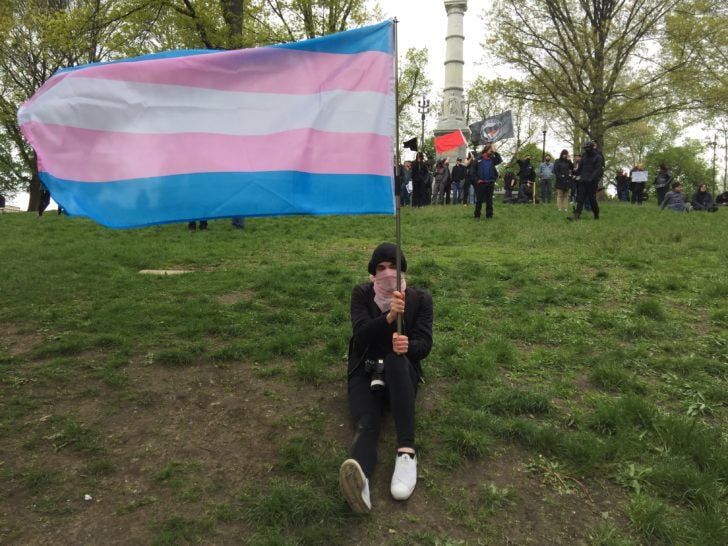
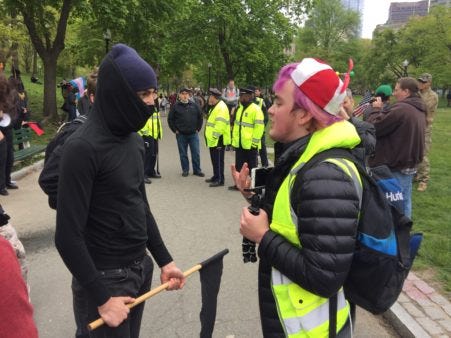
And so it came to pass that an even smaller group of mostly younger people politicized and organized in a different set of internet forums donned a motley assortment of heavy clothing (black being the most prominent color), masks, and in some cases helmets, and stood on Flagstaff Hill looking down on the right wingers around the bandstand from some distance away. Ready to fight if necessary. They were joined by a slightly larger coterie of area left-wing activists — also mostly younger people, but with more political experience overall — who had taken a nonviolence pledge before attending. The Boston police formed a cordon between the right- and left-wing groups. And a shouting war started between the two sides capped by another conservative I’ll call Scooby Dum crossing the skirmish line and belting a left winger after shoving a Pepsi at the person (in an apparently ironic reference to the Kendall Jenner commercial scandal). Both antagonist and victim were arrested. The BPD version of equal justice, one supposes.

 
                        Photo by Luke O’Neil

This tyro armageddon provided red meat for the press that would otherwise have ignored the event, and resulted in coverage that would not have happened if the counter demonstrators had left well enough alone.

Now it’s true the organizers of the right-wing action fell on each other shortly afterwards in a torrent of mutual social media recriminations involving the absurd neologism “cuck.”

But the critical lesson of the whole sorry affair should not be lost on erstwhile “anti-fascists” on the fringes of the American left: There are indeed times when it’s important to stand up against the right wing in militant and very public ways … but you never want to hold response actions to dysfunctional right-wing events that will result in their learning to become more effective organizers. You don’t want to help them evolve. You don’t want to act like an overdose of old antibiotics on a mutating strain of TB. You need to be smart and LET THEM FAIL. So badly that they’re forced to scurry back under their disconnected individual rocks to lick their wounds and perhaps even rethink their more extreme political positions.

In this situation, the correct thing to do was let the right wingers have their wonky little rally and then faction fight themselves into oblivion over its failure. Instead, the ill-conceived counterdemo got that rally far more attention than it deserved, and taught the fringe right that it’s really easy to bait the more jumped-up sectors of the left to play the part of “bad freedom haters” in their latter-day Old Glory-waving passion play. Helping them organize more disaffected young people … and possibly turning them from a sideshow of a sideshow into a serious threat in the process. Not good.

Here’s hoping that the younger left activists who participated in the counter demonstration now decide to turn their energies toward better educating themselves politically and then focus on reaching out to engage society at large with organizing campaigns to challenge the root causes of racism and racist white reaction. And that the more established left-wing organizations that inexplicably decided to join them on the Common revert to their usual activities along those lines. Helping build the majoritarian movement for democracy that America desperately needs, rather than comporting themselves in ways that could end up bringing ruin down on the heads of the left at large. At the hands of a right wing that will always be better at violence in this period than macho posturing fringe leftists looking for a shortcut to their ill-considered version of “revolution.”

Note: This column was written based on my analysis of news coverage and social media posts about the Boston Free Speech rally from the perspective of a longtime political activist who has run large numbers of left-wing protests. I did not attend the event.


Apparent Horizon is syndicated by the Boston Institute for Nonprofit Journalism. Jason Pramas is BINJ’s network director and senior editor of DigBoston.

Copyright 2017 Jason Pramas. Licensed for use by the Boston Institute for Nonprofit Journalism and media outlets in its network.
Check out the Apparent Horizon Podcast on:

iTunesGoogle Play MusicBlubrryStitcherTuneIn, and YouTube

HOW TO FIND A DECENT PROGRESSIVE ACTIVIST GROUP

IMG_1034

Photo by Chris Faraone

February 6, 2017

BY JASON PRAMAS @JASONPRAMAS

So you went to one of the recent big anti-Trump actions, and you want to become a progressive activist. Not just vote every year or two. Great. But there are dozens of major left activist organizations and hundreds of minor ones working on a host of issues at all levels. Which one to join?

Politics is a minefield. No two ways about it. And the group (or groups) you choose to work with will determine both the course of your life going forward and, in some sense, the fate of the nation. How do you even begin to decide?

I recommend starting with a gut check. What issues are most important to you? Do you want to take on a big fight like getting Trump and his rogue’s gallery of white nationalists out of power? A smaller fight, like expanding public transportation in your region? Or a huge fight, like saving humanity from global warming?

Once you’ve thought deeply about where your political interests lie, search for organizations that are taking on the issues you care most about. Look hard. Do deep web dives. Ask everyone you trust that shares your values. Then ask yourself a series of questions like the following:

1) Is the group run democratically? Far too many activist organizations—especially on the national level—are not. If all edicts in the group seem to come from top officials, and none of the important decisions are made by the members, you’re probably barking up the wrong political tree.

2) Is the group led by elites? Look at the staff, elected officials (if any), and board. Do you see lots of rich people and CEOs? Lots of Ivy League connections? Lots of big (and therefore corporate) foundations? And you’re a progressive and want to rein in corporate power? Find another group.

3) Is the group’s membership and (more importantly) leadership diverse? Do you see people who look like you and a broad array of your friends in the organization? If not, you may want to look elsewhere.

4) Is the group’s agenda transparent or opaque? What does the organization stand for? Is it developing its own positions democratically, or does it seem to be taking marching orders from some unseen higher level? Always look for a clear statement of its politics, values, and action plan—and an indication of who calls the shots in the group. Such information should be front and center in outreach materials, websites, and social media presences. If it’s not, keeping moving.

5) Is the group connected to the Democratic Party? You’ll need to think very carefully about this question, because it determines where you’ll come down in the debate on the future of the American left. Do you want to be connected to the populist left wing of the party? The neoliberal corporate wing of the party (that got the country into the mess we’re in)? Do you want to break with the party and form a better left party? Or join the extra-parliamentary left that doesn’t believe in electoral politics at all? Definitely study before you leap.

6) Is the group purely reactive? Does it engage its members in political discussion and debate, determine a strategy, take action, analyze the action, course correct, and move on to achieve meaningful political change. Or does it follow various dog whistles from powerful societal institutions and various media without really developing its own analysis, and encourage members to endlessly engage in aimless street protest. Eschew, if the latter.

7) Is the group a cult? A loaded question, yes. But one worth thinking about. Political cults do exist. If any organization you approach starts putting super heavy pressure on you to join them, to spend all your available waking hours working for them for free, and to disassociate from your friends and family … run.

Otherwise, if you don’t see a group you like, start your own! In general, keep your head about you and use your common sense. Avoid well-off wannabe revolutionaries, radical chic hipsters, and faux radicals who encourage your mouth to write checks to cops, intelligence agencies, and the military that your ass can’t cash, and you’ll be fine. Have fun fighting the power. And let’s be careful out there.

Apparent Horizon is syndicated by the Boston Institute for Nonprofit Journalism. Jason Pramas is BINJ’s network director and senior editor of DigBoston.

Copyright 2017 Jason Pramas. Licensed for use by the Boston Institute for Nonprofit Journalism and media outlets in its network.

Check out the Apparent Horizon Podcast on:
iTunes, Google Play Music, Blubrry, StitcherTuneIn, and YouTube

APPARENT HORIZON image for column site

A QUESTION OF STRATEGY: WILL WOMEN’S MARCH LEADERS HELP BUILD A DEMOCRACY MOVEMENT OR JUST PUT THE DEMS BACK IN POWER?

Photo by Scott Murry

January 24, 2017

BY JASON PRAMAS @JASONPRAMAS

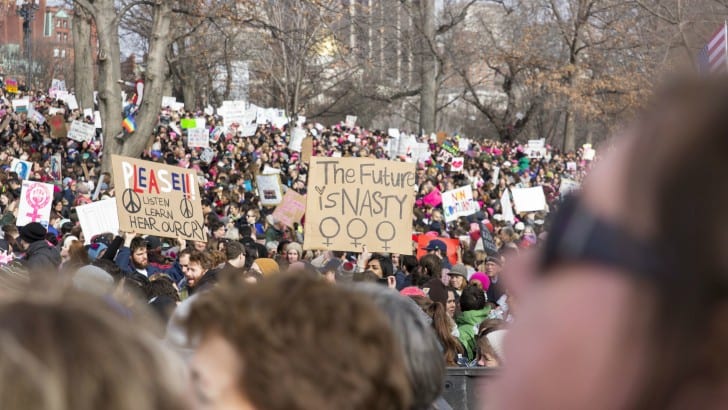
The Boston Women’s March for America was a tremendous success by any metric. Likely the largest political demonstration in the city’s history, its estimated 175,000 attendees made it big enough to dwarf even many national demonstrations of the last many years. Which shows two important things. First, there are a great many Massachusetts residents ready to fight to bring down the Trump administration. Second, the state’s population is strongly in favor of women’s rights—and a number of other positions mentioned in the event’s mission statement, including: racial justice, economic justice, human rights, climate justice, and religious freedom. So, credit where credit is due, march organizers did a wonderful job of reading the political moment, and turning out the broad left against a clear and present threat to democracy … in the form of a triumphalist hard right wing of the Republican Party.

However, the local march and hundreds of related actions across the US last weekend—up to and including the main Washington, DC march—all had an inherent political flaw that’s going to be hard to overcome. That is, their organizers appear to have no follow-up plan beyond mobilizing voters to get the Democrats back in power.

This is because the progressive nonprofits and labor unions behind the marches themselves have no high-level strategy beyond that same goal. Which is why many of them could not even support Bernie Sanders, their party’s credible left alternative in last year’s election. And why the Dems are not much better than the Repubs on a host of key issues—and in some cases, as with the Trans Pacific Partnership that President Trump just shot down as a first order of business, they are worse. Because the organizations that comprise the progressive wing of the Democrats, and provide most of its grassroots muscle, continue to refuse to challenge the still-dominant pro-corporate Clintonite wing of the party for control of its platform.

Given that problematic background, it’s easy to understand why the marches were essentially transformed into giant launchpads for the candidacies of key Democratic politicians for the 2018 and 2020 elections. In Boston, for example, the main speaker was Sen. Elizabeth Warren—a clear contender for the 2020 Democratic presidential nomination, having stood down in the recent election and consolidated her power base. Other rising Democratic politicians like Mass Attorney General Maura Healey, Boston Mayor Marty Walsh, and Boston City Councilor and City Council President Michelle Wu also mounted the podium—and none could ask for a better campaign kickoff for their next races. Whatever those races may be.

But electing more Democrats to office is not going to solve the problems this nation is facing. Especially if the party continues to be led elitist technocrats who fake left, but break right on all the issues that matter to its populist wing.

An otherwise decent progressive like Warren will keep pulling her punches on effective policy prescriptions like single-payer national healthcare, and continue to defend Obamacare when she herself has written in favor of single-payer as the “most obvious solution” to our health crisis. Because she doesn’t have the support of party leadership to take on corporate power.

A union-backed mayor like Walsh will continue to base his economic policies on the simple conceit of attracting as many major corporations to Boston as possible—as he did by supporting the GE Boston Deal—in the likely vain hope that doing so will somehow result in more decent jobs for his working and middle-class constituents. Instead of creating public jobs programs and building large amounts of public housing like big city Democratic pols from the 1930s to the 1960s. Pushed by an ascendant and militant labor movement for much of that period. Because, again, he doesn’t have the support of party leadership for such policies. And because today’s union and nonprofit leaders have been unwilling to push Democrats to back the democratic socialist policies that many of them privately believe in.

So that’s the strategic quandary that progressive Democrats of the type who just pulled off huge and successful mass mobilizations find themselves in. They know perfectly well that a society run by and for the rich is incompatible with the fairness and justice they seek. They know that we cannot solve all the dire problems facing America by handing the reins of power to the CEOs—as both major parties have been doing for decades—and hoping for the best. And they know that the best organizing isn’t top-down, but is instead horizontal and, well, democratic.

Yet even when they pull millions into a great event like the marches against President Trump, they remain afraid to let the grassroots they just inspired to action run the political movement they hope to build. And as long as that cycle continues, the Democratic Party might indeed return to power by 2020. But all the marches in the world won’t bring true democracy to the United States.

Apparent Horizon is syndicated by the Boston Institute for Nonprofit Journalism. Jason Pramas is BINJ’s network director.

Copyright 2017 Jason Pramas. Licensed for use by the Boston Institute for Nonprofit Journalism and media outlets in its network.
Check out the Apparent Horizon Podcast on:
iTunes, Google Play Music, BlubrryStitcher, TuneIn, and YouTube


FIGHT WHERE YOU STAND: ORGANIZING FOR DEMOCRACY ON THE JOB CAN SPARK A MOVEMENT FOR DEMOCRACY NATIONWIDE

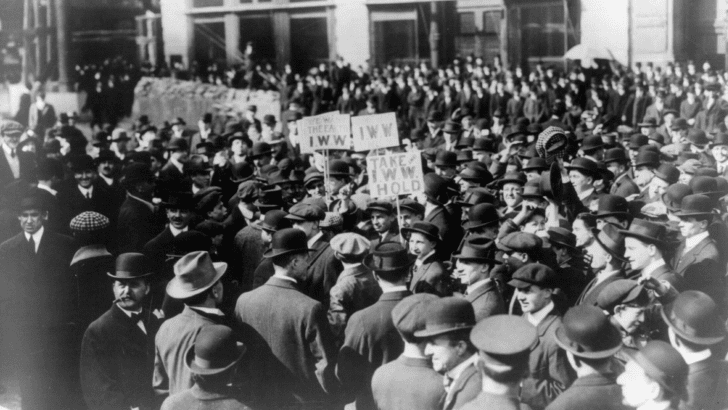
IWW Demonstration. New York (1914)

IWW Demonstration. New York (1914)

October 13, 2016

BY JASON PRAMAS @JASONPRAMAS

In a month featuring a couple of significant labor actions in the Boston area—the Harvard University dining hall workers strike for better pay and benefits, and the Boston Carmen’s Union’s recent civil disobedience action against privatization at the MBTA—it’s worth reflecting on the difference between unionized workers and other workers in the US. Which can be summarized as follows: Union workers fight.

One can criticize them for not fighting hard or effectively enough, and I certainly do from time to time, but when push comes to shove union workers will push back. Collectively. Putting them in a stronger position than the rest of working people in this era. Nearly 90 percent of whom have no representation on the job. Tens of millions of workers who are unprotected “employees at will” that can basically be fired at any time for any reason other than open discrimination. And chances are, you’re one of them.

Yet the reaction by many ununionized workers to their unionized fellows can be puzzling. Egged on by conservative ideologues, the common refrain on social media and in bar rooms from coast to coast is that union workers are “greedy” for wanting more than their bosses give them. Even as billionaires control ever more vast sums year by year. And deploy that wealth to influence politics to make themselves richer by the day.

This leaves union critics caught in a rather obvious contradiction. On the one hand, under capitalism we’re all supposed to applaud people who get rich for constantly demanding more, more, and still more. For themselves alone.

But when union workers demand more as a group, that’s somehow bad. Resulting in the spectacle of anti-union working people arguing that fellow working people in unions need to start acceding to less. Advancing the ludicrous claim that there’s not enough money and stuff to go around in our tremendously wealthy society for anyone but the rich.

Conservative critics—some working people among them—actually think it’s better for such union workers to disband their unions and be satisfied with whatever their bosses feel like giving them. Or, as they typically put it, to accept what “the market” will bear. To join ununionized workers in the war of all against all. Racing each other to the bottom of the economic pyramid, until a new feudalism grips humanity. Where “the multitude,” as Antonio Negri and Michael Hardt put it, are dominated completely by “the one percent” named so accurately by the Occupy movement.

To prevent such a dystopia from ever coming to pass, it’s time for ununionized, and therefore unorganized, workers to draw a proverbial line in the sand at every workplace in America—including right here in Boston.

In place of the culture of fear that reigns at most every job—the fear of being fired for promulgating even the slightest appeal for justice—there must be a culture of democratic resistance. Workers must start organizing together wherever they are to demand more. More money, better benefits, better working conditions. And critically, more control over their workplaces.

This organizing can involve joining traditional unions where possible, but that is not a necessary precondition to starting to fight back. It can begin as simply as holding meetings after work, discussing problems with the way things are going day-to-day, looking into how workers in similar situations have dealt with their problems on the job, and deciding how to fight for redress.

Some will say that such conflict is old-fashioned and counterproductive, and that it’s far better to work together with owners and bosses to come to some kind of accord on the job. From a position of permanent weakness. Leaving power in the hands of the monied elites. In your workplace and in the larger political realm. I would counter by quoting the preamble to the constitution of the storied democratic union of the turn of the 20th Century, the Industrial Workers of the World (IWW), “The working class and the employing class have nothing in common. There can be no peace so long as hunger and want are found among millions of the working people and the few, who make up the employing class, have all the good things of life.”

As the horrendous presidential race approaches its climax, it’s important to keep this in mind. If you’re wondering why both major party candidates are terrible, and why neither of them are standing up for the interests of working people—for your interests—the old language of radical democracy, plainly expressed by the IWW preamble, provides the beginnings of an answer. The rest of that answer—at your job and in world that surrounds it—is up to you. And all of us in the multitude.

HORIZON LOGO TRIMMED

Apparent Horizon is syndicated by the Boston Institute for Nonprofit Journalism. Jason Pramas is BINJ’s network director.

Copyright 2016 Jason Pramas. Licensed for use by the Boston Institute for Nonprofit Journalism and media outlets in its network.

Check out the Apparent Horizon Podcast on:

iTunes

Google Play Music

Stitcher

YouTube

GE BOSTON DEAL: THE MISSING MANUAL, PART 4

Untitled drawing

February 29, 2016

BY JASON PRAMAS @JASONPRAMAS

In May 2012, three former GE executives were imprisoned after being convicted on multiple charges of conspiracy to commit wire fraud and defraud the United States. Dominick Carollo, Steven Goldberg and Peter Grimm had all worked for GE Capital—the financial division that operated as a semi-legal “shadow bank,” and that accounted for about half of its parent corporation’s profits until the global financial collapse it helped precipitate began in 2007. Between 1999 and 2006, the trio conspired to skim millions from municipal bond investment contracts. With the full approval of their bosses.

According to Rolling Stone’s Matt Taibbi, the scam worked as follows for the company that Marty Walsh, Charlie Baker and cheerleaders like the Boston Globe have welcomed to Boston with open arms: Municipal governments commonly partner with big banks to sell bonds to pay for significant capital costs—like building schools. The banks invite investors to buy the municipal bonds and deposit the resulting funds in tax-exempt accounts from which all necessary project expenses can be paid. However, since all the bond money does not get spent at once, municipal governments typically hire brokers to find major financial institutions to invest it for them through a public auction process. In general, it is legally required that brokers get bids from at least three financial institutions—and the one that offers the highest annual rate of return wins the contract to invest the spare cash from a given bond fund.

But for GE Capital—and a host of other major financial institutions—the process was rigged from top to bottom. In the case of GE’s Carollo et al, the defendants conspired with executives at the brokerage CDR and financial institutions like Bank of America, JPMorgan Chase, Wells Fargo, and Morgan Stanley to divvy up investment contracts for municipal bond funds. CDR would drum up business with local politicians around the country—often bribing them with various kinds of campaign donations and gifts. The pols would then reward CDR with contracts to invest unspent funds from municipal bond issues, while CDR would work with the GE Capital—in concert with the other major financial institutions—to illegally decide which corporation would win which auction for such investment contracts in advance. The “winner” of each auction would collude with the other bidding financial services companies on the bid rate to ensure that the “winning” bid was as low as possible. The agreed upon rate was usually lower than a fair market rate by just a few tenths of a percent. But that was enough to make a killing.

For example, if a fair bid in an auction might have been that GE Capital would invest a municipal government’s unused bond funds at a 5.04 percent annual rate of return, CDR would coach the company to only offer 5 percent. The other bidders would purposely offer lower rates, losing in exchange for winning future rigged auctions. GE would then pocket the .04 percent windfall. A municipal bond fund that might have $200,000,000 to invest in its first year would return around $80,000 extra to GE in that fashion. Which doesn’t sound like much. But such bond funds would be invested by GE Capital for years until they were spent down fulfilling their original purpose to build schools and the like. And GE Capital and CDR colluded on huge numbers of such illegal arrangements, pouring vast sums into GE’s coffers. While depriving municipal governments of that same money. GE Capital then kicked back some of its take to CDR as “fees.”

Given the complexity and ubiquity of this practice, no one knows exactly how much was stolen. But since fines paid by large corporations to governments at various levels for such crimes tend to be vanishingly small, it’s possible to get an idea of the scale of the crime. According to the Securities and Exchange Commission (SEC), GE paid a $70 million coordinated settlement in 2011 to the SEC, Department of Justice, Internal Revenue Service, and a coalition of 25 state attorneys general. The SEC alleged that “from August 1999 to October 2004, [GE Capital] illegally generated millions of dollars by fraudulently manipulating at least 328 municipal bond reinvestment transactions in 44 states and Puerto Rico.”

GE committed yet another massive crime against the public interest. And got away with it. In November 2013, Carollo, Goldberg and Grimm were freed on appeal. The reason? The government had taken too long—ten years—to build its case against the former GE executives.

Apparent Horizon is syndicated by the Boston Institute for Nonprofit Journalism. Jason Pramas is BINJ’s network director.

Copyright 2016 Jason Pramas. Licensed for use by the Boston Institute for Nonprofit Journalism and media outlets in its network.
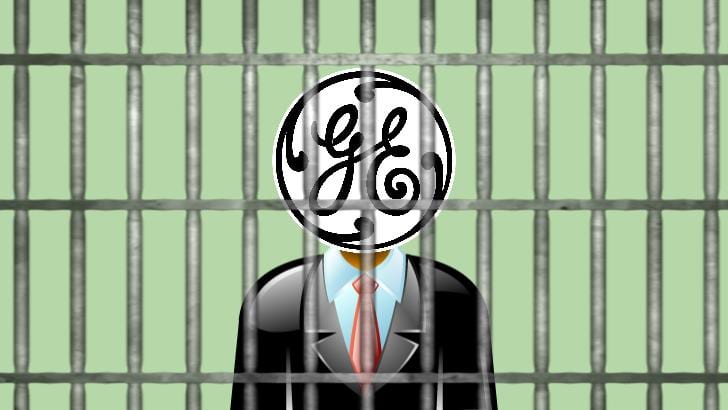
GE BOSTON DEAL: THE MISSING MANUAL, PART 3

Untitled drawing

Image by Kent Buckley

February 15, 2016

BY JASON PRAMAS @JASONPRAMAS

Returning to our ongoing look at General Electric’s recent and inconvenient history of violating the public trust, in part 2 of this “missing manual” the corporation got out of the subprime housing loan market just in time to avoid destruction in late 2007. But it could not escape from the consequences of an economy based on selling toxic home loans to poor people who were defaulting in vast numbers by 2008.

That year, everything began to unravel for GE—as it did for all other large interlocked financial services companies that derived a substantial percentage of their profits from predatory loans in the same period.

According to Fortune magazine, after reporting an unprecedented first quarter loss of $700 million, GE’s stock price began spiraling downwards in April 2008. Failing to sell off its light bulb, appliance, and private-label credit card businesses over the summer due to the worsening economic climate stopped the corporation from making typical course corrections to get back on its feet.

In September 2008, GE’s stock price crashed after Lehman Brothers—a financial services titan—collapsed on the heels of Bear Stearns’ disintegration that March. The company became starved for operating funds. But the private credit markets were frozen in terror.

On September 30, GE made two desperate moves. At 7:30 am it sold $3 billion in preferred stock to billionaire investor Warren Buffet’s Berkshire Hathaway Inc. on very bad terms. At 1:44 pm, GE announced its deal with Buffet and said it would sell $12 billion of common stock the next day at prices far lower than it had paid to buy back $15 billion of its own stock over the preceding year. Meaning it was selling the stock at a huge loss in exchange for ready cash.

The next day, the coup de grace: Word spread throughout the markets that GE would be unable to cover billions in regular payouts to holders of its commercial paper. Basically a kind of I.O.U., commercial paper is a kind of short-term promissory note that big corporations like GE are able to issue on an ongoing basis to raise money to cover things like daily expenses. There is no collateral behind commercial paper. Only the good name—and, ideally, top-flight credit rating—of the company issuing it. In normal times, it’s a far cheaper way to borrow money than a line of credit with a commercial bank. But 2008 was not a normal time. At one point that year, GE had over $100 billion dollars out in commercial paper as it tried to stay afloat.

Executives clearly knew their company was doomed unless the government bailed it out. Already on September 30, a GE spokesperson “e-mailed the media with a message that Congress must act ‘urgently’ on the pending financial bailout package.” But the company didn’t wait for congressional action. Since it was not a traditional bank, GE did not qualify for a significant direct cash infusion under the infamousTroubled Asset Relief Program (TARP). So it spent the next few weeks brokering a backroom deal with the Federal Deposit Insurance Corporation (FDIC).

According to the New York Times, on November 12, 2008 the FDIC announced that it would back GE’s commercial paper for up to $139 billion under the Temporary Liquidity Guarantee Program (TLGP). A program that the federal government changed overnight to allow GE to qualify—just as TARP was changed to benefit Goldman Sachs et al—according to Pro Publica and the Washington Post. GE had “joined major banks collectively saving billions of dollars by raising money for their operations at lower interest rates.” The company was able to sell $74 billion in government-backed commercial paper and longer-term notes by Spring 2009.

And how did GE survive the period between its early October 2008 financial collapse—when it was still short on funds despite the precipitous sale of $15 billion of its stock—and its November 2008 bailout by the TLGP program? In 2010, Pro Publica reported that Federal Reserve Board documents released that year showed that GE had effectively borrowed $16 billion more dollars at that time by selling commercial paper through the Fed’s Commercial Paper Funding Facility (CPFF).

So General Electric was saved by two government programs that provided it with upwards of $90 billion dollars of cheap credit. According to the corporation’s own September 30, 2009 10-Q filing to the Securities and Exchange Commission, GE paid only $2.3 billion in fees for its participation in the TLGP and CPFF programs. Meaning that GE got unbelievably good loan terms—the equivalent of a flat 2.56 percent interest rate. Less than the rates that Americans pay on most any other loans. Including the housing loans that wrecked the economy in 2007-2008. And the student loans that could very well lead to another financial catastrophe before this decade is out.

That is how GE got to survive the recession it helped create. By gaining access to a massive pool of public funds totally unavailable to its tens of thousands of subprime housing loan victims. The same company under the same leadership that Massachusetts officials are paying $270 million to bring to Boston. Excelsior!

Coming soon in part 4: GE’s municipal bond scandal and other amusements.

Apparent Horizon is syndicated by the Boston Institute for Nonprofit Journalism. Jason Pramas is BINJ’s network director.

Copyright 2016 Jason Pramas. Licensed for use by the Boston Institute for Nonprofit Journalism and media outlets in its network.