Skip to content

Jason

UPDATE: DIGBOSTON DISPATCH

Still from NOTES AFTER LONG SILENCE (1989) by Saul Levine


News from behind the editorial curtain plus support for Saul Levine


April 4, 2018

BY JASON PRAMAS @JASONPRAMAS


Seeking next group of working-class journalists

In November, I put out the word that DigBoston was looking for working-class Boston natives to write for us.


Specifically, I called for locals with three of the four qualities we look for in good journalists: ability to communicate, compassion, and deep local knowledge. The fourth quality, formal journalism training, was something my colleagues and I were willing to provide at an introductory level to motivated applicants.


A very diverse group of 15 DigBoston readers hit us back, and we ultimately trained four of them in a free three-hour basic journalism workshop that Chris Faraone and I prepared for the occasion. Since then, two of the trainees have filed draft articles, and you can expect to see them published with us by summer.


So now we’re ready to accept new candidates for our next class of trainees.


And I’ll ask the same questions of interested audience members that I asked before: Are you a smart, compassionate, talkative person from one of Boston’s working-class neighborhoods? Can you put words in rows, and maybe take some pictures on your phone? Do you want to learn to be a journalist? Do you want to tell the world about the place you grew up? About its problems and its successes? About its corruption and its virtue? Its shame and its glory?


Yes? Then drop me a line at execeditor@digboston.com. Let’s talk.


Comment on reader feedback

A few weeks back, I asked DigBoston’s audience to send in comments about what they thought we were doing well and what they thought needed improvement. We then got a bunch of responses—most highly complimentary. Which were nice to read. But some folks also included some very useful criticism about some of our various beats and how we could make them better. We took those to heart and are working to make the requested improvements.


Follow DigBoston on Flipboard

In an editorial a couple of weeks ago, I announced that DigBoston is moving away from Facebook. Not so much because of the ongoing Cambridge Analytica scandal, as that the social media platform has become a drag to use and expects us to pay it to reach our own audience. Regularly. Naturally, the editorial was thin on specifics about how we would do without Facebook. I mentioned that Twitter was one logical place to focus our social media activity, but recognized that Twitter is not really so much different than Facebook that it will provide us with a long-term alternative.


However, there is one hot social network that can replace a big part of what news publications like DigBoston do on the internet… in a more equitable way for all concerned. While we participate in the movement to build the more democratic and decentralized social media we’d ultimately prefer to use.


Flipboard, which has been around for a few years, has more than 100 million users and growing, and provides a great way for people to share news articles with each other. And it’s perfect from our perspective because we don’t have to pay Flipboard to reach readers that follow us there. It pushes our latest articles to all our followers as part of its service.


After a couple of months’ wait, I’m pleased to announce that DigBoston has now been accepted as a Flipboard Publisher. And we invite all our readers to join Flipboard and follow us there. Here’s the link: flipboard.com/@DigBoston. You’ll find using Flipboard for your daily news dose to be a much more pleasant experience than using Facebook. And it’s just as social as Facebook with far more ways to share articles with your friends and family than the larger social network ever had.


Justice for Saul Levine

The Boston art scene was shocked last week when longtime MassArt film professor Saul Levine announced that he had resigned from his job after teaching there 39 years. Why? According to Levine, on the last day of his fall semester senior thesis class he was expecting students to present some of their work in progress. But they didn’t. Scrambling for something to discuss with them, he decided to review different editing constructions. He chose two of his short films to use as examples. One of which, NOTES AFTER LONG SILENCE, had a great number of fast cuts. He had shown the film every year in class since making it in 1989 and thought nothing of using it to make his points. The 15-minute film had some nudity and sex in it, but only a few seconds that go by so fast viewers typically barely notice it.


According to his friend, film critic Gerald Peary, in a Facebook post on Monday, at the end of the class one of the students asked Levine who was having sex in the film. He said, “It was me.” Then, unbeknownst to him, at least one student anonymously reported him to the MassArt administration for sexual harassment… or at least that’s what the school claims.


With no warning about what was coming, the administration called Levine into a Feb 8 meeting where he was “ambushed” and harangued for two hours by officials he felt sure had never watched the “offending” film. They apparently agreed with the anonymous student or students that his showing a movie in which he appeared nude and having sex (with a committed partner) did indeed constitute sexual harassment. Despite the fact that much of his body of artwork is very personal, and sometimes features him nude. And the fact that he had every right to show his own very public and very well-known artwork in his own class for completely valid pedagogical reasons. Artwork which is in no way prurient or pornographic.


Although he had a faculty union leader accompanying him in the meeting and was not fired immediately, Levine felt so pressured by the encounter that he decided to resign rather than wind up in a protracted and expensive legal battle with the administration to clear his name.


“I am a full professor in film and video,” Levine told me on Tuesday. “I am still teaching until 5/31. I chose to resign because I felt targeted. The 2/8 meeting let me know that they were gonna get me!”


Since making a video attacking MassArt last Thursday—excoriating the administration for effectively violating his artistic freedom, his academic freedom, and his rights of free speech and expression—his situation has received coverage in Artforum, Boston Globe, IndieWire, and other outlets.


Dozens of fellow artists and civil libertarians from around Boston and beyond are rushing to his defense. I strongly agree with them that MassArt’s treatment of him is unconscionable. I think the college should make a serious effort to bring him back. And its administration should put much more careful thought into how they handle similar incidents in the future.


NOTES AFTER LONG SILENCE can be viewed here: vimeo.com/73242778/. Levine’s video response to MassArt can be viewed at facebook.com/saullevine/videos/10215932754649479/. I encourage readers to watch both. And if they agree that justice was not done, to join me and other supporters of Saul Levine in contacting MassArt Interim Provost Lyssa Palu-ay (lpaluay@massart.edu, 617-879-7782) and Director/Title IX Coordinator Courtney Wilson (cwilson24@massart.edu, 617-879-7751) and demanding that MassArt apologize to him and offer to reinstate him to his former teaching post immediately—removing any blemish to his record that may have resulted from this unfortunate incident.


Levine concluded: “I’m out of MassArt but people should protest the attack on free speech—which includes showing my film and the manner in which I speak.” The last comment in reference to his lifelong speech and motor disabilities that he feels the college administration used against him.


Jason Pramas is executive editor and associate publisher of DigBoston. He is also arts editor and holds an MFA in visual art from the Art Institute of Boston.
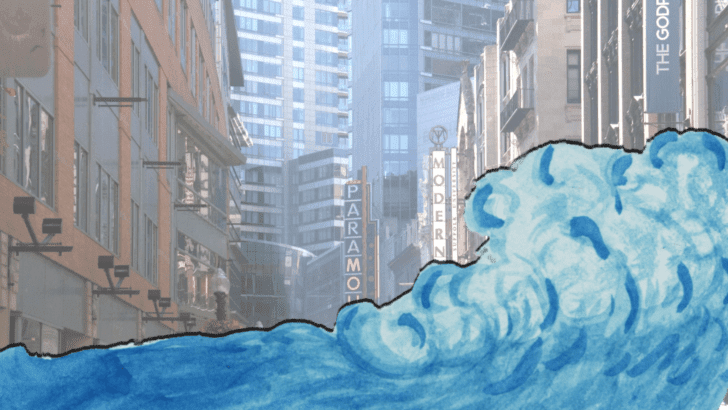

THERE WILL BE NO OUTSIDE WORLD TO HELP US

Boston Underwater


Boston’s global warming plans must prepare region for worst case scenarios


March 28, 2018

BY JASON PRAMAS @JASONPRAMAS


In a couple of recent columns—and several others over the years—I’ve looked at some of the specific threats that scientists expect Boston will be facing from global warming-induced climate change. While there’s plenty of room for debate about the anticipated severity and timetable of such threats, there is no longer any serious doubt that they are real.


Unfortunately, humans have trouble dealing with existential crises like an inexorably rising sea level and the relentless increase of the average air temperature.


We tend to try to plan for future situations based on what has happened in the past. What is, therefore, in the realm of our experience as individuals and as members of various groups. What we’re comfortable with and confident we can handle.


The many learned experts who have been working on the city of Boston’s various climate change initiatives are no less susceptible to this bias than anyone else.


Which is why the reports city government has been producing on making the city more “resilient”—to use the fashionable buzzword pushed by the Rockefeller Foundation and others of late—in the face of climate change all share a major flaw.


That is, despite understanding that global warming is by default—by its very nomenclature—a worldwide phenomenon, they treat the effects of the climate change it’s driving as essentially local.


Furthermore, they try to apply standard disaster preparedness and emergency management protocols as if global warming was simply a series of tractable crises of the type we’ve dealt with since time immemorial. Like the recent series of nor’easters (which were probably climate change-driven themselves).


So, sure, they reason. There will be power outages—some affecting critical infrastructure—so we’ll plan for that. There will be food shortages in some poor areas of the city that are already considered “food deserts” due to their lack of decent cheap supermarkets; so we’ll plan for that. There will be flooding; so we’ll plan for that.


Thus, the language that city officials (and an array of outside advisors and consultants) use in their climate change planning documents demonstrates that they’re either unable to see that previous human experience is insufficient to the task of grappling with global warming… or, more likely, that they’re unwilling to discuss the vast scale and centuries-long duration of the approaching crisis due to a combination of factors. Ranging from not wanting to be seen as alarmists to not wanting to anger top politicians and corporate leaders with big problems requiring expensive solutions.


For example, here’s an illustrative passage from the Climate Ready Boston Final Report, the big global warming preparedness white paper the city published in late 2016:


Members of the IAG [Infrastructure Advisory Group] have identified continued functionality of the city’s transportation infrastructure as a top resiliency priority. Many members have identified road and bridge functionality as a key critical requirement so citizens can evacuate; emergency vehicles can pass; maintenance trucks can reach impacted electric, communication, and water/wastewater assets for swift repair; and hospitals and other emergency facilities can continue to receive food, water, and medical supplies. In turn, the transportation system relies on continued access to electricity and communications systems, so tunnels may remain open, and any blocked paths are cleared quickly or detours swiftly communicated.


Note that it’s assumed that citizens will be able to evacuate the city if necessary. And that various kinds of critical vehicles will have fuel. And that parts will be on hand for infrastructure repair. And that food, water, and medical supplies will be available.


Climate Ready Boston’s series of reports and a raft of related studies certainly mention a variety of problems that the city will have to overcome to ensure that fuel, food, water, medical supplies, vital machine parts, etc. will be available as locals recover from each new storm, flood, or heat wave. Like making sure that Route 93 is no longer the main trade route for the city and that the portions of the highway that are susceptible to flooding be reengineered.


And they definitely allow for the fact that we’ll see more and more storms, floods, and heat waves.


But none of the growing array of reports and plans that city (and also state) government are producing consider this possibility: That at a certain point—especially if we continue along the climate change denial path that the Trump administration and the oil, gas, and coal industries are setting us on—Boston will be alone.


There will be no outside world to help us. Every city, every region, every nation on the planet will be engaged in a life-or-death struggle for survival as the effects of global warming get worse. And worse. And ever worse.


Because maybe humanity does not stop burning carbon in time. Because we do not replace our old dirty energy systems with new clean ones. Because we do not halt the despoiling of land, sea, and air. Because we do not reverse the “sixth extinction” of most species of plants and animals. Because we do not, in sum, stop the destruction of the human race itself and everything that matters to us in the world.


Hopefully, things won’t be so bad by 2100—which is the outer limit of the period seriously considered in city and state plans. Let alone in 20 or 30 years. But the minimal progress on climate change goals that have been made in the quarter century since the Kyoto Protocol was signed does not inspire confidence in human civilization’s ability to reduce greenhouse gas emissions enough to slow—let alone stop—the worst-case scenarios that keep any reasonably well-informed person up at night.  


So if the city and the state that surrounds it want to talk about “resilience,” they have to be able to answer these questions… and many more like them besides:


✦How will Boston (and Massachusetts) feed our already-growing population—when global supply chains are disrupted and ultimately destroyed, the oceans are dead, and much of America’s farmland has turned to dust bowls—given that we can’t even come close to feeding ourselves now? And what about all the climate migrants that will be heading north as parts of our continent become uninhabitable? How will we possibly feed them?


✦How will Boston (and Massachusetts) keep our growing population plus climate migrants clothed, housed, healthy, and gainfully employed in that situation?


✦How will Boston (and Massachusetts) produce enough clean (or dirty) energy to satisfy our growing power needs—including our vehicles—without outside help?


✦How will Boston (and Massachusetts) produce the manufactured goods that we need—including medical supplies and the materials we’ll need to rebuild during a never-ending series of global warming-induced disasters—when we’re on our own?


✦How will Boston (and Massachusetts) grow more food, support more population, and expand industry in the coming decades as we face the expected global warming driven fresh water shortages? Even as we grapple with more and more severe floods due to storms (fresh water), and storm surges (seawater).


✦How will Boston (and Massachusetts) move the city, our state capital, and its critical infrastructure to higher ground—while buying time to do so with the best possible flood defenses we can build?


✦How will Boston (and Massachusetts) help the entire population of the city to move to relative safety when global warming-induced climate change eventually makes our region uninhabitable, too?


Any planning process that fails to raise such questions is not worthy of the name. So both the city of Boston and Commonwealth of Massachusetts had better step up their joint game… fast. Same goes for climate action groups that work hard to keep grassroots pressure on responsible government officials (and generally irresponsible corporate leaders). Work harder, grow your ranks, pursue mitigation efforts that might forestall the worst outcomes, become an unstoppable force, make positive change at least a possibility. If not a certainty.


Because if we can’t stop (or significantly slow) global warming, and we can’t find practicable answers to the above questions soon, then Boston is far from “resilient.” Let alone “strong.” It is completely unprepared to deal with global warming-induced climate change.


And all the reports in the world won’t save our city and our state from the grim fate that awaits us.


Apparent Horizon is syndicated by the Boston Institute for Nonprofit Journalism. Jason Pramas is BINJ’s network director, and executive editor and associate publisher of DigBoston. Copyright 2018 Jason Pramas. Licensed for use by the Boston Institute for Nonprofit Journalism and media outlets in its network.

CARAMEL’S CARAMEL

Caramel at Caramel French Patisserie. Photo by Jason Pramas. Copyright 2018 Jason Pramas.


A taste of the new French bakery cafe’s gateway dessert


March 21, 2018

BY JASON PRAMAS @JASONPRAMAS


The Boston area has been in the midst of a bit of a bakery renaissance in recent years. The growth of small upscale cafe chains like Flour and Tatte is testament to Hub dwellers’ love of sweets, and we don’t seem to have hit the “peak pastry” threshold yet.


Which is lucky because if there wasn’t room for more artisanal confections, then French chef Dimitri Vallier and his business manager sister, Sophie, would never have launched Caramel French Patisserie in downtown Salem in 2015, and at a second location in Davis Square, Somerville, last year.


And that would be a shame… because their baked goods and pastries blow every similar place in our region completely out of the water.


I mean, seriously, I spent the better part of a month in Paris in 2010. And I ate at over a dozen different bakeries there—all highly rated by locals—and Caramel is better than most of those. I’m no expert. But I’ve eaten lots of stuff at pretty much every noted Boston bakery, and I’ve never been to a place where, like the best Parisian bakeries, literally everything is delicious.


Visitors will need several visits to eat a representative sample of the array of croissants, tarts, macarons, and assorted fancy pastries on hand, but I recommend starting with their signature dessert first time out: the eponymous Caramel. It’s one of those creations that sounds simple enough when you read the ingredients but has clearly taken real mastery to perfect.


Delicate caramel mousse enrobing perfectly poached pear slices. The sweetness of the mousse cut by the freshness of the chilled pear. Presented in an artful shape and served cold. It’s a must try.


CARAMEL FRENCH PATISSERIE. 235 ELM ST., DAVIS SQUARE, SOMERVILLE;  ALSO 281 ESSEX ST., SALEM. CHECK THEM OUT ON FACEBOOK AND INSTAGRAM. WEBSITE COMING SOON AT CARAMELPATISSERIE.COM.

EDITORIAL: STRATEGIC RETREAT

Image by freeGraphicToday. CC0.


DigBoston to move away from Facebook, help build democratic social media alternatives


March 21, 2018

BY JASON PRAMAS @JASONPRAMAS


A decade back it seemed only natural for news publications like DigBoston to stake out turf on Facebook. After all, it provided an easy way for us to reach our audience on a regular basis—via a social media platform that was well on its way to becoming the ubiquitous global behemoth it is today.


But now it seems like a particularly good moment to discuss this publication’s evolving thinking on our use of corporate social media. In the wake of the huge and growing Cambridge Analytica scandal that cost Facebook CEO Mark Zuckerberg $6 billion of his net worth after that story broke last week, according to Fortune.


Because Facebook is not working for us anymore—as individuals and as the staff of a metro news weekly.


What was once a fun way to keep in touch with friends and co-workers has turned into a huge drag. Every moment of our time on the social network is completely controlled by Zuckerberg’s minions. Who work to make it ever more addictive. To keep users like us on Facebook for more and more of our time—thus spending less and less of our time on any possible competitor’s network.


Yet the company also carefully limits users’ access to our own connections. And it continues to make repeated changes to its “algorithm” (the code that governs, among other things, what content users see) and other structural changes that are seriously damaging individuals’—and to our point, news outlets’—ability to reach our own audiences.


It is now no more possible for individuals to communicate with even a fraction of their connections on the platform than it is for DigBoston to reach more than a handful of our 24,000 followers. Even if we pay a bunch of money for the privilege, which page managers like us are forced to do. On our two branded pages that Facebook refuses to let us merge… because one page has a blue check mark and one page has a gray check mark, you see. And blue check mark pages may not be merged with gray check mark pages. Facebook “help desk” has spoken. And once Facebook makes a pronouncement, however cryptically and episodically, it cannot be challenged. By conventional means, at least.


Not that we’re surprised that Facebook has its own agenda. Like many reasonably technologically savvy journalists, we understand how the company works. Digital marketer Mitch Joel explained it succinctly in a helpful Maclean’s piece on the Cambridge Analytica affair: “Facebook’s business model is not based on content, marketing or advertising. You—the consumer—are the product and the money that Facebook generates is based on how well they can monetize your data and target you to their brand partners.”


The problem is that we understand all too well that Facebook does what’s best for Facebook—first, last, and always. And my DigBoston colleagues and I have had enough.


Like the staff of tens of thousands of other news organizations around the planet, we know that we have been complicit in Facebook’s rise to power.


We have posted all our content to Facebook. Which has provided free high-quality information that helped attract our existing audience and many others besides to Facebook’s “walled garden” social network. The vast conglomerate then monetized that audience as described above. Used the vast array of personal data at their command to steal the entire news industry’s digital advertising base away—including ours. And has the temerity to charge us to reach the audience we helped bring to them.


Adding insult to injury, according to the Guardian, companies like Cambridge Analytica have found ways to acquire and weaponize that personal data at the behest of operatives like Steve Bannon. Who then use it to help throw elections like the 2016 presidential contest to the political faction of their choice. To name but one of a myriad number of ways that rich and powerful interests—including Facebook itself—are using this “surveillance capitalism,” as it has come to be called, to attempt to control the behavior of entire populations for their own gain.


Given that state of affairs, DigBoston has no choice but to start to move away from Facebook. As our editor-in-chief Chris Faraone so colorfully put it in a related context a couple of months back, “… fuck Facebook. With a big, blue middle finger.”


But move away to what? All the major social networks are owned by big companies doing basically the same thing Facebook is doing. Though none have its reach and market share. Some, like Instagram, are even owned by Facebook.


In the short term, we’re starting to focus more on Twitter—a social media giant that’s slightly less mercenary and slightly more responsive to public pressure. The Lyft to Facebook’s Uber, if you will.


In the longer term, we see no ideal alternative on the horizon.


So we’ve resolved to help create that alternative.


Think this through with us: DigBoston, like legions of other news outlets, has to find a social media solution that meets our need to control and monetize our own data in a platform that our audience is willing to use on a regular basis. Our audience needs a social network that won’t exploit them.


There have been numerous attempts to start standalone “less evil” social media platforms in opposition to Facebook et al—Diaspora, Ello, and Minds to name but three. None of them have succeeded. Why? Because no one knows exactly what causes people to abandon existing social networks for new ones. Sometimes people just bail. Friendster, Orkut, and MySpace were once hot, and now are not. So every prediction of Facebook’s demise at the hands of a new entrant over the last many years has proved to be premature. And every claim to have the magic solution that will cause millions of users to jump ship from Facebook and other major social media has proved to be a pipe dream.


It is true that Facebook’s audience growth is slowing. Usage in the key US and Canadian markets is dropping, according to the LA Times. And the current scandal has already caused the company to lose more than 6 percent of its value on Monday—over $35 billion—according to Fortune. Yet it could easily bounce back. It remains an immensely powerful multinational. And if it convinces its shareholders to stay the course, it can weather almost any conceivable political storm.


What will it take to essentially pull the rug out from under Facebook and companies like it? Returning to the promise of the early internet to democratize global communication, and giving more control over the means of that communication to individuals and the full array of human institutions alike.


There are interesting experiments going on in new grassroots social networks that DigBoston is keeping an eye on. Decentralized federated microblogging systems (think an agglomeration of Twitter-like networks that talk to each other) like Mastodon. Fully decentralized social media projects like IndieWeb—a network of “creators” who have developed tools that allow the owners of independent personal websites to interact with each other. Like a Facebook without the Facebook. Without a central control hub of any kind, really.


Projects like these are great ideas. But they rely on volunteers, and sometimes a handful of low-paid staff, to function. Meaning they can achieve an initial burst of success, only to suffer a long decline to irrelevance as their evangelists move on to other ventures. Plus you typically need to be someone in or around the tech scene and affiliated subcultures to know about their existence. And they tend to require a fair amount of technical expertise to use.


Which is to say that these carefully thought out super democratic social media experiments are not likely to provide the alternative DigBoston and like-minded folks the world over are seeking to build. Not anytime soon. Mastodon had just over a million users last month, according to Mastodon User Count—largely due its community deploying functioning phone apps like the nifty Amaroq for iOS. But that’s obviously a drop in the bucket compared to the 1.4 billion active daily users that Facebook reported in Q4 of 2017. Even allowing for the fact that a nonzero percentage of those accounts are fake, according to Yahoo Finance. And not including many more inactive accounts.


Still, we can but soldier on. For our part, we’re calling a meeting of journalists and techies later this year. Specifically, editors and publishers of Boston area news outlets and high-level coders associated with thoughtful social media projects like Mastodon and IndieWeb. We’re going to compare notes and see if we can start working together to provide better communications solutions for our news organizations and our audiences that will go at least some small fraction of the way to providing a democratic alternative to Facebook and other corporate networks.


We’ll definitely let you all know how that meeting goes. But those of you who think you need to be there, drop me a line at execeditor@digboston.com and tell me why.


Jason Pramas is executive editor and associate publisher of DigBoston. His sad and lonely Mastodon account is @jasonpramas@mastodon.social. Sign up for a free account at mastodon.social and say hi.

TERROR AT 50 FEET

Catapult on Summer Street


Acrimony over Seaport gondola plan speaks to need for expanded MBTA service


March 13, 2018

BY JASON PRAMAS @JASONPRAMAS


Much ink has been spilled in the Boston press over a plan by luxury developer Millennium Partners and its subsidiary Cargo Ventures to spend $100 million to build an aerial gondola system from South Station up Summer Street across Fort Point Channel to the possible future site of what may one day be either its 2 million-square-foot (Boston Globe) or 2.7 million-square-foot (Boston Business Journal) “office campus.” Millennium and Cargo have development rights on “at least three major parcels in South Boston’s Raymond L. Flynn Marine Park and adjacent Massport Marine Park,” according to BBJ. All of which is public land.


According to the Globe, “The proposed gondola system on the South Boston Waterfront would include a hulking terminal across Summer Street near South Station, 13 large towers spanning the one-mile route to the marine industrial park, and about 70 cable cars that can fit 10 passengers each, running every 9 seconds.” The cable cars are currently slated to run from 30 to 50 feet above the street.


An early version of the plan would have had the gondola system traveling as high as 160 feet and traversing a Mass Pike interchange to go directly to the Millennium campus, according to BBJ, but the company just released a scaled-back version that terminates on its Summer Street side—after pushback from state port authority Massport over safety concerns and from the owners of the future $550 million Omni hotel.


News coverage of Millennium’s Seaport project has focused on the gondola itself over the last several months. Which is understandable because it’s an easy target. In fact, my first reaction to the plan was that a giant catapult would be a better idea—if the developer’s goal was simply to get buzz for its project. But it’s a rather specific solution to a real transit logjam that could help keep lots of cars off Seaport roads daily. And, as Boston.com pointed out, it has been proposed before—in 2016, by the office real estate quarterly Blue by Encompass. So I don’t think that it’s just a marketing scheme. And I don’t think the support it’s garnering from South Boston politicians Mayor Marty Walsh, Rep. Stephen Lynch, Rep. Nick Collins, and Councilor Michael Flaherty is necessarily ill-considered either. Especially since Millennium is already discussing a “second phase” for the gondola project that will go—surprise, surprise—across the Reserved Channel into the heart of South Boston proper.


Millennium has an agreement with the city to spend up to $100 million to mitigate the negative effects to Seaport transportation of dumping a big new job site on an already crowded neighborhood, according to Boston.com. The existing transportation options in that district currently being the MBTA Silver Line restricted access bus service, some regular MBTA bus lines, cars, walking, and bicycles.


My problem with the proposed gondola system, then, is not the idea itself. I don’t think it’s practical, but I do think that some kind of elevated mass transit system makes a hell of a lot of sense if you want to avoid existing vehicular traffic and prepare for future global warming-induced flooding.


If crosswinds and storms are a serious concern for gondolas—and, in a Twitter dustup with project boosters, critics like former Mass Secretary of Transportation Jim Aloisi have made clear they are—then perhaps a sturdier alternative like a monorail would fit the bill.


Sure, the idea would trigger mocking laughter even faster than a gondola system, given how much of the population has seen The Simpsons’ infamous monorail boondoggle episode. But the biggest issue with any private alternative transportation proposal for the Seaport is that it would be yet another example of major corporations having too much power to set public policy agendas. Developers like Millennium both dominate policy that applies to their core business and literally get to change the face of the city by completing their developments. With little or no meaningful input and control by the various communities affected by its several projects around Boston. From the completed Millennium Tower to the nearly greenlighted Winthrop Square Tower.


From that perspective, Millennium is cooking up a new way to privatize what should be part of improved and expanded MBTA service. Just like the MBTA’s On-Demand Paratransit Pilot Program—currently extended to April 1—is already doing by contracting some of its “The Ride” service to Uber and Lyft. Instead of developing a municipal ridesharing program that’s a more equitable deal for both drivers and riders like Austin, Texas, did.  


If more transportation options are required, then better to focus on ideas already under study by government planners and transit advocacy groups like Transportation for Massachusetts. Create more dedicated bus lanes throughout the Seaport, add more buses, and build separated bike lanes. Also, consider one active proposal that hasn’t been mentioned much in the feeding frenzy around the gondola idea—revive passenger service on the unused Track 61 that runs from Back Bay Station to the Seaport. The MBTA is already adding a third rail to part of that track and using it to test new Red Line subway cars between 2019 and 2023. So it should be possible to fund its reactivation all the way out to Marine Park, as Rep. Collins proposed to the Globe last summer.


However this particular fight plays out, local and state governments should never invest in expanded transit alternatives to serve the needs of one particular corporation or group of corporations. And they certainly shouldn’t allow companies like Millennium to create unfunded mandates like a private gondola system that could simply shut down the moment there’s a market downturn or the initial investment is spent. Rather, Boston and Massachusetts should carefully plan public transit expansion that best meets the needs of all the communities it would serve. And properly fund it by taking the Big Dig debt burden off the MBTA, and increasing taxes on corporations (again, like Millennium) and the rich (like its owners) to pay for the markedly improved service that the public at large deserves.


If, after a deliberative public process, it turns out that a gondola actually makes sense for parts of Boston like the Seaport, then let the MBTA build and maintain it out of government funds. In a MassLive article last August when the plan was first being floated, Rep. Lynch “said he would prefer the gondola system to be part of the MBTA, rather than a standalone system.


“‘If it goes to a private firm, they can pretty much charge whatever the market will bear, which might not accommodate everyone.’”


If, as is more likely the case, there are a number of other tried-and-true ways to reduce traffic congestion in the Seaport while increasing development, then do that instead.


Just remember that if the city doesn’t construct major defenses around the harbor soon, then ever fiercer and more frequent global warming-driven storms coupled with ongoing sea level rise induced by that same warming—like the three nor’easters we’ve now suffered in a mere 10-day span as of this writing—will wipe the floodplain that is the Seaport cleaner than the surface of the moon within a few decades.


Rendering the entire debate over the Millennium gondola even more pointless than it would otherwise be.


Apparent Horizon is syndicated by the Boston Institute for Nonprofit Journalism. Jason Pramas is BINJ’s network director, and executive editor and associate publisher of DigBoston. Copyright 2018 Jason Pramas. Licensed for use by the Boston Institute for Nonprofit Journalism and media outlets in its network.      

YOUR MOVE, BOSTON

Boston Women's March 2017. Photo by Ryan Dorsey, CC-BY-SA 2.0 Generic.
Boston Women’s March 2017. Photo by Ryan Dorsey, CC-BY-SA 2.0 Generic.


Only a massive protest movement can stop government giveaways to megacorps


March, 2018

BY JASON PRAMAS @JASONPRAMAS


Boston politics—in both its state and local variants—seems to consist largely of backroom deals between government officials and major corporations punctuated by rituals of representative democracy that are increasingly put on just for show. Perhaps it has ever been thus. But that doesn’t mean that Bostonians have to like it.


One would be tempted to call this politics incipient fascism were it not all such a desultory affair—unsullied by any ideology other than a very primitive capitalist greed. And in that way, it is reminiscent of current federal politics. The fact that most of the damage is being done by people calling themselves “Democrats” rather than people calling themselves “Republicans” making almost no discernible difference.


Which is why it becomes tiresome to write about. One disgusting display of government servility to corporate power replaces another week by week, month by month. The storyline is always the same. Only the brand names change.


On the ground—physically close to the halls of actual power in the Financial District, Back Bay, and now the Seaport District, but a million miles away in terms of elite awareness—the situation is dire. People don’t have good jobs. Or affordable housing. Or adequate public schools. Or cheap, safe, frequent, and environmentally friendly public transportation. Or a proper healthcare system. Or pensions. Or sufficient leisure time. Or freedom from several kinds of debt peonage.


But city and state political leadership have no plans to fix these problems. Because they can’t do so without discomfiting the ascendant rich and powerful. So they squirrel around the edges. They juggle budget lines, and change program names, and reorganize departments, and send out obfuscatory press releases, and do whatever they can do to cover up the fact that they aren’t taxing giant companies and their owners nearly as much as they should be. And in failing to collect sufficient tax revenue, they lack the needed funds to fix the worst damage done by those companies.


Yet they never fail to find millions in ready cash for vast conglomerates like General Electric. And now Amazon. A multibillion dollar trust that did not pay a cent in US income taxes last year, according to the Institute on Taxation and Economic Policy—and is expecting a one-time $789 million break from thanks to Pres. Donald Trump’s kinder, more corporate-friendly tax plan.


So, sure, I could write another column this week inveighing against Mayor Marty Walsh’s new scheme to dump $5 million in local tax breaks on Amazon in exchange for bringing another 2,000 jobs to the city. Well, not to the actual city, but to job sites within 25 miles of the city, according to the Boston Globe. And not right away, but by 2025. Maybe. And dumping another $5 million if Amazon brings yet another 2,000 jobs to (Greater) Boston. Not the decent working class jobs that most Bostonians need, of course. Jobs that highly educated people from around the world will come to the area to fill. Exacerbating our housing, transportation, and environmental crises in the process.


And, yes, the proposed $5-10 million is not as much as Walsh arranged to throw at GE—in a deal swiftly running off the rails as that corporate behemoth crashes and burns thanks to the gentle ministrations of its own “activist” investors. But once Gov. Charlie Baker adds state money to the kitty, the new Amazon deal will start to look very similar to the earlier deal. Which he will almost certainly do. Given that he’s so excited for Boston to “win” the far larger “HQ2” boondoggle that he wants to pass a new law that will allow the Commonwealth to shovel truly epic wads of public lucre at the rapacious anti-worker multinational, according to State House News Service.


Yet with such deals becoming so frequent, it really strikes me that writing is never enough to change the politics that allows this kind of backroom deal making by itself—regardless of how boring or exciting it is for me to crank out. After all, providing information to the population at large only goes so far.


Political action is inevitably required. And not just by one journalist. Because stopping the public gravy train for corporations that are also among the biggest donors to state and local politicians’ war chests is going to take truly massive and sustained protest on the part of the people of Boston (and the rest of Massachusetts).


How massive? Well, remember last year’s Women’s March of over 175,000? Or last year’s 40,000-strong march against a few ultra-right weasels? That’s the scale of the street actions that would be required on a regular basis—in tandem with concerted and well-coordinated lobbying efforts—to not only stop particular giveaways to corporations like GE and Amazon, but to outlaw them. And, for good measure, start criminal proceedings against politicians and corporate leaders that collude to loot the public till.


Who will lead such efforts? Hard to say. But at the end of the day, I think it will be new entrants that will step into the political vacuum I’ve outlined, and directly challenge state and local government deals with major corporations. People like most of my regular audience. Working people, many without college degrees, that will finally decide that enough is enough. I think that the existing oppositional forces—ranging from the left wing of the Democratic Party through formations like Our Revolution to grassroots activist coalitions like Poor People’s Campaign to rising socialist organizations like Democratic Socialists of America to some of the more enlightened elements of organized labor—will play a role in the necessary popular movement that will emerge. But I suspect that the main energy will not come from those forces, but from new ones. As has been the case with the Occupy and Black Lives Matter movements in recent years. The trick will be sustaining early momentum long enough to bring some big corporations down to earth. And then moving on to tackling the truly terrifying federal corruption.


Until that happens, it’s going to be one sad government giveaway to huge companies after another in Boston. And I’ll do my best to keep you all up to speed on at least the worst of them. But I look forward to the day that I can help chronicle the victory of a powerful movement for social justice. Rather than merely track democracy’s looming demise.


Apparent Horizon is syndicated by the Boston Institute for Nonprofit Journalism. Jason Pramas is BINJ’s network director, and executive editor and associate publisher of DigBoston. Copyright 2018 Jason Pramas. Licensed for use by the Boston Institute for Nonprofit Journalism and media outlets in its network.

EDITORIAL: FEEDBACK REQUESTED


DigBoston asks readers to chime in about our coverage, digital presence, and events


February 28, 2018

BY JASON PRAMAS @JASONPRAMAS


Frequent readers know that my colleagues and I on the new DigBoston staff like to hear from people from all the varied communities that make up our audience, talk with them, and hang out with them. So, it should come as no surprise that we’re very open to suggestions about what we do as a news organization and how we do it.


Nevertheless, we believe it’s important that we periodically extend a formal invitation to our audience—our extended community—to give us such feedback. To demonstrate that we’re not only amenable to two-way communication as journalists, but that we actively encourage it. And that, as we’ve said in the past, we think it’s impossible to be good journalists without it.


After running this paper for eight months, we can use specific input in three areas: our coverage, our digital presence, and our public events. We’d really appreciate it if respondents put some serious thought into their suggestions, and fill out the fast response form at the bottom of this page.


Coverage

The heart of any news publication is obviously its content. DigBoston has a number of regular sections, including News, Music, Theater, Film, Visual Arts, Comedy, and Comics. In addition, we run Chris Faraone’s “Dear Reader” editorial weekly, a number of columns, opinion pieces when we have them, and my occasional editorials (like this one). Increasingly we also have big special features that dive deep into important issues of the day. And nice photos and artwork scattered throughout our publication and featured on the front page of our print edition.


In terms of feedback on our coverage, we’d like to hear: a) what people like and want to see more of, b) what people don’t like and want to see less of, and c) what areas readers think we don’t cover but should.


General responses are appreciated, but specific responses are always more useful to us.


Digital

In this era, it’s expected that a print newspaper like DigBoston will have a robust online presence. We do our best with limited resources, but we know that we still have a ways to go before we’re up to speed on this front.


The core of a good digital news operation remains a website. But now that more and more people are getting their news from phones, tablets, and traditional computers alike, websites have to be upgraded to display properly on a variety of screen sizes.


At least once a week these days, one or more readers will hit us up to complain about our digboston.com website not being mobile-friendly. And we definitely hear them loud and clear. So this spring we’re building a new website that will look good on any device.


Still, since we’re just about to start work on that site, it’s a great time for folks to let us know what kind of other features they’d find useful on it.


We’d also like advice on a couple of innovations we’re planning to introduce on digboston.com. Namely, we’re thinking about eliminating ads from the site entirely, and about doing a pop-up on every web article that will take up the bottom third of the reader’s screen (like theguardian.com) and invite them to become sustainers (in exchange for invites to special events, etc.) to help make sure that we’re able to keep providing you all with the kind of hard-hitting news coverage and fun arts and entertainment articles that you can’t find anywhere else in our region. Any advice on those moves would be super helpful.


Also, you can find every Dig article on no less than six social media platforms. We post to them pretty much every day. Here they are:


You can also subscribe to DigBoston content for free on the following news aggregators: Apple News, Google Play Newsstand, and soon Flipboard.


We even make the pdf of our print edition available on issuu.com/digboston. And help manage the recently-reactivated /r/bostonjournalism subreddit at reddit.com/r/bostonjournalism/.


While that seems like a broad digital presence, there are new social media platforms and news aggregators starting up all the time. So we’d like to know if there are any we should be on, but aren’t. And are we using the platforms and aggregators in question in the best way? If digital mavens have any tips and tricks to share with us, please do.


Events

We organize public events all the time, and participate in the events of other organizations as well. We do talks, workshops, courses, concerts, conferences, fairs, and festivals. We now also do a discrete amount of direct political activism by working for the abolition of nuclear weapons.


Are you with an organization—particularly a group rooted in one of the many Boston-area communities we cover on a regular basis? Do you like what we do at DigBoston? Are you running an event you’d like us to participate in? Or would you like to propose organizing an event with us? Then drop us a line.


And readers in general, are there events we’ve done that you have some input on? Are there events you’d like to see us do? Let us know.


Anything else I didn’t mention about DigBoston that you’d like to comment on? Then, again, please fill out the fast response form at the bottom of this page.


Look forward to hearing from you all.


Jason Pramas is executive editor and associate publisher of DigBoston.

TOWNIE: MASS REGIONAL TRANSIT AUTHORITIES FACE MAJOR BUDGET CRISIS

RTA bus


Gov. Baker’s proposed cuts throw gasoline on raging policy fire


February 21, 2018

BY JASON PRAMAS @JASONPRAMAS


A quarter-century ago, I lived in Lawrence for a few months. Because it was the closest place to Boston that I could find a cheap apartment on short notice. Unfortunately, I had a low-paying job in the city and couldn’t afford a car. So I took the commuter rail over an hour each way back and forth whenever I had a shift. Then at the end of the day, I was faced with getting to my apartment a couple of miles away from the station. Merrimack Valley Regional Transit Authority (MVRTA) bus service ran near my place. But even in the early 1990s with a state budget that looks more humane in retrospect, it was infrequent at best. And my bus dropped me off a few blocks away from where I lived when it was running.


Now that was during rush hour on a weekday. If I got home later than early evening—especially on weekends—MVRTA buses had already stopped running. I moved there in December. And until I moved back to Boston the following March, through what proved to be a very cold winter, I would often get off my train, watch all but a handful of people get into waiting cars and leave, and then begin the long, frozen slog home. Across the Merrimack River, on sidewalks that were mostly unshoveled and roads that were indifferently plowed.


Standing in the middle of Duck Bridge one Sunday night in mid-February during a fierce snowstorm, I experienced a moment of nearly perfect alienation. The scene was completely desolate. No vehicles were on the road. It was pitch black except for the occasional street light with the darker black of largely abandoned textile mills looming in the middle distance. Snow was piling up all around me. The brutal wind off the water cut through my coat. My sneakers were entirely insufficient to the task of keeping me consistently upright—let alone keeping my feet warm and dry. And I remember thinking that if I had slipped and fallen into the river, no one would have the slightest idea of where I’d gone until spring. Because in the era before ubiquitous cell phones or texters, I could not have typed “aaaaaaah” to my girlfriend as I fell. So who would be the wiser?


Fast-forward to this week, and that memory immediately sprang to mind when I read the transportation section of Gov. Charlie Baker’s annual state budget proposal. And discovered that he’s planning to level-fund the 15 regional transit authorities (RTAs) for $80.4 million, according to the Mass Budget and Policy Center, while most Bostonians are focusing on the ongoing fight to keep the MBTA solvent. Authorities like the Merrimack Valley Regional Transit Authority… which is already cutting back bus, van, and Boston commuter service and eliminating that Sunday service I kept missing in the early ’90s. Since level-funding means a budget cut, given annual cost increases. And it’s not looking like the legislature is likely to swoop in to save the RTAs later in our now-normalized austerity budget process.


After all, if the legions of working- and middle-class Bostonians that rely on public transit can’t yet force elected state officials to properly fund the MBTA, the smaller numbers of riders in outlying cities like Brockton, Fitchburg, Lowell, and Lawrence are in even worse straits. Especially when many of them are immigrants who can’t vote.


Yet the need for public transit gets more dire the farther you get from Boston. If you don’t have a car in places like Athol, Greenfield, Holyoke, and Pittsfield, literally your only inexpensive transit option is bus service run by your regional transit authority. Which I’ve already made quite clear is of limited usefulness at the best of times. RTAs don’t go everywhere riders need to go and don’t run many of the times riders need to use them. As I experienced during my brief, unpleasant Lawrence sojourn.


People without cars in the many parts of the state that aren’t reached by the MBTA’s main bus and subway lines are already at a major disadvantage in terms of their ability to access jobs, laundry, shopping, education, social services, daycare, and healthcare in the best of times. If RTA service continues to be whittled away year by year, eventually there will be no public transportation left in many locales. And taking an Uber or Lyft won’t be an option for people that can’t even afford a hike in bus fare. Even while those private transportation services are angling to replace public transit for those that can pay their largely unregulated fares.


That is no minor problem—lest readers think that only small numbers of people lack cars in Mass cities outside of the Boston metro area. It’s a major crisis. For example, according to a Governing magazine article looking at car ownership in US cities with a population over 100,000, 19.3 percent of Worcester households and 22.2 percent of Springfield households did not have a car in 2016. Meanwhile, my colleague Bill Shaner at Worcester Magazine just reported that “[t]he Worcester Regional Transit Authority Advisory Board voted to send proposed service cuts to a public hearing after decrying the possible changes as a ‘death spiral’ for the bus system.


He continued, “WRTA officials unveiled several possible measures to bridge a $1.2 million budget gap, due mostly to budget cuts to the RTA system at the state level. The possible measures include routes cut wholesale, cut weekend service, and diminished routes, which would increase wait times between buses.”


Both WRTA Board Chairman William Lehtola and WRTA Administrator Jonathan Church agreed that the system would “cease to exist in a few years” if the funding crisis continues unabated.


Meanwhile, the Republican reported that Springfield RTA “the Pioneer Valley Transit Authority has proposed a 25 percent across-the-board increase in fares and pass prices and a slate of service cutbacks, all to take force July 1.”


So make no mistake, this is a significant escalation in the war on Mass working families by Baker and any legislators that back similar cuts to public transit around the state. Cuts that RTAs have already been struggling with for years. As with the battle to save the MBTA and other public services, the RTAs can only be defended with a concerted fight from their riders. Whose goal must be to increase taxes on corporations and the rich in the Commonwealth, and to change state and local budget priorities to better serve the needs of all Mass residents.


Failing that, you’ll see a lot more people walking long distances in inclement weather statewide. And all too many of them won’t be able to escape their “transit desert” like I did. They will simply become more and more isolated. Until they literally disappear. The way I feared doing on a lonely bridge in the depths of a Merrimack Valley winter half a lifetime agone.


Townie (a worm’s eye view of the Mass power structure) is syndicated by the Boston Institute for Nonprofit Journalism. Jason Pramas is BINJ’s network director, and executive editor and associate publisher of DigBoston. Copyright 2018 Jason Pramas. Licensed for use by the Boston Institute for Nonprofit Journalism and media outlets in its network.

First Mail Post

Capping off a day of WordPress breakthroughs on my new site, it’s only fitting that I do my first post by email. Appendages crossed (ow).

Today’s big achievement, however, was finding a free rss to WP post plugin that actually worked. Third try was the charm, and now viewers can check out everything.

I’m reading day to day in the permanent running archive I’ve created on my Readings page.

Tedious work, but fun to be building my own site on a contemporary CRM platform.

More soon…

CRISIS AVERTED

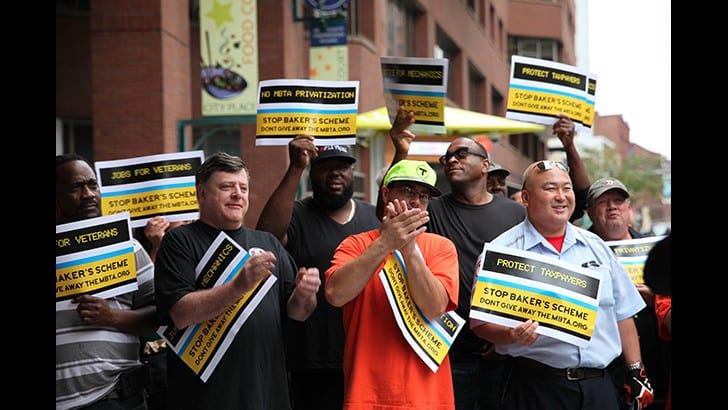
MBTA workers protest privatization. Image courtesy INVEST NOW.


MBTA bus mechanics beat back privatization… at a cost


February 14, 2018

BY JASON PRAMAS @JASONPRAMAS


Unionized bus mechanics represented by the International Association of Machinists Local 264 won an important victory last week when they agreed to a four-year contract with the MBTA—effectively ending a two-year effort by the transportation authority’s Fiscal and Management Control Board to privatize three bus garages, eliminate 150 good jobs according to IAM District 15 Assistant Directing Business Representative Mike Vartabedian, and crush the union.


The attack on the bus mechanics, and all unionized MBTA workers, actually began in 2015 when Gov. Charlie Baker (with plenty of help from his pals at his old stomping grounds, the right-wing libertarian Pioneer Institute) pushed a three-year suspension of the landmark anti-privatization Pacheco Law through the Mass legislature as part of the annual budget. The suspension applied only to the T. Shortly thereafter, Baker appointed the five-member FMCB—one of them, Steve Poftak, being a former Pioneer staffer like the governor—to get to work privatizing a public transit system serving much of eastern Massachusetts.


Because, you know, reasons. Most of them involving transferring as much public wealth into private hands as possible. And freedom. For the rich to get richer and the poor to starve.


The 1993 law, officially known as the Taxpayer Protection Act, protects unionized state workers and the people of Massachusetts from outsourcing and related corporate malfeasance in six ways that the Institute for Local Self-Reliance was thoughtful enough to summarize:


  1. Agencies seeking to contract out a service must prove not only that the move would save money, but that it would save money even if state employees were to work in the “most cost-efficient manner.”


  1. Firms cannot win business if they’ll pay less than the lowest amount the state pays its employees for similar services.


  1. Every privatization contract must contain provisions requiring the contractor to offer positions to qualified regular employees of the agency whose state employment is terminated because of the privatization contract.


  1. The contractor must add lost tax revenues to the cost of the bid if any work is to be performed outside Massachusetts.


  1. Private bids must also include estimated costs of monitoring contractor performance.


  1. Public employees have the opportunity to submit bids to keep the work in-house and “the agency shall provide adequate resources for the purpose of encouraging and assisting present agency employees to organize and submit a bid to provide the subject services.”


In suspending the law, the Baker administration meant to allow corporations free reign to eliminate huge numbers of good unionized public transit jobs and replace them with bad underpaid jobs with few or no benefits and little security. All in the service of reigning in costs at a quasi-independent transportation agency that is only having budget trouble because the state government—including the dominant Democratic legislative leadership that absolutely does not put its money where its collective mouth is—refuses to return to fully funding it based on its actual needs (see my 2016 column “Squawk or Walk” for more background). Rather than hobbling the MBTA with insufficient annual support and then dumping a huge amount of Big Dig debt on it for good measure. Because that might involve finally raising taxes on corporations and the rich. And corporations and the rich don’t want that. Just ask Raise Up Massachusetts—the folks pushing for the upcoming referendum fight for the “Millionaires’ Tax” that would devote money to properly funding public transit, among other worthy goals.


The expected script happily got flipped by the Machinists union and the labor-led INVEST NOW coalition, who fought hard for many months to demonstrate that privatizing the MBTA bus garages was a bad move. For everyone but the fat cats that stood to make millions off the misery of T workers and T riders alike. Since the already-overburdened, underfunded T bus system would basically collapse without the skilled union mechanics keeping its bus fleet in good order for short money.


The union coalition and allies like Attorney General Maura Healey scored major points when they demonstrated that only one private transportation company, First Transit, had submitted a bid to run the T bus garages in question. The same company that paid a $7.3 million settlement to the Commonwealth in 2012 after backing out of a contract to run the T’s The Ride, a door-to-door service for disabled commuters.


Advocates and labor-friendly legislators—including the author of the Pacheco Law, Sen. Marc Pacheco (D-Taunton), himself—testified to the Fiscal and Management Control Board that First Transit’s action resulted in a $66 million deficit for the state, according to State House News Service.


Ultimately, the union’s grassroots campaign worked, and the FMCB, the governor, conservatives from both parties in the legislature, and the ideologues at the Pioneer Institute were forced to back off this latest privatization push. But all battles exact a cost. So while the T bus mechanics scored a solid win overall, their new contract looks to be a mixed bag. On the upside, it keeps all nine MBTA bus garages plus one support facility in Everett public and includes Taxpayer Protection Act provisions that will help provide Local 264 members legal cover against privatization until the law’s suspension ends later this year.


On the downside, it forces the workers to accept low cost-of-living raises over the contract term and allows the T to bring in new workers for worse money and benefits than they would have started with previously, according to the Patriot Ledger. And, like the Carmen’s Union contract that preceded it, the Machinists’ agreement allows the T to hire private contractors to perform work outside its 955-bus core service. But only if they “maintain the same procedures and quality standards followed by the machinists,” according to Commonwealth magazine.


Since the devil is often in the details of such statements, it’s hard to tell if that will really stop T management from undercutting the union should bus service expand. Which it very well might—since the Boston Globe reported that T capital expenditures have risen under the Baker administration, even while it has done its level best to ram through cuts in operating expenditures on the backs of workers. Like the 406 bus mechanics and fuelers in Local 264’s MBTA bargaining unit, who are essentially having $4.1 million a year in concessions forced on them in the service of a completely avoidable budget deficit.


Still, all in all, the contract demonstrates that fighting for justice in the workplace remains far better than not fighting. If the union had been defeated, many workers would have lost their jobs and their families would have been immediately thrown into poverty. Their replacements would have been un-unionized and unable to easily defend themselves against T management. So, readers observing this fight should think twice before criticizing the bus mechanics, and think carefully about their own work situation. If your bosses decide to outsource your jobs to some fly-by-night company tomorrow, could you and your co-workers defend yourselves? For nearly 90 percent of American workers who aren’t unionized, the answer remains “probably not.”


The only thing that can change that sorry situation is for workers to stand their ground. Those of you interested in doing that should check out the website of the main US labor federation, the AFL-CIO, for more information on how to form a union at your workplace: aflcio.org/formaunion.


It’s not easy to do, no lie. I lost a job for helping lead a union drive not three years back. Fortunately, all the other workers in my former unit at that employer are now unionized. So it’s worth the risk. And it’s necessary. And everyone who lives from paycheck to paycheck should consider it.


Apparent Horizon is syndicated by the Boston Institute for Nonprofit Journalism. Jason Pramas is BINJ’s network director, and executive editor and associate publisher of DigBoston. Copyright 2018 Jason Pramas. Licensed for use by the Boston Institute for Nonprofit Journalism and media outlets in its network.