Skip to content

politics

CRISIS AVERTED

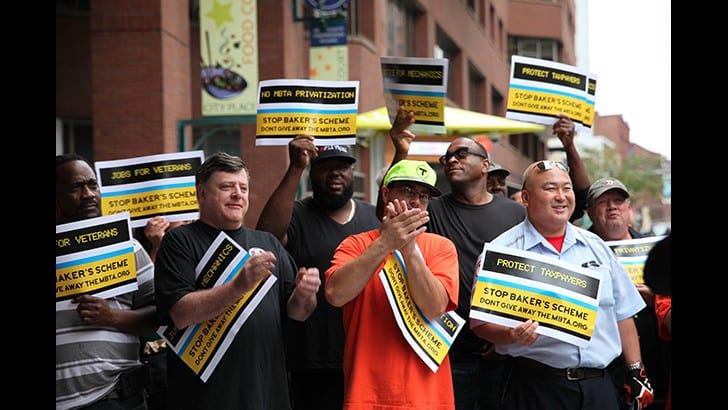
MBTA workers protest privatization. Image courtesy INVEST NOW.


MBTA bus mechanics beat back privatization… at a cost


February 14, 2018

BY JASON PRAMAS @JASONPRAMAS


Unionized bus mechanics represented by the International Association of Machinists Local 264 won an important victory last week when they agreed to a four-year contract with the MBTA—effectively ending a two-year effort by the transportation authority’s Fiscal and Management Control Board to privatize three bus garages, eliminate 150 good jobs according to IAM District 15 Assistant Directing Business Representative Mike Vartabedian, and crush the union.


The attack on the bus mechanics, and all unionized MBTA workers, actually began in 2015 when Gov. Charlie Baker (with plenty of help from his pals at his old stomping grounds, the right-wing libertarian Pioneer Institute) pushed a three-year suspension of the landmark anti-privatization Pacheco Law through the Mass legislature as part of the annual budget. The suspension applied only to the T. Shortly thereafter, Baker appointed the five-member FMCB—one of them, Steve Poftak, being a former Pioneer staffer like the governor—to get to work privatizing a public transit system serving much of eastern Massachusetts.


Because, you know, reasons. Most of them involving transferring as much public wealth into private hands as possible. And freedom. For the rich to get richer and the poor to starve.


The 1993 law, officially known as the Taxpayer Protection Act, protects unionized state workers and the people of Massachusetts from outsourcing and related corporate malfeasance in six ways that the Institute for Local Self-Reliance was thoughtful enough to summarize:


  1. Agencies seeking to contract out a service must prove not only that the move would save money, but that it would save money even if state employees were to work in the “most cost-efficient manner.”


  1. Firms cannot win business if they’ll pay less than the lowest amount the state pays its employees for similar services.


  1. Every privatization contract must contain provisions requiring the contractor to offer positions to qualified regular employees of the agency whose state employment is terminated because of the privatization contract.


  1. The contractor must add lost tax revenues to the cost of the bid if any work is to be performed outside Massachusetts.


  1. Private bids must also include estimated costs of monitoring contractor performance.


  1. Public employees have the opportunity to submit bids to keep the work in-house and “the agency shall provide adequate resources for the purpose of encouraging and assisting present agency employees to organize and submit a bid to provide the subject services.”


In suspending the law, the Baker administration meant to allow corporations free reign to eliminate huge numbers of good unionized public transit jobs and replace them with bad underpaid jobs with few or no benefits and little security. All in the service of reigning in costs at a quasi-independent transportation agency that is only having budget trouble because the state government—including the dominant Democratic legislative leadership that absolutely does not put its money where its collective mouth is—refuses to return to fully funding it based on its actual needs (see my 2016 column “Squawk or Walk” for more background). Rather than hobbling the MBTA with insufficient annual support and then dumping a huge amount of Big Dig debt on it for good measure. Because that might involve finally raising taxes on corporations and the rich. And corporations and the rich don’t want that. Just ask Raise Up Massachusetts—the folks pushing for the upcoming referendum fight for the “Millionaires’ Tax” that would devote money to properly funding public transit, among other worthy goals.


The expected script happily got flipped by the Machinists union and the labor-led INVEST NOW coalition, who fought hard for many months to demonstrate that privatizing the MBTA bus garages was a bad move. For everyone but the fat cats that stood to make millions off the misery of T workers and T riders alike. Since the already-overburdened, underfunded T bus system would basically collapse without the skilled union mechanics keeping its bus fleet in good order for short money.


The union coalition and allies like Attorney General Maura Healey scored major points when they demonstrated that only one private transportation company, First Transit, had submitted a bid to run the T bus garages in question. The same company that paid a $7.3 million settlement to the Commonwealth in 2012 after backing out of a contract to run the T’s The Ride, a door-to-door service for disabled commuters.


Advocates and labor-friendly legislators—including the author of the Pacheco Law, Sen. Marc Pacheco (D-Taunton), himself—testified to the Fiscal and Management Control Board that First Transit’s action resulted in a $66 million deficit for the state, according to State House News Service.


Ultimately, the union’s grassroots campaign worked, and the FMCB, the governor, conservatives from both parties in the legislature, and the ideologues at the Pioneer Institute were forced to back off this latest privatization push. But all battles exact a cost. So while the T bus mechanics scored a solid win overall, their new contract looks to be a mixed bag. On the upside, it keeps all nine MBTA bus garages plus one support facility in Everett public and includes Taxpayer Protection Act provisions that will help provide Local 264 members legal cover against privatization until the law’s suspension ends later this year.


On the downside, it forces the workers to accept low cost-of-living raises over the contract term and allows the T to bring in new workers for worse money and benefits than they would have started with previously, according to the Patriot Ledger. And, like the Carmen’s Union contract that preceded it, the Machinists’ agreement allows the T to hire private contractors to perform work outside its 955-bus core service. But only if they “maintain the same procedures and quality standards followed by the machinists,” according to Commonwealth magazine.


Since the devil is often in the details of such statements, it’s hard to tell if that will really stop T management from undercutting the union should bus service expand. Which it very well might—since the Boston Globe reported that T capital expenditures have risen under the Baker administration, even while it has done its level best to ram through cuts in operating expenditures on the backs of workers. Like the 406 bus mechanics and fuelers in Local 264’s MBTA bargaining unit, who are essentially having $4.1 million a year in concessions forced on them in the service of a completely avoidable budget deficit.


Still, all in all, the contract demonstrates that fighting for justice in the workplace remains far better than not fighting. If the union had been defeated, many workers would have lost their jobs and their families would have been immediately thrown into poverty. Their replacements would have been un-unionized and unable to easily defend themselves against T management. So, readers observing this fight should think twice before criticizing the bus mechanics, and think carefully about their own work situation. If your bosses decide to outsource your jobs to some fly-by-night company tomorrow, could you and your co-workers defend yourselves? For nearly 90 percent of American workers who aren’t unionized, the answer remains “probably not.”


The only thing that can change that sorry situation is for workers to stand their ground. Those of you interested in doing that should check out the website of the main US labor federation, the AFL-CIO, for more information on how to form a union at your workplace: aflcio.org/formaunion.


It’s not easy to do, no lie. I lost a job for helping lead a union drive not three years back. Fortunately, all the other workers in my former unit at that employer are now unionized. So it’s worth the risk. And it’s necessary. And everyone who lives from paycheck to paycheck should consider it.


Apparent Horizon is syndicated by the Boston Institute for Nonprofit Journalism. Jason Pramas is BINJ’s network director, and executive editor and associate publisher of DigBoston. Copyright 2018 Jason Pramas. Licensed for use by the Boston Institute for Nonprofit Journalism and media outlets in its network.


“WON’T SOMEBODY PLEASE THINK OF THE CHILDREN?!”

Apparent Horizon column North Andover MA collage


Moral panic hamstrings promising North Andover cannabis farm deal


February 6, 2018

BY JASON PRAMAS @JASONPRAMAS


Last fall, I wrote about the history of Osgood Landing—a large industrial facility in North Andover—as part of a column (“An Andover North Andover Deal?”) slamming a hasty bid to win the Amazon HQ2 contract put together by that town in partnership with nearby Haverhill, Lawrence, and Methuen. For decades, it had been a huge Western Electric manufacturing plant and AT&T research center, the storied Merrimack Valley Works—heavily unionized and employing over 12,000 area residents at its height. After the AT&T breakup in 1984, it began its downward slide. First under Western Electric successor corporation Lucent, then under French multinational Alcatel-Lucent—which killed the facility off completely by 2008. Blowing a hole thousands of jobs wide in the fortunes of a region that had already fallen far from its heyday as an industrial powerhouse between the 19th century and WWII.


A small company called Ozzy Properties bought the complex from Lucent in 2003 for a bargain-basement price at the time of its merger with Alcatel, and over the years has only managed to fill about 40 percent of its 1.8 million square feet with a grab bag of companies that together provide about 1,000 jobs and pay North Andover about a third of the $1 million in taxes a year on average that it used to get when Lucent owned the site, according to a 2017 North Andover Citizen article.


Well before town leaders decided to court Amazon to set up shop in part at Osgood Landing, its owner, Ozzy Properties’ Dr. Jeff Goldstein, had been floating a proposal to turn the unused 1.1 million-square-foot portion of the facility into one of the world’s largest indoor cannabis-growing farms.


After reviewing all the problems I thought that Amazon would be likely to bring to the area should the Merrimack Valley bid for HQ2 have prevailed (which we now know it did not), I closed my “Amazon North Andover” column by reminding the people of Haverhill, Lawrence, Methuen, and North Andover to remember the advice recently proffered by their own regional planners:


[T]he 2013 Merrimack Valley Comprehensive Economic Development Strategy produced by the Merrimack Valley Planning Commission stated, “The region’s best prospects for future economic growth are its local entrepreneurs.” Local entrepreneurs like the Osgood Landing owners, if they choose to start their marijuana farm rather than grab for the brass ring Amazon could offer them. A sustainable “growth” industry if ever there was one that could provide an estimated 2,500 good jobs to the region—two-thirds of which would not require college degrees. But it seems like local residents, perhaps with former Lucent employees in the lead, will now have to remind their elected officials. If not in lobby days and protests prior to an Amazon deal, then definitely at the ballot box come next election should such a disastrous initiative ever actually come to pass.


Fast-forward to last week and we find Goldstein trying to get his cannabis farm proposal passed by North Andover Town Meeting for the second time in under a year. Now projecting only 1,500 new jobs for the Merrimack Valley region, but upping the ante with a pledge to pay the town $5 million a year for 20 years—$100 million overall—for the privilege of doing business “around the corner” from where he lives. But the town meeting passed a ban on all recreational marijuana establishments instead. Preempting the planned vote on the bylaw changes needed to zone Osgood Landing for a marijuana business, and placing the future of Goldstein’s grand “Massachusetts Innovation Center” plan (which includes the farm and a medical cannabis “research campus”) in serious doubt.


Seems like an unfortunate outcome from this corner. And not just because of the usual fact-light, emotion-heavy prohibitionist antics on display at the latest town meeting dustup, according to multiple sources. For the kids, don’t you know. Who are busy getting baked as regularly as the parents who are now trying to “protect” them did when they were teenagers. No, I guess such behavior is only to be expected from North Andover’s still-robust contingent of downwardly mobile, middle-class burghers hoping to keep up bourgeois respectability by not becoming known as the “Pot Town” to some imaginary audience of tut-tutting social betters in Georgetown or Boxford or, god forbid, Andover—and which clearly had the effect desired by such retrograde anti-pot crusaders. Far better, apparently, to be known as yet another “Oxy Town” as they continue to fail to replace all the good jobs they’ve lost and turn to opiates to kill the pain of maxing out their last credit cards shortly before becoming homeless, am I right?!


But to my point, even if the planned cannabis facility ended up providing half the 1,500 jobs currently being promised by Goldstein and company—750 jobs—that would at least go most of the way toward replacing the 800 jobs and attendant tax revenue lost earlier in the decade when Converse and Schneider Electric both left North Andover (the former to Boston’s Seaport District, the latter to evil twin Andover). And while I’m not in the habit of suggesting that backing corporations as a municipal economic development strategy is any kind of optimal solution, at least Dr. Goldstein is offering to actually give $100 million to the town, rather than just trying to extract huge bribes from local government like most companies do when they set up shop pretty much anywhere these days.


Which is not to say that he hasn’t at least tried to benefit from government largesse before. He has, as when Osgood Landing was designated the Osgood Smart Growth Overlay District (yes, OSGOD, of all acronyms) in 2006. And there was supposedly a tax increment financing (TIF, aka a significant corporate tax break) plan of the type I often criticize attached to the district. But in a 2015 North Andover Citizen article, Selectman Rosemary Smedile was quoted saying the TIF wasn’t activated.


Regardless, it seems highly unlikely North Andover is going to find a better deal anytime soon. And certainly not with any company that has the kind of built-in market that an industrial cannabis concern would have in a state with a robust recreational market for the “demon weed.” What it will get instead is some version of the bad Amazon deal from large corporations that will demand millions in tribute from local and state governments before ever putting two sticks together anywhere near the town.


And that’s a shame. Now Goldstein will have to find a way to get some version of his proposal passed before his investors abandon him, or his clever idea for a modicum of municipal renewal (and a tidy profit to be sure) will go the way of most clever ideas. Into the dust heap of history.


While the teenagers of North Andover remain as stoned as ever.


Apparent Horizon is syndicated by the Boston Institute for Nonprofit Journalism. Jason Pramas is BINJ’s network director, and executive editor and associate publisher of DigBoston. Copyright 2018 Jason Pramas. Licensed for use by the Boston Institute for Nonprofit Journalism and media outlets in its network.

SEA LEVEL RISE IS JUST ONE OF BOSTON’S WORRIES

Image via Environmental Defense Fund

As Earth approaches several catastrophic global warming “tipping points”


January 24, 2018

BY JASON PRAMAS @JASONPRAMAS


Before writing more columns examining Boston city government’s emerging plans to cope with the effects of global warming, I think a quick review of what area residents are likely to face in the coming decades is in order. Because it’s important to disabuse people of the idea that we’re dealing with “just” a handful of significant problems over time—a rise in air temperature, an increase of extreme weather events, and a rise in sea level—that those problems are isolated to just Boston or the United States, that they are going to continue until the end of the century and then stop, and that there are some simple things we can do to prevent those problems from becoming unmanageable.


The reality is far more frightening. According to Mother Jones, “In 2004, John Schellnhuber, distinguished science adviser at the Tyndall Centre for Climate Change Research in the United Kingdom, identified 12 global-warming tipping points, any one of which, if triggered, will likely initiate sudden, catastrophic changes across the planet.”  


There’s been much research and debate since that time about which systems can be considered tipping points and which ones need more research before we can be sure, but the Environmental Defense Fund has a page on its website with an overview of the latest science. It’s called “Everything you need to know about climate tipping points” and you should read it in full. But here’s a quick summary of the tipping points that the Earth is passing or on its way to passing. Largely due to humans continuing to burn CO2-producing oil, gas, and coal decades after it was known to be suicidal to do so.


1) Disappearance of Arctic Summer Sea Ice

The poles are warming faster than the rest of the planet. In the Arctic, sea ice has been melting much more quickly than it used to for much more of every year as the average global temperatures rise year after year. Scientists are now predicting ice-free Arctic summers by mid-century. The less of the year that ice covers the Arctic, the less sunlight is reflected back to space. Sunlight that is not reflected warms the Arctic Ocean, leading to other problems and more global warming overall.


2) Melting of the Greenland Ice Sheet

Of particular concern to Bostonians because of our relative proximity to Greenland, the melting of its ice cap may continue for the next few hundred years until there is none left. Unlike melting sea ice that doesn’t add water to the world’s oceans, melting ice from land does. This will ultimately result in global sea level rise of up to 20 feet, and the process is underway.


3) Disintegration of the West Antarctic Ice Sheet

This tipping point may already have been passed—with the West Antarctic ice sheet already starting to collapse. Like the Greenland ice sheet, it too is expected to take hundreds of years to finish melting, but when it does it could raise the global sea level up to 16 feet.


4) Collapse of Coral Reefs

With oceans already warming and becoming more acidic, the algae eaten by the coral that make up the world’s often huge and spectacular reefs is being jettisoned, resulting in coral bleaching. This process weakens the coral and hastens its death. Which is accelerating the destruction of marine spawning and feeding grounds globally with dire consequences for many nations whose economies rely on them—and for biodiversity. Scientists now predict that the remaining coral reefs will collapse before there is rise in the global temperature of 2 degrees from the old normal average. Most climate models show the world reaching that threshold before the end of this century.


Beyond these, there are several other expected tipping points being studied: the disruption of ocean circulation patterns from the massive influx of fresh water from melting ice (especially in the North Atlantic, which would play havoc with Boston’s climate), the release of marine methane hydrates (which would accelerate the global warming already being caused by the CO2 emissions considered the main cause of climate change), ocean anoxia (a process creating growing oxygen-deprived “dead zones” in our oceans that can no longer support most life, aka “bye bye seafood”), the dieback of the Amazon rainforest (caused by human activity like cutting down huge numbers of trees with devastating consequences for biodiversity coupled with the loss of a major CO2 sink), the dieback of the boreal forests (still being studied, but means the death of more vast forests in and around our latitude of the planet), the weakening of the marine carbon pump (the Earth’s oceans have been absorbing much of the excess carbon in the atmosphere, but through this process will become less effective at it), the greening of the Sahara (some positive effects would come from this, but many basic ocean life forms rely on nutrients from the desert sand blowing into the ocean and will be negatively affected by losing it), and the increasingly chaotic Indian summer monsoons (could result in extensive drought in one of the Earth’s most populous regions).


Other processes underway may also be potential tipping points, including the collapse of deep Antarctic ocean circulation, the appearance of an Arctic ozone hole (joining the existing Antarctic ozone hole in causing rising UV levels in the Arctic with various negative effects), the aridification of the US Southwest (as moisture moves to the upper Great Plains), the slowdown of the jet stream (which could leave more weather systems stuck in place for weeks at a time, including extreme systems like our recent polar vortex-induced cold wave, among other negative effects), the melting of the Himalayan glaciers (which help provide fresh water for much of South Asia’s population), a more permanent El Niño state (which could result in more drought in Southeast Asia and elsewhere), permafrost melting (which results in more CO2 and methane being released, accelerating global warming further), and tundra transition to boreal forest (with uncertain effects).


Adding the above to the general effects of global warming that we’re already experiencing—areas that got lots of rain getting less and areas that got little rain getting more rain storms for more of the year, hotter temperatures overall leading to an array of bad effects like tropical diseases moving north, and the “sixth extinction” of large numbers of species of animals and plants—and keeping in mind that this is happening everywhere around the planet, readers should understand that we’re not facing a localized crisis.


And remember, all the processes mentioned above are interlinked in complex ways that are absolutely not fully understood by our current science.


So Boston is not just going to “trial balloon and town hall meeting” its way out of this array of existential crises. Surviving even one of the major problems caused by global warming—like the flooding from rising sea levels I wrote about last week—is going to be very difficult… and very expensive. And who’s going to pay for it? Well, going forward, in addition to pointing out that we’ll have to devote an ever-increasing percentage of public budgets to these problems, expect me to call for the corporations that started and continue to profit from global warming—the oil, gas, and coal companies—to pay for cleaning up the mess they created. To the degree possible. Which might not be sufficient to the monumental tasks at hand.


Still, it will be critical for Boston to join municipalities like New York City in suing the carbon multinationals Exxon, Chevron, BP, Shell, ConocoPhillips, and others for redress. While divesting the city from all investments in those companies’ stocks. And suing, and ultimately deposing, governments like the Trump administration that are aiding and abetting these corporations’ destruction of the planet.


Failing that, Boston and all of human civilization is literally sunk… burned… and perhaps ultimately suffocated. Dying not with the bang of nuclear war—itself a fate we also need to organize immediately to avoid given the federal government’s return to atomic sabre rattling—but with an extended agonizing whimper.


It’s up to all of us to stop that from happening.


Apparent Horizon is syndicated by the Boston Institute for Nonprofit Journalism. Jason Pramas is BINJ’s network director, and executive editor and associate publisher of DigBoston. Copyright 2018 Jason Pramas. Licensed for use by the Boston Institute for Nonprofit Journalism and media outlets in its network.

THE SEAPORT FLOOD IS JUST THE BEGINNING

THE SEAPORT FLOOD IS JUST THE BEGINNING


Unless Boston builds proper defenses against global warming-driven sea level rise


January 17, 2018

BY JASON PRAMAS @JASONPRAMAS


So, Boston’s Seaport District flooded early this month during a bad snowstorm in the midst of several days of arctic temperatures. And nobody could be less surprised than me. Because I’ve spent a lot of the last quarter century closely following developments in the science of climate change. And the “bomb cyclone” that caused the flooding, and the polar vortex that caused that, are both likely to have been caused by global warming. Yale University Climate Connections just produced a great video that features several luminary climate scientists explaining why at yaleclimateconnections.org. Definitely check it out.


No question, though, that it’s good to live in a region where local government at least recognizes that global warming is a scientific reality. The city of Boston is certainly ahead of most municipalities in the US in terms of laying plans to reduce greenhouse gas emissions enough to become “carbon neutral” and to deal with some of the anticipated effects of climate change. Particularly, flooding from inexorably rising sea levels and increasingly powerful and frequent storms. Which the more reactionary Boston TV newsreaders still insist on calling “wild weather.” But its plans are largely just that… plans. And they are still incomplete and, frankly, woefully inadequate to deal with the magnitude of the crisis facing us all.


Boston city government has initiated an array of climate change initiatives, including Greenovate Boston, a section of the Imagine Boston 2030 process, and—most germane to this discussion—Climate Ready Boston. They are all producing very nice reports grappling with some of the challenges to humanity presented by global warming in the decades to come. But the reports are written by planners and experts who are clearly pulling their punches for reasons that remain somewhat opaque. And in doing so, any good that might come out of the reports and the policy actions that will result from them is essentially undone.


A look at metro planning on global warming-induced flooding is a good way to illuminate the problem in question. The Climate Ready Boston program released a 340-page report in December 2016 that was meant to be a comprehensive assessment of the threats presented to the city by global warming—with plans for possible correctives. It does mention the idea of building giant dikes, storm barriers, and retractable gates (which they call a “harbor-wide flood protection system”) across Boston Harbor as the method with the most potential to save much of the city from major flooding. Which makes sense since Mayor Marty Walsh signed a 2015 agreement with Dutch officials to work together to manage rising sea levels, according to Boston Magazine. And the Dutch are recognized world experts on giant storm barriers and hydroengineering in general, lo, these last few hundred years.


But there’s no firm commitment for harbor-wide defenses in the report. Yet it should be obvious that they are absolutely necessary if Boston is going to continue as a living city for even a few more decades. At least Amos Hostetter of the Barr Foundation—who is a major player in Boston’s climate efforts—put up $360,000 for the UMass Boston Center for the Environment to study their feasibility last year, according to the Boston Globe.


More concerning than its waffling on building big dikes, the big Climate Ready Boston report chooses to focus on the possibility of sea level rise of no more than 3 feet by 2070—although it allows that a rise of 7.4 feet is possible by 2100:


The highest sea level rise considered in this report, 36 inches, is highly probable toward the end of the century if emissions remain at the current level or even if there is a moderate reduction in emissions. … If emissions remain at current levels, there is an approximately 15 percent chance that sea levels will rise at least 7.4 feet by the end of century, a scenario far more dire than those considered here.


Similar caution is on display with an October 2017 Climate Ready Boston report called “Coastal Resilience Solutions for East Boston and Charlestown”—focusing on tactics to protect two Boston neighborhoods on Boston Harbor at high risk for flooding caused by global warming. Once again, the authors’ assumption is that global warming-related sea level rise in Boston will be no more than 3 feet higher than year 2000 figures by 2070. Even though such estimates—which we have already seen are conservative by Climate Ready Boston’s own admission—also indicate that we could face 7-plus feet of sea level rise or more by 2100. And even higher rises going forward from there. Because sea level rise is slated to continue for generations to come.


What’s weird about such methodological conservatism is that a 2016 paper in the prestigious science journal Nature co-authored by a Bay State geoscientist says the lower figures that all the city’s climate reports are using already look to be wildly optimistic.


According to the Boston Globe:


“Boston is a bull’s-eye for more sea level damage,” said Rob DeConto, a climate scientist at UMass Amherst who helped develop the new Antarctica research and who co-wrote the new Boston report. “We have a lot to fear from Antarctica.” … If high levels of greenhouse gases continue to be released into the atmosphere, the seas around Boston could rise as much as 10.5 feet by 2100 and 37 feet by 2200, according to the report.


What’s even weirder is that the same UMass scientist, Rob DeConto, co-authored a detailed June 2016 report for Climate Ready Boston called “Climate Change and Sea Level Rise Projections for Boston: The Boston Research Advisory Group Report” with 16 other climate scientists that look at an array of possible outcomes for the city—and include a discussion of the higher sea level rise figures mentioned in the Nature paper. The report concludes with an admission that current science doesn’t allow for accurate predictions of climate change in the second half of the century. All the more reason, one would think, that models predicting higher than anticipated sea level rise should not seemingly be dismissed out of hand in other Climate Ready Boston reports.


The Globe also reported that a study by the National Oceanic and Atmospheric Administration (NOAA) says Boston can expect a sea level rise of 8.2 feet by 2100. Both 8.2 foot and 10.5 foot estimates are higher than the 7.4 foot estimate that Climate Ready Boston says is possible by 2100, and well above the 3 feet that it is actually planning for by 2070.


The same team that produced the larger Climate Ready Boston report authored the East Boston and Charlestown report; so they are doubtless quite well-aware of all this. Which is evident in this sentence about the (insufficient) extensibility of their proposed neighborhood-based flood defenses: “If sea levels rise by more than 36 inches, these measures could be elevated at least two feet higher by adding fill, integrating structural furniture that adds height and social capacity, or installing deployable flood walls. With this built-in adaptability, their effectiveness could be extended by an additional 20 years or more.”


The point here is not that the Boston city government is doing nothing about global warming-induced flooding. It’s that the city is potentially proposing to do too little, too late (given that most of the flood defenses it’s proposing will remain in the study phase for years, and many will protect specific neighborhoods but not the whole city when finally built), for reasons that aren’t entirely clear. Though it’s probable that those reasons are more political and economic than scientific. Avoiding scaring-off the real estate developers and major corporations that provide much of the current city tax base, for example. The kind of thing that will make life difficult for politicians who then make life difficult for staffers and consultants working on global warming response plans.


Regardless, if experts like the Dutch are basically saying, Boston really needs to build the biggest possible harbor-wide flood protection system to have any hope of surviving at least a few more decades, then we can’t afford to do one of the more half-assed versions of the big cross-harbor storm barrier plan mentioned in the original Climate Ready Boston report—or, worse still, fail to build major harbor-wide defenses at all. If major studies by climate experts are saying that 3 feet of sea level rise by 2070 and 7.4 feet by 2100 are overly optimistic figures, then we need to plan for at least the highest reasonable estimates: currently, the NOAA’s 8.5 feet or, better yet, the Nature paper’s 10.5 feet for the end of the century. It’s true that we could get smart or lucky and avoid those numbers by 2100. But what about 2110? Or 2150? Or 2200? Sea level rise is not just going to stop in 2070 or 2100.


Are city planners and researchers willing to gamble with the city’s fate to avoid sticky political and economic fights? Let’s hope not. For all our sakes. Or the recent Seaport District flood—and numerous other similar recent floods—will be just the start of a fairly short, ugly slide into a watery grave for the Hub.


Apparent Horizon is syndicated by the Boston Institute for Nonprofit Journalism. Jason Pramas is BINJ’s network director, and executive editor and associate publisher of DigBoston. Copyright 2018 Jason Pramas. Licensed for use by the Boston Institute for Nonprofit Journalism and media outlets in its network.

DON’T TAKE JOURNALISM LYING DOWN

DON’T TAKE JOURNALISM LYING DOWN


If a DigBoston article inspires you, take action to right wrongs


January 3, 2018

BY JASON PRAMAS @JASONPRAMAS


As each new year arrives, DigBoston staff—and journalists in general—like to offer some thoughts for the 12 months to come. These missives often take the shape of admonitions, wish lists, or resolutions, and the subjects covered can be literally anything that comes to our minds. So they’re typically fun to write. But now that I help run a metro weekly newspaper, I find myself thinking a lot about the mechanics of how news media works, how it’s used by our audience, and the role it plays in our troubled democracy.


And I feel that this year it’s worth saying something that may seem obvious at first glance, but isn’t: Good journalism isn’t meant to be passively consumed. It’s meant to be acted upon.


As a journalist, I spend a lot of my time writing articles about social and political ills affecting area communities—as do many of my colleagues at DigBoston in one way or another. We do this not because we expect someone to stick gold stars on our foreheads, but because we sincerely hope to inspire our readers to take notice of the real-life problems Bostonians face day to day… and take action to resolve them. We think that this is precisely the role that journalists must play in a democracy, if we’re serious.


What journalists cannot do—as I put it to a critic of one of my recent pieces—is, having led the proverbial horses of our readership to the water of knowledge, shove their heads into the trough and make them drink to the point of wanting to effect social change.


So it’s up to the public—you, reading this newspaper or consuming any news media of any type—to either act upon what journalists say, or not.


Just remember that without readers getting active on issues journalists raise, nothing much happens in a political economic system that’s spiraling downward toward oligarchy. Especially in this era of information overload.


Which is why I’d like to encourage DigBoston readers to do the following three things with our journalism—be it our news features, columns, investigative reporting, or critical arts and entertainment articles—going forward:


1) Learn More

After first reading an article that’s trying to redress a societal grievance, process it awhile. Then, if you decide that it’s really speaking to you, return to it again. Note the issues at stake, go online (if you’re not already), find other articles that relate to those issues, and read them for more background. Advanced readers may also look for related academic articles and books for a really deep dive.


2) Survey the Field

Once you have a better handle on the issues, look up the people mentioned in Dig articles and/or the organizations they work with, and determine who seems to be trying to right whatever wrongs are under discussion. Find their websites and social media presences. If you go to our digboston.com website, we’ll often provide links; so you can just click and easily find the information you need. But if we don’t, just google the people and institutions that look to be on the side of the angels. After that, don’t forget to take a look at any “bad guys” mentioned too. Maybe you’ll decide that there’s no harm, and therefore no foul. And that will be that. But if you agree there is a problem that needs fixing, and think that you’re just the person who should help fix it, then proceed to the final step.


3) Act

If you decide to get involved in a fight we write about in DigBoston, you’ll typically have two options. Either find an advocacy organization (or sometimes a public figure) that is mentioned in the article you’re reading, contact them (any good organizer will make it easy to do so), and ask them how you can plug in. Or, and this is the tougher route, if you’re really inspired to get active on an issue mentioned in one of our articles, and no one seems to be working on it yet, consider starting your own advocacy organization. Even if the group is a simple neighborhood committee consisting of family members and neighbors, that’s a great start. Particularly if the issue of concern affects you directly at the local level. If that seems like more than you can handle, then do whatever you can do out of the gate. Write an outraged email. Call up some big bad you read about, try to get them on the phone, and give them a piece of your mind. Donate to an advocacy group you think is doing good work. Vote for a politician that you think is a champion on your issue, and decent overall.


Once you’ve taken that action step, you might find it gives you a sense of accomplishment. If so, take another one. And another. And soon enough, you won’t just be reading the news… you’ll be making it. Which would please all of us at DigBoston to no end. Because then we’ll really know that we’ve done our job by turning a passive spectator into an active participant in the revival of our democracy. And we’ll know that 2018 will be a good year for our brand of community journalism in the public interest.


Jason Pramas is executive editor and associate publisher of DigBoston.


ON MAKERSPACES AND SOCIAL RESPONSIBILITY


Making can be cool, but conscious making is cooler


December 19, 2017

BY JASON PRAMAS @JASONPRAMAS


For many of us living in and around Boston in recent years, it has become common to see lots of communications from makerspaces around holiday time. Which is totally understandable. Such creative centers produce neat things year-round, so it’s only natural that their members would turn to producing gifts like busy elves (and holding workshops about how to produce gifts like… um… smart busy elves) as fall turns to winter.


However, if you’re someone who thinks critically about social institutions and their interaction with technology, then you might join me in feeling some concern about the trajectory of these spaces. Which boils down to this: Do makers and the makerspaces they found think about why they make, and for whom they make? Obviously, it varies from maker to maker and space to space, but my observation has been that the maker movement could do much better on that front. So I thought I would run through some of my apprehensions on that theme and make some suggestions for reform. In the spirit of holiday giving and all that.


There’s no question that makerspaces have been a boon to society in many different ways. Described by the Somerville nonprofit makerspace Artisan’s Asylum as “community centers with tools,” these logical outgrowths of the hacker and DIY cultures—and the older crafter culture, amateur radio culture, and cultures around magazines like Popular Electronics and Popular Mechanics—have grown to become a significant social force in the last decade. Particularly in places like the Boston area that have lots of colleges producing lots of engineers, scientists, and artists.


But it’s important to remember that—as with science, technology, and art in general—there is a problem with pushing “making” in the abstract without thinking about its social and political consequences. Because tools and techniques may be inherently neutral, but people and the institutions we create are not.


Including makerspaces. So it’s worth being aware that, according to PandoDaily, in early 2012 O’Reilly Media’s MAKE division —publisher of Make magazine, perhaps the best known popularizer of the maker movement—announced that it had won a grant from the Pentagon’s Defense Advanced Research Projects Agency (DARPA) to participate in the agency’s Manufacturing Experimentation and Outreach (or MENTOR) program. The money was to be used to start 1,000 makerspaces in high schools around the country.


Now DARPA may be most famous as the super clever agency that brought us the Internet. But it worked on that project in part—protestations from its fans and allies taken as given—to help solve the insoluble problem of how to keep America’s military, research, and control centers in communication with each other after an all-out nuclear war. And somehow help our government survive the unsurvivable.


It is also the super clever agency that has brought us an array of very nasty war machines in the last six decades. Notably, according to Air & Space magazine, the Predator drones that have killed hundreds of innocent people around the world—including many children—in recent years at the behest of presidents from Bush to Obama to Trump. Because they’re just not as accurate as our military and political leaders would have us believe. And because those leaders don’t really care about what they call “collateral damage” when they’re prosecuting what human rights groups like the American Civil Liberties Union and the Center for Constitutional Rights claim are extralegal assassination campaigns.


As it turned out, the DARPA MENTOR high school program never really got off the ground because it lost its budget in President Obama’s big “Sequestration” budget cut of March 2013. And it’s certainly worth mentioning that the program sparked protests from within the maker community.


But DARPA continues to participate in a variety of science and technology events aimed at high school kids—notably the young robotics crowd that overlaps with makerspaces.


And DARPA is also aiming events squarely at makerspaces… and some makerspaces are definitely participating. For example, according to the DARPA website, this November the agency held the DARPA Bay Area Software Defined Radio (SDR) Hackfest at NASA Ames Conference Center in Moffett Field, California. The relevant webpage explains that “Teams from across the country will come together to explore the cyber-physical interplay of SDR and unmanned aerial vehicles, or UAVs, during the Hackfest.”


“Unmanned aerial vehicles” is another term for drones. Two of the eight teams invited to participate along with teams from military contractors like Raytheon were the Fat Cat Flyers from Fat Cat Fab Lab, a volunteer-run makerspace in New York City, and Team Fly-by-SDR from Hacker DoJo, a nonprofit community of hackers and startups in Silicon Valley… which is also a makerspace.


Whatever you in the viewing audience think about the Pentagon in particular and the American military in general, we can all agree that there are moral, ethical, social, and political questions that must be asked in a democratic society about the intersection of maker culture and makerspaces with those institutions.


For that reason, I think it’s critical that makerspaces raise and address such questions on an ongoing basis. That they maintain a scrupulous policy of transparency regarding who they work with and why. And that they hold classes and public forums on the moral, ethical, social and political dimensions of why makers make and for whom they make. Something you really don’t see much of at makerspaces at present. But should.


Anyhow, I’m keen to engage with the maker community on this topic and flesh these ideas out more. Folks interested in discussing the issues I’m raising at more length can drop me a line at execeditor@digboston.com.


A shorter version of this column was originally written for the Beyond Boston regional news digest show—co-produced by the Boston Institute for Nonprofit Journalism and several area public access television stations.


Apparent Horizon is syndicated by the Boston Institute for Nonprofit Journalism. Jason Pramas is BINJ’s network director, and executive editor and associate publisher of DigBoston. Copyright 2017 Jason Pramas. Licensed for use by the Boston Institute for Nonprofit Journalism and media outlets in its network.

TOWNIE: CORPORATE TAX FABLES AND COMMUNITARIAN KIDDIE TABLES

CORPORATE TAX FABLES AND COMMUNITARIAN KIDDIE TABLES


December 12, 2017

BY JASON PRAMAS @JASONPRAMAS


Big local corps quiet about huge profits to come from Repub tax scheme… except GE

An interesting WBUR article, “Largest Mass. Companies Are Mostly Silent On GOP Tax Plans,” asked the top 12 corporations in the Commonwealth to comment on the recently passed Republican scheme to transfer vast amounts of money from the working and middle classes to the rich and the corporations they control—euphemistically called “tax reform” in most of the major news media. Unsurprisingly, Bay State business leaders didn’t want to take time away from rubbing their hands together and cackling with glee about all the free money they’re going to get—choosing instead to remain mum for the moment.


But WBUR did get a statement out of General Electric after the Senate vote on the tax plan:


GE commends Congress and the White House for their commitment to comprehensive tax reform. GE supports the Senate tax reform plan because it would upgrade the U.S. to a territorial tax system, bring rates in line with other countries, and allow U.S. businesses and workers to compete fairly around the world, so it’s the quality of our products that determine whether we win global deals, and not tax differences.


No surprise GE would say that, since it will benefit tremendously from the drop in federal corporate tax from 35 percent to only 20 percent. But it will also get to repatriate as much of the lucre it’s been offshoring as it would like at a one-time tax rate of merely 12 percent. And now that the feds are “upgrading” to a “territorial tax system,” the company will make even more money. Why? Because a territorial tax system means that all the profits multinationals sock away in offshore tax havens will be taxed at a rate of zero percent. You read that correctly. Nada. No taxes at all on foreign profits.


Currently, companies like GE stash profits in other countries because, although they have been technically taxed on all profits—foreign and domestic—at the base 35 percent rate (basically a total joke since there are so many corporate tax loopholes that big companies like GE actually end up with a negative tax rate some years, but let’s play along for the purpose of this explanation), they are only required to pay those taxes when they “repatriate” the money back to the US. Which has often been never thanks to a complicated system called “transfer pricing” where corporations book profits in low tax countries, and take deductions in the US and other higher tax countries. And then borrow cheap money on the strength of their foreign bank accounts to make more profits.


The result will be even more offshoring of both money and jobs by megacorps. Because why would a company like GE not move more of both away from the US if foreign profits are  tax free—without nearly as much of the tricky accounting that’s currently needed to play the transfer pricing game? Just really bad news for Mass workers. And for boosters of the GE Boston deal. And anyone who thinks big companies like Amazon are going to have much incentive to add lots of jobs anywhere in the US going forward.


BPDA “PLAN: Glover’s Corner” protested in Dorchester

As the neoliberal capture of the government and the public sector continues apace, earnest technocrats at the Boston Planning and Development Agency (BPDA, formerly known as the BRA) still find it necessary to play the communitarian “public meeting” game when trying to sell bad deals that advance corporate interests to the working families who are all too often the targets of such deals.


Communitarianism being the decades-old fad where institutions representing the rich and powerful work hard to make sure that “every constituency has a seat at the table” when they want to do something that will harm those constituencies. But, of course, the power relations remain unchanged. The rich and powerful remain rich and powerful. Everyone else does not. And “the table” isn’t the real table—where bankers, CEOs, and top government leaders meet to make policy decisions happen. Usually behind closed doors. It’s basically a kiddie table where regular people can pretend they have some impact on a process that’s over before it begins.


Which is why it’s nice to see that housing activists with the Dorchester Not For Sale coalition decided to crash a recent BPDA transit-oriented public meeting on its “PLAN: Glover’s Corner”—which is slated, among other things, to add hundreds of units of housing that will be mostly unaffordable to current Dot residents.


According to the Bay State Banner and the Dorchester Reporter, the Dorchester activists are taking a page from JP and Roxbury housing activists with the Keep It 100% for Egleston coalition who protested the larger BPDA PLAN: JP/Rox—which might ultimately involve thousands of units of new housing—until the city relented and mandated that 36 percent of the new units (and 40 percent overall, including units currently permitted for construction) must be affordable.


The definition of “affordable” for the JP/Rox plan area is pegged to percentages of the average median income of the Boston region set by the US Department of Housing and Urban Development (HUD). So, for example, according to an August Spare Change News article, some “affordable” units being rented and sold as part of the 3200 Washington complex are being offered to households making 70 percent of the region’s average median income, and some to households making 100 percent.


But JP and Roxbury advocates have continued to protest PLAN: JP/Rox even after it was made official because its definition of “affordable” remains too high.


Spare Change continues, “For the Boston metropolitan region, the average median income is just over $100,000, and according to the U.S. Census Bureau, the average household income for all of Jamaica Plain is $76,968. However, households within the plan’s range have an average income of just over $50,000.”


According to a March Bay State Banner article, activists three goals for the plan are “to deepen the affordability level on designated affordable housing units so that they are attainable by households making less than $35,000 per year; increase goals for the portion of new housing that’s designated as affordable from 36 percent to 55 percent; and require the conversion of 250 market-rate units into affordable units..”


So while their activism raised the amount of “affordable” housing the BPDA planned to offer in the deal from 30 percent to 36 percent, it’s not going to help many people currently living in or near the affected neighborhoods to stay in the area unless the definition of affordable is changed to reflect economic reality. Given that fact, Mayor Marty Walsh’s much-vaunted progress on getting more affordable housing built on his watch is based largely on smoke and mirrors because much of it remains unaffordable to the people who need it most.


The Dorchester activists, meanwhile, are demanding that the BPDA accept a six-month moratorium on PLAN: Glover’s Corner, use the extra time to provide more data to the community on the plan, and do things like provide childcare at public meetings to allow more locals to attend.


Thus far, the BPDA is blowing off such demands and trying to plow forward without significant changes to its plan. Boston City Councilor Frank Baker, who attended the Glover’s Corner meeting, agreed with the BPDA in a recent Spare Change article, saying “As far as I’m concerned, it’s not a valid request.”


Seems the fight for housing justice is far from over in Dorchester.


Townie (a worm’s eye view of the Mass power structure) is syndicated by the Boston Institute for Nonprofit Journalism. Jason Pramas is BINJ’s network director, and executive editor and associate publisher of DigBoston. Copyright 2017 Jason Pramas. Licensed for use by the Boston Institute for Nonprofit Journalism and media outlets in its network.

EVERSOURCE SCREWS MASS CONSUMERS

EVERSOURCE SCREWS MASS CONSUMERS


With a little help from its friends, the “regulators” at the Department of Public Utilities


December 5, 2017

BY JASON PRAMAS @JASONPRAMAS


It is perhaps understandable that one of the most important Massachusetts news stories of the year was buried in the avalanche of reports coming out of Washington last week. But Eversource Energy, a large investor-owned utility serving much of Connecticut, New Hampshire, and Massachusetts, just got a big rate hike approved by the Commonwealth’s Department of Public Utilities Commission. This despite strong opposition from Mass Attorney General Maura Healey—who believes the company should be forced to cut its rates, rather than being allowed to needlessly accumulate more profits on the backs of consumers.


According to Commonwealth magazine, “Eversource Energy won approval to hike power rates $36.9 million a year for its 1.4 million electricity customers, a slimmed-down boost from the company that initially requested a $96 million increase.” A situation the company had the temerity to complain about when it has already been making solid profits under the rate system that has been in place since 2005. The new rates—which will slam Western Mass especially hard—are slated to go into effect on Jan 1 and last until 2022.


Healey, for her part, said the 10 percent shareholder return the rate increase includes is “one of the highest in the country” for a publicly regulated utility, according to the Boston Herald. And Eversource has some serious rate-related skeletons in its closet, it seems. Even as its rent-seeking drama played out at the DPU, the AG started looking into recent allegations by the Environmental Defense Fund that the Eversource and fellow regional utility Avangrid, Inc. rigged gas pipeline reservations on frigid winter days to artificially drive up electric and gas prices to its customers. Then, according to The Republican, shortly after that charge was leveled several New England residents, represented by Hagens Berman Sobol Shapiro LLP, filed a related class action suit against Eversource and Avangrid for using the pipeline scheme to cause “electricity consumers to incur overcharges of $3.6 billion in a years-long scheme that impacted six states and affected 14.7 million people.”


There is much that can be said about how problematic it is to have former energy industry lawyers like DPU Commission Chair Angela M. O’Connor and DPU Commissioner Cecile M. Fraser—both appointed by Gov. Charlie Baker (Fraser only in July with the Eversource rate hike vote looming)—playing the role of corporate foxes guarding the chicken coop of the public trust. It’s also worth mentioning that the third commissioner, Robert Hayden, was a longtime DPU staffer—and ran for the Mass 10th Congressional seat as a conservative Republican in 2010 on a “small government” platform, according to the Barnstable Patriot. So don’t expect much consumer protection to come from his corner either. But even if the three-person DPU Commission was all pro-consumer, we’d still have to deal with the structural crisis of energy conglomerates using their money and political clout to continue to make state government dance to whatever tune they care to play.


For example, Eversource and other investor-owned utilities have remained extremely hostile to the new wave of renewable energy options. Especially solar, which they have consistently lobbied heavily and successfully against to prevent it from becoming widespread enough to potentially break their regional monopolies.


Reining in such entrenched corporate utilities will take a long, hard fight by a broad coalition of consumers and local governments. But there is one seemingly small change to state law that would go a long way toward winning such a conflict. A group called the Massachusetts Alliance for Municipal Electric Choice (MAMEC), led by Lexington resident Patrick Mehr, got state legislators to file an important “muni choice” bill with significant support from dozens of cities, towns, and major stakeholder organizations around the state no less than eight times in 16 years between 2000 and 2016. If passed, it would have struck language from state law that gives investor-owned utilities like Eversource veto power over the establishment of new municipal electric utilities in the Commonwealth. It was shot down all eight times by the cheap and oft-used device of sending each attempt into “study.” Basically the same thing as killing the bill without as much PR blowback for state pols in the pocket of major corporations.


Turns out that 41 cities and towns in Massachusetts already have municipal—that is, publicly owned and managed—utilities. And advocates like MAMEC say they provide generally better service and, more to the point, significantly cheaper rates than energy corporations like Eversource. Sadly, the last new muni utility came online in 1926. It will take passage of a muni choice bill to allow more cities and towns to exercise that option.


MAMEC and its allies may have lost many battles against powerful, well-connected foes. But that doesn’t mean the idea of expanding the number of muni utilities is a bad one. Far from it. Because every new muni that comes online is another stake in the heart of the greedy, environmentally destructive, investor-owned utilities that will keep taking Mass consumers for a ride until they are brought to heel. Failing that, consumers can expect to get spanked with regular and ever more painful rate hikes for the foreseeable future.


So, I encourage readers to get active in the fight for a more fair, democratic, and environmentally conscious regional energy system. Working to get more public-spirited DPU commissioners seated is certainly a good interim goal. But creating a larger network of publicly owned and managed municipal energy utilities will go further down the road toward extricating us from the structural mess we’re in thanks to the big investor-owned utilities like Eversource. Though even that won’t solve all the myriad problems with our current byzantine system of electricity generation and distribution.


Regardless, check out MAMEC at massmunichoice.org. Patrick Mehr told me that the group remains active, and it seems like a good starting place for those of you who don’t want to continue to take rate hikes lying down.


Frankly, increased public pressure on Eversource and other investor-owned utilities in our region cannot come soon enough. Turns out the recent rate hikes are only the first part of the DPU order relating to Eversource. The second part is being released on Dec 31, according to a DPU press release, and advocates are warning that even worse rate shenanigans are in the works. So, find a good group working for utility reform and join it, or start your own utility reform group… or continue to be a victim of price gouging by investor-owned utilities. Those are your options. Choose wisely.


Apparent Horizon is syndicated by the Boston Institute for Nonprofit Journalism. Jason Pramas is BINJ’s network director, and executive editor and associate publisher of DigBoston. Copyright 2017 Jason Pramas. Licensed for use by the Boston Institute for Nonprofit Journalism and media outlets in its network.

TOWNIE: UMB DRUBBING, PAWSOX GRUBBING

UMB DRUBBING, PAWSOX GRUBBING


University cuts and a (possible) corporate scam just in time for the holidays


November 27, 2017

BY JASON PRAMAS @JASONPRAMAS


UMass Boston admin lays off more staff, unions push back

The neoliberal war on public higher education continues unabated in Massachusetts as the UMass Boston administration announced the layoff of 36 personnel last week, and a reduction in hours for seven more. According to the Boston Globe, all of them are “staff who clean the school, help run academic programs, work in the student health office, or in other ways support the daily operations of the university. Some have worked there more than 30 years.” UMB had 2,095 employees in 2016, but has cut 130 jobs so far this year. The university serves over 16,000 students.


As of this writing, campus unions are planning protests. Hopefully, such actions will ultimately build a political movement capable of operationalizing the prescriptions of the fine report a coalition of UMB “students, staff unions, and faculty” released in September. Entitled “Crumbling Public Foundations: Privatization and UMass Boston’s Financial Crisis,” it lays the responsibility for the budget crisis currently engulfing the university at the feet of the UMB administration, the UMass Board of Trustees, and the state legislature.


As well it should. The legislature has been slashing the state higher ed budget since the 1980s. The board keeps raising the tuition and fees paid by students and families to cover the resulting gap. And the UMB administration continues increasing the number of high-level administrators with questionable job descriptions and fat paychecks who somehow rarely face layoffs—despite costing the school far more per capita than each of the low-level employees who keep getting axed of late. All while expanding the campus in ways that don’t always benefit the urban students that institution was built to serve… running up unsustainable debt loads in the process.


The report calls for five major reforms that its authors believe would set the campus to rights:


  1. UMass Boston should not be required to show a positive net income in its budget. Instead, it should be allowed to make debt payments using the reserves it’s been forced to build up for the last few years—and the Board of Trustees should “release Central Office reserves” to help with those payments. Rather than compelling students and their families to shoulder such costs through ever-increasing tuition and fees.
  2. The UMB administration should engage in an open and transparent planning process with faculty, staff, and students that will “ensure that the campus can continue to provide an affordable and diverse education along with appropriate support services to its students,” review interest and principal payments, and review the rapid increase in high-level administrator expenses.
  3. The UMass Board of Trustees should endorse the Fair Share Amendment that will levy an additional 4 percent income tax on millionaires and spend the money on public higher education, pre-K-12 education, and transportation if passed by binding statewide referendum next year.
  4. The Mass Legislature should cover the cost of rebuilding crumbling campus infrastructure.
  5. The Mass Legislature should annually increase appropriations for public higher education until we are at least on par with the national average based on our state’s wealth.  The Commonwealth is presently at the bottom of the pack for state appropriations for public higher ed.


The white paper concludes with a visionary sentiment that’s worth reprinting in full: “In considering these recommendations, we ask that we all—members of the Massachusetts legislature, the UMass Board of Trustees, UMass Boston’s administration, and the larger community of Boston—remember the purpose with which we are tasked. Chancellor John W. Ryan, at UMass Boston’s 1966 Founding Day Convocation, reminded those gathered that ‘we have an obligation to see that the opportunities we offer… are indeed equal to the best that private schools have to offer.’ This is the expectation that the citizens of our Commonwealth have for themselves and their family members when they come to UMass Boston. This is the responsibility that UMB staff, faculty, and administrators take on each day on behalf of our students. This should be what guides the decision of the Board of Trustees and the Mass legislature as we work to address the crisis at UMB.”


PawSox Worcester visit: boondoggle in the making?

Meanwhile, in faraway central Mass, my Worcester Magazine colleague Bill Shaner is tracking what could be another big giveaway of local and state money. Seems that the Pawtucket Red Sox—the BoSox Triple A affiliate team—have been courting Worcester for a few months and might be looking to move there in exchange for lashings of public lucre. Shaner reports that multiple sources said that Jay Ash, secretary of Gov. Baker’s Executive Office of Housing and Economic Development, attended a meeting last week between Worcester officials and PawSox bigs. Though “City and PawSox officials both declined to comment on the meeting, or whether or not it took place.” While “Ash’s staff confirmed he was in Worcester Monday but couldn’t say what for.” All I can say for now is that, like some capitalist Santa Claus, whenever Ash appears corporate leaders can virtually always expect a yuuuuge present from the Bay State and any municipal government in range in the near future. So this nascent Woo-town deal is definitely worth watching.


Townie (a worm’s eye view of the Mass power structure) is syndicated by the Boston Institute for Nonprofit Journalism. Jason Pramas is BINJ’s network director, and executive editor and associate publisher of DigBoston. Copyright 2017 Jason Pramas. Licensed for use by the Boston Institute for Nonprofit Journalism and media outlets in its network.

TOWNIE: TAX DELINQUENT, TAX GIVEAWAY


Crutchfield sues Mass over online taxes, unions protest Siemens


Online retailer tries to duck sales taxes

For a long time, the internet was like the Wild West for online sales. Companies sold products to consumers all over the US, and the feds and many states were slow to tax those transactions. You know, because “innovation goooood” and all that. On Oct 1, Massachusetts finally started collecting its standard 6.25 percent sales tax on internet sales from out-of-state companies with 100 or more online transactions last year. And last week, according to the Salem News, “online car stereo and electronics retailer, Crutchfield Corp., says Massachusetts’ policy violates interstate commerce laws and is therefore unenforceable.”


Why? In its legal challenge the company is basically saying: You collect taxes on us, but not on other companies who might do the same business by other means. Virginia-based Crutchfield also says it’s covered by a Virginia law designed to protect businesses in that state from having to pay taxes in other states where the business has no brick-and-mortar presence. Yet the Commonwealth has already argued that under a 1992 Supreme Court decision, having “cookies” stored on consumer’s computers from companies like Crutchfield counts as a physical presence in the Bay State. The Salem News also notes that NetChoice—a group representing online retailers like eBay and PayPal—is arguing “that the Baker administration doesn’t have the authority to tax businesses with no actual presence in Massachusetts.”


What’s most fascinating about these developments is the lengths big online retailers will go to avoid paying very standard state taxes (and, of course, federal taxes) in places where they do a significant amount of business. Any corporate victory on this front translates to millions of dollars being effectively stolen from the public that could be used to pay for social goods like education, housing, environmental, and welfare programs. Just what we don’t need.


German multinational faces protests over job promises, tax breaks

Walpole is a town with a population of 24,000 at the 2010 Census, but it’s punching above its weight in lavishing tax breaks on the huge German conglomerate Siemens. And area labor unions—led by the Building and Construction Trades Council of the Metropolitan District (Metro BTC)—are not happy. According to Wicked Local Walpole, hundreds of residents and area union members turned out for an Oct 19 protest on Walpole Common to demand that Siemens Healthineers, the goofily renamed healthcare division of the company (formerly Siemens Healthcare Diagnostics Inc.), follow through on its 2016 promises to the community.


In March of that year, the Walpole town meeting representatives voted 76-51 in favor of giving tax breaks worth millions between 2018 and 2037 to Siemens—an average savings of 75 percent on its property tax for the 20 years, according to the Brockton Enterprise—in support of the $300 million expansion of its existing plant there. The company said it would add 400-700 “permanent jobs” to its existing workforce of about 700 by 2026.


But at the recent rally, Walpole Selectman David Salvatore told the crowd that Siemens has “only hired 32 Walpole residents” to date out of the 170 jobs the company says it has created since the deal was cut. In an earlier Boston Globe article—released just after the town meeting vote on the agreement—he had provided more background: “The benefits of this project are regional, and the burden is local. Of the 620 current employees at the Siemens plant, a mere 33 are Walpole residents; most are not even from Norfolk County, and 83 are from Rhode Island.” So, Walpole is putting a bunch of money on the table for a big company that has thus far only created about 60 jobs for town residents.


Union leaders, according to an Oct 16 press release, are angry that Siemens has not committed to using union labor to build the 300,000-square-foot expansion of the factory or to hiring more local workers—especially since it’s getting such a large tax break. Their pressure campaign is calling for “slowing down the slated expansion for further community input and review.” One would think that a company with a market capitalization of $109.8 billion in May, according to Forbes, can afford to work things out with its critics. But it will be interesting to see how the situation plays out, regardless.


Townie (a worm’s eye view of the Mass power structure) is syndicated by the Boston Institute for Nonprofit Journalism. Jason Pramas is BINJ’s network director, and executive editor and associate publisher of DigBoston. Copyright 2017 Jason Pramas. Licensed for use by the Boston Institute for Nonprofit Journalism and media outlets in its network.