Skip to content

Writing

BROKEN MEDIA, BROKEN POLITICS

Charlie Baker


If Mass journalists were doing their jobs, Baker would not be so popular


May 1, 2018

BY JASON PRAMAS @JASONPRAMAS


It’s always funny to hear that Charlie Baker is a very popular governor… The most popular governor in the country at the moment, according to polls. Because he doesn’t do anything very differently than his predecessor Deval Patrick did. Or than Mass House speaker Robert DeLeo does. Or than most any state Democratic leader when it comes down to core economic issues—with the exception of the leaders with little actual power.


Baker, Patrick, DeLeo, and all their ilk in both major parties essentially follow the same game plan. They work to lower taxes for those most able to afford them, cut desperately needed social programs to the bone, and give away as much money as possible to giant corporations.


Much of the rest of what they do is posturing for the various constituencies that make up their particular electorates. And that’s the stuff that gets the most media coverage. Which is not to say they’re necessarily insincere about such activity. But they’re elected to represent the wealthy interests that run the Commonwealth, and the work they do for that most important constituency is always their top priority.


So when Patrick and Baker, for example, shovel over $1.5 billion in free public money at the biotech industry or arrange millions in tax breaks and direct state aid for huge companies that don’t need them on an ongoing basis—with DeLeo’s blessing in both administrations—to the extent those acts get coverage, they’re presented as done deals that are “good for the economy.” Then it’s on to the next press spectacle of the day. Events where they can “show leadership” and the like. As when there’s a snowstorm. In Massachusetts, a northern state noted for its frequent snowstorms. And the current governor gets on TV and says “stay indoors during the snowstorm.” That is apparently showing leadership.


Which explains Baker’s high numbers, I think. Simple public relations. Accentuate the positive, eliminate the negative, and all that. With most of the major news outlets gamely playing along. And his numbers are higher than Patrick’s were because he’s a white guy in a super racist state that likes to think it’s super anti-racist.


That’s what results in people that don’t pay attention to politics—including the vast majority of white voters—going, “Oh, Baker’s such a nice man” when pollsters ask their opinion of him. More than they did with Patrick. No doubt Baker is a nice man in person or whatever. Lots of people who do bad things when they have power are personally “nice.” Like, I’m sure when some buddy of his from childhood needs money, he’ll give it to him. Or at least loan it to him. But when all the legions of people he doesn’t know personally need good jobs with benefits, need free higher education, need major improvement to infrastructure like the MBTA—because of entrenched structural inequality—that’s a different story.


A story whose narrative you can hear if you listen to Baker’s remarks to the 2018 Mass Republican Convention in Worcester last weekend.


Stripping away obligatory pleasantries and nods to major supporters, the speech was aimed at the same white middle-class suburbanites who remain the base of the state Republican Party. Baker addressed them directly at one point while enumerating the “successes” of his administration: “We offered early college programs, our Commonwealth Commitment program, which dramatically reduces the cost of a college education. And increases in state scholarships to make the price of college more affordable for moderate- and middle-income families.”


See, he thinks they’re so important he mentioned them twice in a row: “moderate- and middle-income families.” No word about low-income families, though. At all. Not even a nod. Sure, working families are discussed. But in Republican-speak, “working families” isn’t code for “working class” as it often is for Democrats. It means “those who work.” As opposed to “those who do not work.” Like all those “lazy shiftless” folks that used to be called working class in more honest times. And those totally nonindustrious [ha!] immigrants. And the “undeserving” poor in general. Everyone who supposedly lives off the bounty of “our”––the good “moderate- and middle-income” people’s, the “taxpayers’”—labor.


But no mention of his most important constituency, the one he actually works for, either. “Small business” is mentioned a number of times. But not major corporations and the rich people that own them.


Still, they’re there. Lurking behind all of Baker’s remarks. Especially when he said several things that are completely and obviously false to anyone who follows politics reasonably closely. Like taking credit for “dramatically” reducing the cost of a college education. When public higher education is an absolute disaster in Massachusetts. When both the working-class families he seemingly deplores and the middle class he purports to represent—immigrant and nonimmigrant alike—are forced to run up ruinous amounts of debt just to put kids through schools that were once so cheap as to nearly be free. While tuition and fees keep getting raised year after year. Under both Democratic and Republican administrations.


The rich and the corporations are there because public higher ed, like virtually every other beneficial government program, is being starved for operating funds. To fatten that 1 percent’s coffers. Because politicians like Baker make a virtue out of cutting taxes. Slashing budgets. Laying off public workers. Privatizing anything they can get away with. As Baker himself has certainly been doing at the much-beleaguered MBTA. Another public service he addressed in Worcester, saying: “We took on the special interests at the MBTA. Created a Fiscal Management and Control Board. And saved taxpayers hundreds of millions of dollars, and we’re rebuilding its core infrastructure.” While, in the real world, that same public transportation infrastructure continues to fall apart for lack of the needed direct infusion of state funds.


Is everything Baker does bad? No. Is he as dangerous as federal counterparts like President Donald Trump? Or the feral reactionary theocrat Scott Lively that fully 28 percent of Mass Republican delegates just chose to run against Baker in a primary this fall? No. Not yet at least.


But that’s not the point.


The point is that a polity where a Charlie Baker can be incredibly popular is a broken polity. And a news media that enables him is a broken news media. Baker does not represent even the interest of the white middle class that keeps voting him into office, let alone the working class as a whole. A media that was doing its job would make that patently clear. Every hour of every day. Yet it does the opposite. Because it too is controlled by the same rich and powerful interests that control politics and ensure pols like Baker keep getting elected. Whether those pols call themselves Republicans or Democrats.


So to fix politics, we have to fix the media. And I can’t address how that might be done in a single column. But my colleagues and I are trying our damndest to do it in practice at DigBoston and the Boston Institute for Nonprofit Journalism. And the fix starts with journalists who are independent and strive to tell the truth about problems in media and the political system. Every hour of every day. Beyond that, there’s much more to say. So, I’ll plan to talk about specific potential fixes in future columns and editorials.


Apparent Horizon is syndicated by the Boston Institute for Nonprofit Journalism. Jason Pramas is BINJ’s network director, and executive editor and associate publisher of DigBoston. Copyright 2018 Jason Pramas. Licensed for use by the Boston Institute for Nonprofit Journalism and media outlets in its network.

TOWNIE: WHAT GOES AROUND COMES AROUND

former GM Framingham plant


Or how tax breaks for fat cats relate to a defeat for Harvard management rats


April 26, 2018

BY JASON PRAMAS @JASONPRAMAS


“Opportunity” for the few

Gov. Charlie Baker submitted paperwork to the US Department of Treasury last week, according to the Republican, asking the federal government to consider 138 tracts in dozens of Massachusetts communities for inclusion in the new “Opportunity Zones” program—passed in December as part of the Trump administration’s sweeping tax reform legislation.


As the name implies, each opportunity zone is a low-income area of an American city or town. According to Next City, acceptance to the program makes such areas eligible to receive investment from “Opportunity Funds”—which are to be certified by the treasury department. The funds “will be required to invest at least 90 percent of their investment dollars into businesses or properties located in designated Opportunity Zones,” and the initiative “allows investors to defer some of their taxes on capital gains in exchange for investing some of their accumulated wealth into the opportunity zones.”


This week, MetroWest Daily News looked at tracts chosen for the program in Framingham and Marlborough. In Framingham, “City officials nominated a pair of contiguous neighborhoods on the southeast side of the city, which has struggled to rebound from the decline of manufacturing and the legacy of environmental contamination in the area.”


One of those tracts is particularly interesting because it contains “a significant amount of industrial land, including the state prison and the former General Motors plant, which is now the site of Adesa, the vehicle auction house.” And thus encapsulates everything that’s wrong with neoliberalism—the return to 19th-century dog-eat-dog capitalism in which private interest must always outweigh any possible public good.


Which is germane to this discussion because the opportunity zone scheme was cooked up by a “bipartisan” (read “neoliberal”) think tank called the Economic Innovation Group—led by a who’s who of Silicon Valley movers and shakers, according to the Los Angeles Times. Napster founder Sean Parker, former Facebook general counsel Ted Ullyot, and a rogue’s gallery of major West Coast venture capital investment house leaders are all part of the organization’s “founders circle.”


So it’s absolutely no surprise that the program is essentially yet another tax break for the rich. In a federal tax regime that’s now replete with them—especially after Trump’s ungentle ministrations. More problematic, however, is the fact that the so-called opportunity zones give the rich and powerful even more control over economic development in areas already impoverished by the rich and powerful.


Which brings us back to the Framingham tract in question. It houses MCI-Framingham, a medium-security women’s prison with a population that includes a majority of nonviolent offenders. Most of whom are from working-class families, and most of whom would not be there if the state and federal government put less money into the “prison-industrial complex” and more money into guaranteeing economic opportunity for those families.


It is also home to the former General Motors plant. Which once employed as many as 5,000 workers in high-paying jobs unionized with the United Auto Workers. Just the kind of jobs that increasingly downwardly mobile working-class families need, if they want to avoid turning to crime to make ends meet.


According to the New York Times, the last 2,100 workers were laid off from the GM plant in 1989. And the working families of Framingham and environs have never really recovered since then. Because pols and CEOs and policy wonks can talk all they want about Massachusetts having recovered from the Great Recession of 10 years back. They can claim we’ve achieved “full employment.” But the jobs that working people have been able to get since the destruction of the Bay State’s largely unionized industrial base between the 1950s and the 1990s are not nearly as good as the ones that were lost.


Gone also is the social—and therefore political—solidarity that once enabled the local working class to defend and maintain the improvements they won on the job for decades.


In its place, we have programs like the “opportunity zones” that help the rich find new and exciting ways to get richer. But that don’t mandate the creation of good jobs for working families, or provide for the democratic control of new enterprises that are created by the people that work in them.


Furthermore, as Next City points out, “Opportunity funds could end up raising too much capital without enough deals in the designated census tracts, blunting the impact per tax dollar lost, or they could end up without enough capital raised to make a discernible difference.”


Seems likely that the new program will go the way of a similar neoliberal program from the Clinton era: “Empowerment Zones.” Which never produced gains for poor communities that could be tied to the program. Instead lining the pockets of legions of contractors and investors along the way.


Harvard University grad union victory

In light of the loss of 5,000 good jobs unionized with the UAW at GM Framingham decades back, it’s extremely ironic that 5,000 graduate assistants at Harvard University just successfully unionized with—you guessed it—the UAW. Big congrats to all concerned.


The labor campaign was absolutely necessary because the same neoliberal system that purposely depresses working-class wages and benefits worldwide to increase corporate profits also hurts grad assistants. Harvard is a large employer, and—nonprofit or not—like most large employers it always strives to save money on staffing costs. So it makes perfect sense that a union that was decimated by decades of assaults from auto industry tycoons should get vengeance of a sort by unionizing grad assistants at a ruling-class university that continues to help spearhead the corporate drive to crush global labor power. Grad assistants that—together with various kinds of adjunct faculty—get overused by fully corporatized university management to avoid increasing the ranks of more expensive (and far more powerful) tenured faculty.


Naturally, being a teaching or research assistant for a few years is not the same kind of job as the ones lost at GM Framingham. And the fortunes of people with advanced degrees from an elite school are typically much different than those of auto workers that often only had high school degrees. But beyond the improvements that grad assistants will see in their working lives during their short time at Harvard, and the bump that the labor movement will get from their very public victory, here’s hoping that the students will learn to feel genuine solidarity with working families the world over. And move into their professional lives with the determination to help undo the grievous damage that too many of their predecessors did, and continue to do, to the billions of people who don’t control the commanding heights of politics and the economy.


Townie (a worm’s eye view of the Mass power structure) is syndicated by the Boston Institute for Nonprofit Journalism. Jason Pramas is BINJ’s network director, and executive editor and associate publisher of DigBoston. Copyright 2018 Jason Pramas. Licensed for use by the Boston Institute for Nonprofit Journalism and media outlets in its network.

EDITORIAL: HOW YOU CAN SUPPORT DIGBOSTON

Official Dig Baby


A reader’s guide to building a better news weekly


April 19, 2018

BY JASON PRAMAS @JASONPRAMAS


What does it mean to support a news outlet? Clearly the answer to that question varies widely depending on whether the outlet is big or small, nonprofit or for profit, subscription- or advertising-based.


But in an era when news organizations of all sizes are having a great deal of difficulty keeping their doors open, it’s an important one to consider.


For DigBoston, the answer to that question must be based on how we organize our operation. As we’ve said in past editorials, our organization is very porous to the world around us. We don’t cut ourselves off from the communities we serve. Quite the reverse. We’re always working to connect more strongly to those communities. To serve them better.


In fact, we are part of many Boston-area communities. You can view our staff, freelance talent, interns, contractors, and advertisers as a network of personal networks—all of which pay close attention to the news we produce together. Everyone in this primary network then connects to the broad spectrum of local communities that make up our overall audience.


The better a job we do as journalists, the more that audience becomes part of our primary network—becomes, in short, directly connected to us.


The more that happens, the better our news is. Because people who know us personally, naturally come to trust us. We then hear about community developments faster and faster, and the information we communicate gets concomitantly more accurate and more relevant.


So to support DigBoston, the most important thing that you can do as an audience member is to reach out to us the way we’re reaching out to you. To become part of our primary network.


And here are eight ways you can do that.


Read the paper

This seems like the most obvious suggestion, but it is not. Because reading us doesn’t mean reading us every now and then. It means actively looking for us every week. Making it a habit to check out every issue we produce… and making Dig a part of your life, and therefore more strongly part of the culture that makes our city unique. Which is easy enough to do—especially for people living in and around Boston. We typically start putting new articles online on digboston.com every Tuesday, and our print edition hits the stands in Boston, Cambridge, Somerville, and busy parts of Brookline on Thursdays.


Show it to your friends

Don’t keep us to yourself. Pass around our articles on email and social media. And, more importantly, keep a paper copy on hand and physically pass it around to friends and family. Remember that stuff about networks above? By reading us often and sharing our work with your personal network, you’re helping build a fan base that interacts more strongly with us over the long term. Which is a recipe for ensuring DigBoston continues to produce good journalism for many years to come.


Use our information

We like it when we make people think about issues of the day. That’s definitely part of why we do what we do. But we love it when people act on the news we put out. If we write about a concert or play or art show, go check it out. If we introduce you to a political activist campaign that you agree with, plug in. Get involved. There’s little point in outlets like DigBoston producing news if no one acts on the stories we report.


Talk to us

We say this regularly, but we’ll say it again: You like one of our articles? Don’t like one? A fan of one of our writers, photographers, or artists? Drop us a line. Say hi. It might take us a day or three to get back to you, but we do our best to talk to readers that want to talk to us. For most purposes, emailing us at editorial@digboston.com is the best way to connect.


Frequent our advertisers

Another seemingly obvious thing, but we make the money that enables us to put out our newsweekly through advertising. And what’s the best way to keep the ad money flowing? Giving your business to institutions that advertise with us. And making it known that you heard about them from DigBoston. Know a similar enterprise? Spread the word that we’re a great place to advertise and that we’re helping a number of industries grow locally. Consider yourself part of our sales force. Like seriously, because we’re actually hiring a salesperson. Interested in selling for us? Send us a resume and cover letter by email to jobs@digboston.com.


Advertise with us

Are you a decision maker who’s looking to drum up business in Boston? Then how about buying an ad? You can start with a four- to six-week run, see how your campaign does, and if you’re happy then make it a long-term contract. Drop us an email to sales@digboston.com to get started. Mention that you read this editorial, and we’ll give you a nice discount. Because of course we will.


Donate

Donate?! Yeah, we know it’s kind of counterintuitive. A for-profit company asking for donations through crowdfunding or at least simple, unobtrusive pop-ups on the new website we’re building this year. But even large news outlets like the Guardian are doing it. Because news production is expensive and profit margins for newspapers like DigBoston are razor-thin. We put out a fine product every week with a handful of (shall we say) modestly paid regular staffers and dozens of “stringers” (freelancers). No one is making big bucks. We’re all doing it because we believe in the importance of good community journalism to the democratic society we’re trying to help save. If you’d like to see us expanding our news operation and bringing you more and more news you can’t find anywhere else, definitely toss us a few bucks when we ask for it. Because donations help us pay for the kind of longer-form hard news that a weekly paper like ours couldn’t afford to produce regularly without some extra cash.


Give us credit

This one applies to a very specific subset of our audience. We understand our role in the metro news ecology includes acting as an early warning system for larger outlets like the Boston Globe. But that doesn’t mean we think it’s cool when our colleagues at the “bigs” get “inspired” by our work and basically replicate it without granting us the simple courtesy of listing us as a source. We may kick such outlets around from time to time on political and journalistic grounds, but we still mention them as sources all the time. Some reciprocity would be nice. For real.


So that’s our list. What’s the takeaway? It’s not “data” or “algorithms” or certainly not robots that are going to keep journalism relevant in 21st-century America.


It’s people. Working together to make sure that DigBoston, and other news outlets like us all over the nation, can keep doing what we’re doing… in the public interest.


And it all starts with each of you, taking the time to read our work. Every week.


Thank you.


Jason Pramas is executive editor and associate publisher of DigBoston.

New Liberation News Service Radio – November 13, 1992

Photo of NLNS poster in DigBoston Office. Copyright 2017 Jason Pramas.


New Liberation News Service Radio – November 13, 1992. Presented by Jason Pramas, NLNS founder and editor. A segment on No Censorship Radio, produced and hosted by David Goodman, broadcast on WMBR-FM In Cambridge, MA, USA. Part of a brief experiment reading news articles from the New Liberation News Service wire. CC-BY-NC-SA Jason Pramas.


TOWNIE EXTRA: YASER MURTAJA, PRESENTE!

Cartoon by Mike Flugennock

The killers of the Palestinian journalist must be brought to justice


April 11, 2018

BY JASON PRAMAS @JASONPRAMAS


Typically, I mainly focus on Bay State issues in this column. But I’ll make an exception this time and stand with my colleagues at the International Federation of Journalists (IFJ) and their affiliate the Palestinian Journalists’ Syndicate (PJS) to protest the killing of Palestinian photojournalist Yaser Murtaja by the Israel Defense Forces (IDF) in the strongest possible terms, and to demand that his killers be brought to justice. I encourage all working journalists and editors to do the same.


Murtaja was shot Friday by an IDF sniper near the border of the Gaza Strip and Israel, according to the Guardian. He had been covering one of an ongoing series of Palestinian protests demanding their right of return from Gaza to their families’ ancestral homes in Israel—from which they were driven in the 1947–1948 Civil War in Mandatory Palestine and the 1948 Arab–Israeli War. He was wearing a flak jacket clearly marked “PRESS” in English in huge block letters. According to the press rights group Reporters Without Borders, he was 31, the father of a young son, and one of the founders of the independent news agency Ain Media (“Eye Media”).


Based in the Gaza Strip, Murtaja was never able to travel anywhere else even once. Largely because of the difficulties created by the longstanding Israeli military blockade of the territory.


The IDF has promised to investigate the killing and the wounding of four other Palestinian journalists the same day, according to the Intercept. Regardless, calls are rising from the global human rights community to charge Israel with war crimes over the use of live ammunition on the “Great Return March” demonstrations. Starting with the 15 unarmed protesters killed and hundreds wounded by IDF snipers at a March 30 border rally of 50,000 Gazans. Followed by nine more killed—including Murtaja—and hundreds more wounded at last Friday’s action, according to Haaretz. Plus more deaths and woundings at other border demonstrations. Fatou Bensouda, prosecutor of the International Criminal Court, issued a statement on Sunday saying the court is considering opening an investigation into both the Israeli actions and the possible use of Gaza civilians as “human shields” by Hamas’ military brigades.


The Gaza border demonstrations are expected to continue until May 15—known as Nakba Day (Day of the Catastrophe) to the Palestinians, the commemoration of the ethnic cleansing of their land that took place before and after the Declaration of the Establishment of the State of Israel on May 14, 1948.


According to the IFJ, “In a statement, the PJS confirmed that they will pursue action against Murtaja’s murderers in the international forums and courts and that they will intensify their efforts to bring the murderers of Palestinian journalists to international justice. The PJS also called on the UN and all its bodies’ to act immediately and to implement its decisions, specifically the [UN] Security Council’s decision no. 2222, and to take concrete steps to provide immediate protection to Palestinian journalists on the ground.”


For up-to-date information on the campaigns to hold Israel accountable on this and related matters, check out the websites of the International Federation of Journalists, Reporters Without Borders, and the Committee to Protect Journalists.


And read the main 4.11.18 TOWNIE column AIRLINES SUING, UMASS SCREWING here.


Townie (a worm’s eye view of the Mass power structure) is syndicated by the Boston Institute for Nonprofit Journalism. Jason Pramas is BINJ’s network director, and executive editor and associate publisher of DigBoston. Copyright 2018 Jason Pramas. Licensed for use by the Boston Institute for Nonprofit Journalism and media outlets in its network.

TOWNIE: AIRLINES SUING, UMASS SCREWING

TOWNIE: AIRLINES SUING, UMASS SCREWING


Corporate attack on workers rights and a corporate-style attack on UMB by UMA


April 11, 2018

BY JASON PRAMAS @JASONPRAMAS


If there’s one thing I think people should do every day, it’s read the business press. Because that’s where you see how the world runs. A world that naturally includes Massachusetts.


Airlines sue Mass over sick time law

Case in point, Airlines for America—a coalition that includes JetBlue Airways, United Airlines, American Airlines, and several other carriers, according to the Boston Globe business section—sued Mass Attorney General Maura Healey last week over a 2015 law that guarantees sick leave to many Bay State workers. Including airline employees. “Now surely,” you’re all doubtless thinking, “an industry that wouldn’t exist were it not for decades of massive government subsidies couldn’t possibly consider doing anything that might hurt its workers by attacking a government program that helps them.” But no, the airlines are totally doing that. It’s what big corporations always do to their workers. Along with endless union busting.


According to the Mass.gov Earned Sick Time page, the law states that most workers “in Massachusetts have the right to earn and use up to 40 hours of job-protected sick time per year to take care of themselves and certain family members. Workers must earn at least one hour of earned sick leave for every 30 hours worked.” It further states that employers “with 11 or more employees must provide paid sick time. Employers with fewer than 11 employees must provide earned sick time, but it does not need to be paid.” Employers can “ask for a doctor’s note or other documentation only in limited circumstances.”


The airlines are basically trying to argue—in the fashion of sadly deceased comic Phil Hartman in the role of Unfrozen Caveman Lawyer—that the Mass sick time law “frightens and confuses” them. And that with all the billions of dollars they either gouge out of travelers or simply have the federal government hand them whenever they cry poverty, they can’t possibly figure out how to sync up all their various state, national, and international sick time laws they’ve already handled for decades with the Commonwealth’s more decent law. Despite, you know, computers.


Bottom line, they want an exemption from the law to make slightly bigger profits and escape regulation, and they’re suing Healey to get their way. Claiming it’s unconstitutional and shouldn’t apply to airlines. The same thing they did in Washington State in February, according to the Seattle Times.


The AG should have fun with this one. But readers can give her a hand by calling up the airlines and their front group and telling them to stop attacking the Commonwealth’s sick leave program.


UMass Boston suffers more cuts while UMass Amherst buys Mount Ida College

A couple of related developments in the UMass system over the last several days. First, UMass Amherst is buying the private Mount Ida College in Newton for $37 million, according to WBUR. It plans to use the campus as a base for Boston-area internships and co-ops for its students. The school will also assume Mount Ida’s debt of up to $70 million.


The situation is widely viewed as an unfortunate attack on UMass Boston turf by the more “elite,” better-funded, and melanin-challenged UMass Amherst. With UMB faculty, staff, and students; higher ed experts; and the editorial boards of publications from the Boston Globe to the Lowell Sun asking why it’s necessary for UMA to spend big money on a separate suburban campus to connect its students to Boston. Especially given that there’s already the perfectly good but woefully underfunded UMass Boston campus in the city itself. Which could certainly use an injection of tens of millions of dollars from any source of late.


Speaking of which, second, UMass Boston is slashing the budget of 17 of its research centers by $1.5 million, including the famed veteran-focused William Joiner Institute for the Study of War and Social Consequences, as part of its attempt to get out from under the $30 million in mostly new construction-related deficit it’s been saddled with by a state government that insists on running its colleges like individual businesses. Rather than branches of a single statewide public service.


It’s worth mentioning, as I do on a regular basis, that we need to move the state and nation to the kind of fully public higher education system that many other countries have. Which spends sufficient tax money to guarantee every US resident a K-20 education. And tells private schools like Harvard that they can only remain private if they stop taking public money.


That’s the only way we’re going to stop this kind of spectacle. Where two parts of the same state public university system—one, Amherst, that primarily serves middle-class white suburban students, and one, Boston, that primarily serves working-class urban students of color—work at cross-purposes to one another. Amherst with a larger budget, and Boston with a smaller one. Separate and unequal.


For the moment, readers can help out by joining me in signing the petition to save the William Joiner Institute at change.org. And those so inclined can protest the Mount Ida College sale to UMass Amherst at the Board of Higher Education meeting on April 24. But I think critical calls and emails to UMass President Marty Meehan will likely be most effective. You can find his contact page on the massachusetts.edu website.


Check out TOWNIE EXTRA: YASER MURTAJA, PRESENTE! here.


Townie (a worm’s eye view of the Mass power structure) is syndicated by the Boston Institute for Nonprofit Journalism. Jason Pramas is BINJ’s network director, and executive editor and associate publisher of DigBoston. Copyright 2018 Jason Pramas. Licensed for use by the Boston Institute for Nonprofit Journalism and media outlets in its network.

UPDATE: DIGBOSTON DISPATCH

Still from NOTES AFTER LONG SILENCE (1989) by Saul Levine


News from behind the editorial curtain plus support for Saul Levine


April 4, 2018

BY JASON PRAMAS @JASONPRAMAS


Seeking next group of working-class journalists

In November, I put out the word that DigBoston was looking for working-class Boston natives to write for us.


Specifically, I called for locals with three of the four qualities we look for in good journalists: ability to communicate, compassion, and deep local knowledge. The fourth quality, formal journalism training, was something my colleagues and I were willing to provide at an introductory level to motivated applicants.


A very diverse group of 15 DigBoston readers hit us back, and we ultimately trained four of them in a free three-hour basic journalism workshop that Chris Faraone and I prepared for the occasion. Since then, two of the trainees have filed draft articles, and you can expect to see them published with us by summer.


So now we’re ready to accept new candidates for our next class of trainees.


And I’ll ask the same questions of interested audience members that I asked before: Are you a smart, compassionate, talkative person from one of Boston’s working-class neighborhoods? Can you put words in rows, and maybe take some pictures on your phone? Do you want to learn to be a journalist? Do you want to tell the world about the place you grew up? About its problems and its successes? About its corruption and its virtue? Its shame and its glory?


Yes? Then drop me a line at execeditor@digboston.com. Let’s talk.


Comment on reader feedback

A few weeks back, I asked DigBoston’s audience to send in comments about what they thought we were doing well and what they thought needed improvement. We then got a bunch of responses—most highly complimentary. Which were nice to read. But some folks also included some very useful criticism about some of our various beats and how we could make them better. We took those to heart and are working to make the requested improvements.


Follow DigBoston on Flipboard

In an editorial a couple of weeks ago, I announced that DigBoston is moving away from Facebook. Not so much because of the ongoing Cambridge Analytica scandal, as that the social media platform has become a drag to use and expects us to pay it to reach our own audience. Regularly. Naturally, the editorial was thin on specifics about how we would do without Facebook. I mentioned that Twitter was one logical place to focus our social media activity, but recognized that Twitter is not really so much different than Facebook that it will provide us with a long-term alternative.


However, there is one hot social network that can replace a big part of what news publications like DigBoston do on the internet… in a more equitable way for all concerned. While we participate in the movement to build the more democratic and decentralized social media we’d ultimately prefer to use.


Flipboard, which has been around for a few years, has more than 100 million users and growing, and provides a great way for people to share news articles with each other. And it’s perfect from our perspective because we don’t have to pay Flipboard to reach readers that follow us there. It pushes our latest articles to all our followers as part of its service.


After a couple of months’ wait, I’m pleased to announce that DigBoston has now been accepted as a Flipboard Publisher. And we invite all our readers to join Flipboard and follow us there. Here’s the link: flipboard.com/@DigBoston. You’ll find using Flipboard for your daily news dose to be a much more pleasant experience than using Facebook. And it’s just as social as Facebook with far more ways to share articles with your friends and family than the larger social network ever had.


Justice for Saul Levine

The Boston art scene was shocked last week when longtime MassArt film professor Saul Levine announced that he had resigned from his job after teaching there 39 years. Why? According to Levine, on the last day of his fall semester senior thesis class he was expecting students to present some of their work in progress. But they didn’t. Scrambling for something to discuss with them, he decided to review different editing constructions. He chose two of his short films to use as examples. One of which, NOTES AFTER LONG SILENCE, had a great number of fast cuts. He had shown the film every year in class since making it in 1989 and thought nothing of using it to make his points. The 15-minute film had some nudity and sex in it, but only a few seconds that go by so fast viewers typically barely notice it.


According to his friend, film critic Gerald Peary, in a Facebook post on Monday, at the end of the class one of the students asked Levine who was having sex in the film. He said, “It was me.” Then, unbeknownst to him, at least one student anonymously reported him to the MassArt administration for sexual harassment… or at least that’s what the school claims.


With no warning about what was coming, the administration called Levine into a Feb 8 meeting where he was “ambushed” and harangued for two hours by officials he felt sure had never watched the “offending” film. They apparently agreed with the anonymous student or students that his showing a movie in which he appeared nude and having sex (with a committed partner) did indeed constitute sexual harassment. Despite the fact that much of his body of artwork is very personal, and sometimes features him nude. And the fact that he had every right to show his own very public and very well-known artwork in his own class for completely valid pedagogical reasons. Artwork which is in no way prurient or pornographic.


Although he had a faculty union leader accompanying him in the meeting and was not fired immediately, Levine felt so pressured by the encounter that he decided to resign rather than wind up in a protracted and expensive legal battle with the administration to clear his name.


“I am a full professor in film and video,” Levine told me on Tuesday. “I am still teaching until 5/31. I chose to resign because I felt targeted. The 2/8 meeting let me know that they were gonna get me!”


Since making a video attacking MassArt last Thursday—excoriating the administration for effectively violating his artistic freedom, his academic freedom, and his rights of free speech and expression—his situation has received coverage in Artforum, Boston Globe, IndieWire, and other outlets.


Dozens of fellow artists and civil libertarians from around Boston and beyond are rushing to his defense. I strongly agree with them that MassArt’s treatment of him is unconscionable. I think the college should make a serious effort to bring him back. And its administration should put much more careful thought into how they handle similar incidents in the future.


NOTES AFTER LONG SILENCE can be viewed here: vimeo.com/73242778/. Levine’s video response to MassArt can be viewed at facebook.com/saullevine/videos/10215932754649479/. I encourage readers to watch both. And if they agree that justice was not done, to join me and other supporters of Saul Levine in contacting MassArt Interim Provost Lyssa Palu-ay (lpaluay@massart.edu, 617-879-7782) and Director/Title IX Coordinator Courtney Wilson (cwilson24@massart.edu, 617-879-7751) and demanding that MassArt apologize to him and offer to reinstate him to his former teaching post immediately—removing any blemish to his record that may have resulted from this unfortunate incident.


Levine concluded: “I’m out of MassArt but people should protest the attack on free speech—which includes showing my film and the manner in which I speak.” The last comment in reference to his lifelong speech and motor disabilities that he feels the college administration used against him.


Jason Pramas is executive editor and associate publisher of DigBoston. He is also arts editor and holds an MFA in visual art from the Art Institute of Boston.

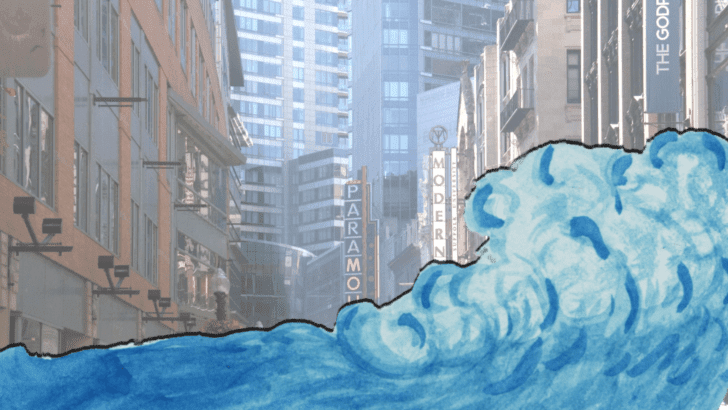
THERE WILL BE NO OUTSIDE WORLD TO HELP US

Boston Underwater


Boston’s global warming plans must prepare region for worst case scenarios


March 28, 2018

BY JASON PRAMAS @JASONPRAMAS


In a couple of recent columns—and several others over the years—I’ve looked at some of the specific threats that scientists expect Boston will be facing from global warming-induced climate change. While there’s plenty of room for debate about the anticipated severity and timetable of such threats, there is no longer any serious doubt that they are real.


Unfortunately, humans have trouble dealing with existential crises like an inexorably rising sea level and the relentless increase of the average air temperature.


We tend to try to plan for future situations based on what has happened in the past. What is, therefore, in the realm of our experience as individuals and as members of various groups. What we’re comfortable with and confident we can handle.


The many learned experts who have been working on the city of Boston’s various climate change initiatives are no less susceptible to this bias than anyone else.


Which is why the reports city government has been producing on making the city more “resilient”—to use the fashionable buzzword pushed by the Rockefeller Foundation and others of late—in the face of climate change all share a major flaw.


That is, despite understanding that global warming is by default—by its very nomenclature—a worldwide phenomenon, they treat the effects of the climate change it’s driving as essentially local.


Furthermore, they try to apply standard disaster preparedness and emergency management protocols as if global warming was simply a series of tractable crises of the type we’ve dealt with since time immemorial. Like the recent series of nor’easters (which were probably climate change-driven themselves).


So, sure, they reason. There will be power outages—some affecting critical infrastructure—so we’ll plan for that. There will be food shortages in some poor areas of the city that are already considered “food deserts” due to their lack of decent cheap supermarkets; so we’ll plan for that. There will be flooding; so we’ll plan for that.


Thus, the language that city officials (and an array of outside advisors and consultants) use in their climate change planning documents demonstrates that they’re either unable to see that previous human experience is insufficient to the task of grappling with global warming… or, more likely, that they’re unwilling to discuss the vast scale and centuries-long duration of the approaching crisis due to a combination of factors. Ranging from not wanting to be seen as alarmists to not wanting to anger top politicians and corporate leaders with big problems requiring expensive solutions.


For example, here’s an illustrative passage from the Climate Ready Boston Final Report, the big global warming preparedness white paper the city published in late 2016:


Members of the IAG [Infrastructure Advisory Group] have identified continued functionality of the city’s transportation infrastructure as a top resiliency priority. Many members have identified road and bridge functionality as a key critical requirement so citizens can evacuate; emergency vehicles can pass; maintenance trucks can reach impacted electric, communication, and water/wastewater assets for swift repair; and hospitals and other emergency facilities can continue to receive food, water, and medical supplies. In turn, the transportation system relies on continued access to electricity and communications systems, so tunnels may remain open, and any blocked paths are cleared quickly or detours swiftly communicated.


Note that it’s assumed that citizens will be able to evacuate the city if necessary. And that various kinds of critical vehicles will have fuel. And that parts will be on hand for infrastructure repair. And that food, water, and medical supplies will be available.


Climate Ready Boston’s series of reports and a raft of related studies certainly mention a variety of problems that the city will have to overcome to ensure that fuel, food, water, medical supplies, vital machine parts, etc. will be available as locals recover from each new storm, flood, or heat wave. Like making sure that Route 93 is no longer the main trade route for the city and that the portions of the highway that are susceptible to flooding be reengineered.


And they definitely allow for the fact that we’ll see more and more storms, floods, and heat waves.


But none of the growing array of reports and plans that city (and also state) government are producing consider this possibility: That at a certain point—especially if we continue along the climate change denial path that the Trump administration and the oil, gas, and coal industries are setting us on—Boston will be alone.


There will be no outside world to help us. Every city, every region, every nation on the planet will be engaged in a life-or-death struggle for survival as the effects of global warming get worse. And worse. And ever worse.


Because maybe humanity does not stop burning carbon in time. Because we do not replace our old dirty energy systems with new clean ones. Because we do not halt the despoiling of land, sea, and air. Because we do not reverse the “sixth extinction” of most species of plants and animals. Because we do not, in sum, stop the destruction of the human race itself and everything that matters to us in the world.


Hopefully, things won’t be so bad by 2100—which is the outer limit of the period seriously considered in city and state plans. Let alone in 20 or 30 years. But the minimal progress on climate change goals that have been made in the quarter century since the Kyoto Protocol was signed does not inspire confidence in human civilization’s ability to reduce greenhouse gas emissions enough to slow—let alone stop—the worst-case scenarios that keep any reasonably well-informed person up at night.  


So if the city and the state that surrounds it want to talk about “resilience,” they have to be able to answer these questions… and many more like them besides:


✦How will Boston (and Massachusetts) feed our already-growing population—when global supply chains are disrupted and ultimately destroyed, the oceans are dead, and much of America’s farmland has turned to dust bowls—given that we can’t even come close to feeding ourselves now? And what about all the climate migrants that will be heading north as parts of our continent become uninhabitable? How will we possibly feed them?


✦How will Boston (and Massachusetts) keep our growing population plus climate migrants clothed, housed, healthy, and gainfully employed in that situation?


✦How will Boston (and Massachusetts) produce enough clean (or dirty) energy to satisfy our growing power needs—including our vehicles—without outside help?


✦How will Boston (and Massachusetts) produce the manufactured goods that we need—including medical supplies and the materials we’ll need to rebuild during a never-ending series of global warming-induced disasters—when we’re on our own?


✦How will Boston (and Massachusetts) grow more food, support more population, and expand industry in the coming decades as we face the expected global warming driven fresh water shortages? Even as we grapple with more and more severe floods due to storms (fresh water), and storm surges (seawater).


✦How will Boston (and Massachusetts) move the city, our state capital, and its critical infrastructure to higher ground—while buying time to do so with the best possible flood defenses we can build?


✦How will Boston (and Massachusetts) help the entire population of the city to move to relative safety when global warming-induced climate change eventually makes our region uninhabitable, too?


Any planning process that fails to raise such questions is not worthy of the name. So both the city of Boston and Commonwealth of Massachusetts had better step up their joint game… fast. Same goes for climate action groups that work hard to keep grassroots pressure on responsible government officials (and generally irresponsible corporate leaders). Work harder, grow your ranks, pursue mitigation efforts that might forestall the worst outcomes, become an unstoppable force, make positive change at least a possibility. If not a certainty.


Because if we can’t stop (or significantly slow) global warming, and we can’t find practicable answers to the above questions soon, then Boston is far from “resilient.” Let alone “strong.” It is completely unprepared to deal with global warming-induced climate change.


And all the reports in the world won’t save our city and our state from the grim fate that awaits us.


Apparent Horizon is syndicated by the Boston Institute for Nonprofit Journalism. Jason Pramas is BINJ’s network director, and executive editor and associate publisher of DigBoston. Copyright 2018 Jason Pramas. Licensed for use by the Boston Institute for Nonprofit Journalism and media outlets in its network.

CARAMEL’S CARAMEL

Caramel at Caramel French Patisserie. Photo by Jason Pramas. Copyright 2018 Jason Pramas.


A taste of the new French bakery cafe’s gateway dessert


March 21, 2018

BY JASON PRAMAS @JASONPRAMAS


The Boston area has been in the midst of a bit of a bakery renaissance in recent years. The growth of small upscale cafe chains like Flour and Tatte is testament to Hub dwellers’ love of sweets, and we don’t seem to have hit the “peak pastry” threshold yet.


Which is lucky because if there wasn’t room for more artisanal confections, then French chef Dimitri Vallier and his business manager sister, Sophie, would never have launched Caramel French Patisserie in downtown Salem in 2015, and at a second location in Davis Square, Somerville, last year.


And that would be a shame… because their baked goods and pastries blow every similar place in our region completely out of the water.


I mean, seriously, I spent the better part of a month in Paris in 2010. And I ate at over a dozen different bakeries there—all highly rated by locals—and Caramel is better than most of those. I’m no expert. But I’ve eaten lots of stuff at pretty much every noted Boston bakery, and I’ve never been to a place where, like the best Parisian bakeries, literally everything is delicious.


Visitors will need several visits to eat a representative sample of the array of croissants, tarts, macarons, and assorted fancy pastries on hand, but I recommend starting with their signature dessert first time out: the eponymous Caramel. It’s one of those creations that sounds simple enough when you read the ingredients but has clearly taken real mastery to perfect.


Delicate caramel mousse enrobing perfectly poached pear slices. The sweetness of the mousse cut by the freshness of the chilled pear. Presented in an artful shape and served cold. It’s a must try.


CARAMEL FRENCH PATISSERIE. 235 ELM ST., DAVIS SQUARE, SOMERVILLE;  ALSO 281 ESSEX ST., SALEM. CHECK THEM OUT ON FACEBOOK AND INSTAGRAM. WEBSITE COMING SOON AT CARAMELPATISSERIE.COM.

EDITORIAL: STRATEGIC RETREAT

Image by freeGraphicToday. CC0.


DigBoston to move away from Facebook, help build democratic social media alternatives


March 21, 2018

BY JASON PRAMAS @JASONPRAMAS


A decade back it seemed only natural for news publications like DigBoston to stake out turf on Facebook. After all, it provided an easy way for us to reach our audience on a regular basis—via a social media platform that was well on its way to becoming the ubiquitous global behemoth it is today.


But now it seems like a particularly good moment to discuss this publication’s evolving thinking on our use of corporate social media. In the wake of the huge and growing Cambridge Analytica scandal that cost Facebook CEO Mark Zuckerberg $6 billion of his net worth after that story broke last week, according to Fortune.


Because Facebook is not working for us anymore—as individuals and as the staff of a metro news weekly.


What was once a fun way to keep in touch with friends and co-workers has turned into a huge drag. Every moment of our time on the social network is completely controlled by Zuckerberg’s minions. Who work to make it ever more addictive. To keep users like us on Facebook for more and more of our time—thus spending less and less of our time on any possible competitor’s network.


Yet the company also carefully limits users’ access to our own connections. And it continues to make repeated changes to its “algorithm” (the code that governs, among other things, what content users see) and other structural changes that are seriously damaging individuals’—and to our point, news outlets’—ability to reach our own audiences.


It is now no more possible for individuals to communicate with even a fraction of their connections on the platform than it is for DigBoston to reach more than a handful of our 24,000 followers. Even if we pay a bunch of money for the privilege, which page managers like us are forced to do. On our two branded pages that Facebook refuses to let us merge… because one page has a blue check mark and one page has a gray check mark, you see. And blue check mark pages may not be merged with gray check mark pages. Facebook “help desk” has spoken. And once Facebook makes a pronouncement, however cryptically and episodically, it cannot be challenged. By conventional means, at least.


Not that we’re surprised that Facebook has its own agenda. Like many reasonably technologically savvy journalists, we understand how the company works. Digital marketer Mitch Joel explained it succinctly in a helpful Maclean’s piece on the Cambridge Analytica affair: “Facebook’s business model is not based on content, marketing or advertising. You—the consumer—are the product and the money that Facebook generates is based on how well they can monetize your data and target you to their brand partners.”


The problem is that we understand all too well that Facebook does what’s best for Facebook—first, last, and always. And my DigBoston colleagues and I have had enough.


Like the staff of tens of thousands of other news organizations around the planet, we know that we have been complicit in Facebook’s rise to power.


We have posted all our content to Facebook. Which has provided free high-quality information that helped attract our existing audience and many others besides to Facebook’s “walled garden” social network. The vast conglomerate then monetized that audience as described above. Used the vast array of personal data at their command to steal the entire news industry’s digital advertising base away—including ours. And has the temerity to charge us to reach the audience we helped bring to them.


Adding insult to injury, according to the Guardian, companies like Cambridge Analytica have found ways to acquire and weaponize that personal data at the behest of operatives like Steve Bannon. Who then use it to help throw elections like the 2016 presidential contest to the political faction of their choice. To name but one of a myriad number of ways that rich and powerful interests—including Facebook itself—are using this “surveillance capitalism,” as it has come to be called, to attempt to control the behavior of entire populations for their own gain.


Given that state of affairs, DigBoston has no choice but to start to move away from Facebook. As our editor-in-chief Chris Faraone so colorfully put it in a related context a couple of months back, “… fuck Facebook. With a big, blue middle finger.”


But move away to what? All the major social networks are owned by big companies doing basically the same thing Facebook is doing. Though none have its reach and market share. Some, like Instagram, are even owned by Facebook.


In the short term, we’re starting to focus more on Twitter—a social media giant that’s slightly less mercenary and slightly more responsive to public pressure. The Lyft to Facebook’s Uber, if you will.


In the longer term, we see no ideal alternative on the horizon.


So we’ve resolved to help create that alternative.


Think this through with us: DigBoston, like legions of other news outlets, has to find a social media solution that meets our need to control and monetize our own data in a platform that our audience is willing to use on a regular basis. Our audience needs a social network that won’t exploit them.


There have been numerous attempts to start standalone “less evil” social media platforms in opposition to Facebook et al—Diaspora, Ello, and Minds to name but three. None of them have succeeded. Why? Because no one knows exactly what causes people to abandon existing social networks for new ones. Sometimes people just bail. Friendster, Orkut, and MySpace were once hot, and now are not. So every prediction of Facebook’s demise at the hands of a new entrant over the last many years has proved to be premature. And every claim to have the magic solution that will cause millions of users to jump ship from Facebook and other major social media has proved to be a pipe dream.


It is true that Facebook’s audience growth is slowing. Usage in the key US and Canadian markets is dropping, according to the LA Times. And the current scandal has already caused the company to lose more than 6 percent of its value on Monday—over $35 billion—according to Fortune. Yet it could easily bounce back. It remains an immensely powerful multinational. And if it convinces its shareholders to stay the course, it can weather almost any conceivable political storm.


What will it take to essentially pull the rug out from under Facebook and companies like it? Returning to the promise of the early internet to democratize global communication, and giving more control over the means of that communication to individuals and the full array of human institutions alike.


There are interesting experiments going on in new grassroots social networks that DigBoston is keeping an eye on. Decentralized federated microblogging systems (think an agglomeration of Twitter-like networks that talk to each other) like Mastodon. Fully decentralized social media projects like IndieWeb—a network of “creators” who have developed tools that allow the owners of independent personal websites to interact with each other. Like a Facebook without the Facebook. Without a central control hub of any kind, really.


Projects like these are great ideas. But they rely on volunteers, and sometimes a handful of low-paid staff, to function. Meaning they can achieve an initial burst of success, only to suffer a long decline to irrelevance as their evangelists move on to other ventures. Plus you typically need to be someone in or around the tech scene and affiliated subcultures to know about their existence. And they tend to require a fair amount of technical expertise to use.


Which is to say that these carefully thought out super democratic social media experiments are not likely to provide the alternative DigBoston and like-minded folks the world over are seeking to build. Not anytime soon. Mastodon had just over a million users last month, according to Mastodon User Count—largely due its community deploying functioning phone apps like the nifty Amaroq for iOS. But that’s obviously a drop in the bucket compared to the 1.4 billion active daily users that Facebook reported in Q4 of 2017. Even allowing for the fact that a nonzero percentage of those accounts are fake, according to Yahoo Finance. And not including many more inactive accounts.


Still, we can but soldier on. For our part, we’re calling a meeting of journalists and techies later this year. Specifically, editors and publishers of Boston area news outlets and high-level coders associated with thoughtful social media projects like Mastodon and IndieWeb. We’re going to compare notes and see if we can start working together to provide better communications solutions for our news organizations and our audiences that will go at least some small fraction of the way to providing a democratic alternative to Facebook and other corporate networks.


We’ll definitely let you all know how that meeting goes. But those of you who think you need to be there, drop me a line at execeditor@digboston.com and tell me why.


Jason Pramas is executive editor and associate publisher of DigBoston. His sad and lonely Mastodon account is @jasonpramas@mastodon.social. Sign up for a free account at mastodon.social and say hi.