Skip to content

Apparent Horizon

UMASS CAMBRIDGE: MAKING HARVARD UNIVERSITY PUBLIC WILL SOLVE ITS WORKERS’ PROBLEMS—AND THE COMMONWEALTH’S HIGHER ED CRISIS

umass-cambridge

October 24, 2016

BY JASON PRAMAS @JASONPRAMAS

Three weeks into their strike, Harvard University dining hall workers are in a difficult position. Their union’s demands for better wages, benefits, and working conditions are falling on deaf ears in the Harvard administration. They cannot continue picketing indefinitely on $200 weekly strike pay—which itself won’t last for long … and the bosses know it.

That same administration talks about the situation as if the workers are already overpaid since they make wages higher than the industry standard. Even though college food service workers generally get low pay with few benefits by convention. It tries to make the Harvard dining hall workers union, UNITE HERE Local 26, look greedy by asking for more, when all the workers want is a living wage to be able to survive the increasingly insane costs of living in Greater Boston. And a health care package that doesn’t raise their out-of-pocket costs. Which other Harvard unions have already agreed to, sadly.

This despite the fact that Harvard has an unbelievably massive $35 billion endowment. The largest amount held by any institution of higher learning in the world. Larger than the annual budgets of many nations. The school’s endowment page makes it clear that its administration knows that making any pitch for sympathy on labor costs is ludicrous on its face (although that’s precisely what they do when they attack the dining hall workers’ extremely moderate demands as somehow unaffordable). In a section of that page entitled “Why can’t Harvard use more of its endowment in order to cover additional expenses or reduce tuition costs?” the following logic is offered:

Endowment gifts are intended by their donors to benefit both current and future generations of students and scholars. As a result, Harvard is obligated to preserve the purchasing power of these gifts by spending only a small fraction of their value each year. Spending significantly more than that over time, for whatever reason, would privilege the present over the future in a manner inconsistent with an endowment’s fundamental purpose of maintaining intergenerational equity.

A statement worthy of a CEO or banker. Or neoliberal ideologue. Basically saying, We can’t spend more money from the endowment because we don’t want to touch our principal and lower our profits. Funny attitude for a supposed nonprofit. One that’s unfortunately being emulated at colleges around the country as the privatization of higher education continues apace.

Since Harvard is unwilling to spend down its endowment by even a tiny percentage to ensure all its employees receive truly fair wages and benefits, it’s all the more imperative that dining hall workers continue to press their demands. And that more people support them.

Because not only is Harvard screwing its own food service staff while amassing wealth beyond the dreams of avarice, it is also doing grievous damage to the Massachusetts public higher education system. Which raises the stakes considerably. And links the problems of one group of working people to the fortunes of the working families of an entire state. For whom shaking the edifice of Harvard’s endowment must become a central political concern.
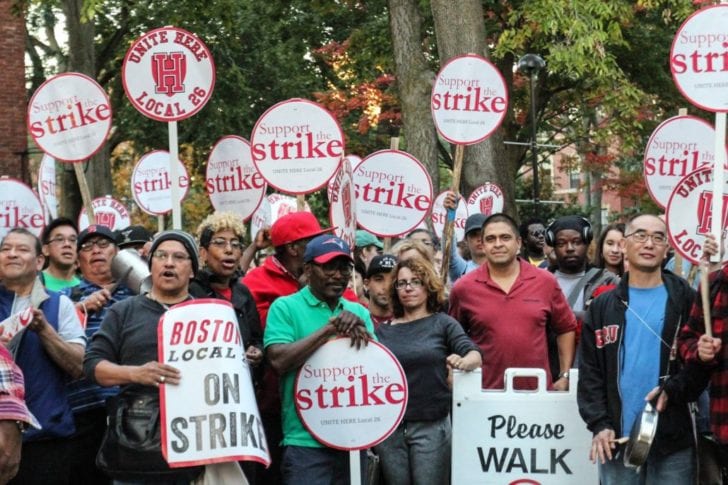
Image via Boston's Local 26

Image via Boston’s Local 26

Understanding Harvard’s finances is the key to apprehending why the university’s very existence is problematic in a democracy—and a clear and present danger to the state public higher education system. And to answering the central question: Why is an institution of higher learning allowed to run like a multinational corporation? Socking away funds that it possesses mainly because it educates the children of the one percent—scions of powerful families who steal money from the rest of us in myriad ways and then donate part of that money back to the supposedly nonprofit school in exchange for income tax breaks. A school not required to pay taxes on its vast income by dint of that nonprofit status. Which then also takes huge amounts of public funds despite being a private school.

It’s also worth asking why Harvard is not a public college. Why is it not UMass Cambridge? Harvard was, after all, originally part of Massachusetts state (and colonial) government. Yet over the centuries it was able to reorganize itself as a private nonprofit school, and essentially write the rules it plays by.

But for a “private” school it’s certainly awash in public money. A brief review of how Harvard enthusiastically drains government coffers that it refuses to replenish should make it painfully obvious that it is indeed a public university. And therefore in dire need of democratic reform to better align its mission with the needs of the Mass public higher ed system.

First, all the funds in the Harvard endowment, and all the money it makes from financial investments, is not taxed. Neither is all the property Harvard owns—on which it famously expends small “Payments in Lieu of Taxes” (PiLoTs) instead of much higher property taxes. According to Slate, a report by Nexus Research and Policy Center—a right-wing pro-corporate think tank that I would normally avoid citing—does some sloppy math that nevertheless helps us think more clearly about the magnitude of the problem with giving private schools nonprofit status. The report says that, in 2014, Harvard made the equivalent of $48,000 in tax savings from federal, state, and local governments for each of its students. Many of whom can definitely afford to pay full freight on their education. While predominantly working and middle class Massachusetts public college students are educated in woefully underfunded state institutions. The Nexus report indicates that UMass Amherst—the Commonwealth’s flagship university— made only the equivalent of $9,900 in tax savings for each of its students. While undergraduate tuition and fees amounted to $13,258, and average room and board costs were $10,957, for a total cost of $24,485 that year. Even before thousands in book costs and other fees are considered.

Second, although it may not be obvious to outsiders, many Harvard students use public grants and loans to get through school. According to its website, the annual disbursement from the Harvard endowment covered 35 percent of the university’s $4.5 billion operating budget in 2015—including much of the cost of tuition and fees for undergraduate students who need it. And the Harvard administration makes clear that “Even with endowment support, Harvard must fund nearly two-thirds of its operating expenses … from other sources, such as federal and non-federal research grants, student tuition and fees, and gifts from alumni, parents, and friends.” But a good chunk of the aforementioned tuition and fees is covered with public money.

It’s true that Harvard pays all expenses for the 20 percent of current undergrads who come from families that make less than $65,000 a year. One cheer for that given the provenance of Harvard’s money. However, undergrads whose families make between $65,000 and $150,000 a year are expected to contribute up to 10 percent of the total cost of their education annually. And undergrads whose families make more than $150,000 a year pay concomitantly higher percentages of their education costs. Students whose families can’t cover those costs, and don’t receive enough scholarships, grants, or stipends from private sources can apply for federal and state financial aid like any other college student(though foreign undergrads generally don’t qualify for such aid).

Graduate students lean more heavily on public support. Harvard financial aid is similar to other universities in its expectation that its grad students—especially the cash cow master’s degree students—will apply for federal and state financial aid for any expenses they can’t pay out of pocket. Its PhD students get a supposedly free ride, as elsewhere, but the stipends the school pays for their labor as teaching and research assistants clearly aren’t much better than anywhere else given that they are now trying to emulate their peers at public universities by organizing a labor union. Certainly not enough to live on for many students. So public grants and loans are used to fill gaps in funding.

Harvard made its estimated federal grant and loan totals available online for the 2011-2012 academic year. Its students received $10,257,035 in federal grants, $8,371,891 in Perkins Loans, and $135,249,758 in federal direct loans. A tidy sum to be sure.

Third, and perhaps most damningly, Harvard gets a ton of direct federal appropriations every year. To cite just one significant example, in 2014, Harvard had about 20,000 students and received $572,918,000 in federal research and development money according to the National Science Foundation. About $28,646 per student, although it’s obviously not distributed that way. Critics may respond “no harm, no foul” since Harvard gets lots of public R&D money because they do lots of R&D. But that gets things backwards. Harvard does lots of R&D because it has long gotten lots of public R&D money—which should be used to fund public universities to do the work instead. With more public oversight in the public interest.

That same year, the UMass system had almost 74,000 students and received $362,157,000 in research and development money from the federal government. However, the Massachusetts public higher education system also includes nine state universities and 15 community colleges. Both additional groups of colleges receiving only negligible federal research and development funds as teaching colleges rather than research colleges. So the government money UMass gets for R&D covers all of the 194,371 students in the combined public higher education system in the Bay State in the period in question. Amounting to a mere $1,863 per student. Or about $4,894 per student looking at just the UMass system.

Harvard also gets other money from various branches of American government at every level—overtly or covertly, directly or indirectly. But for anyone who believes in public higher education as a vital democratic institution, every penny of government funding that goes to an elite institution like Harvard is money that should be going to the cash-starved public university system. And Harvard is only one of over a dozen supposedly “private” universities with major endowments in Massachusetts who take public money. Others include: Amherst College, Boston College, Boston University, Massachusetts Institute of Technology, Northeastern University, Smith College, Tufts University, Wellesley College, and Williams College. Plus dozens of smaller privates and erstwhile “for-profits” that suck up even more public funds. [Ironically, as part of a decades-long trend of public universities emulating the privates, UMass itself has an endowment of over $700 million. Much of which should be released to reverse faculty and staff cuts at schools like UMass Boston, and the remainder could be kept in a reasonable “rainy day” fund.]

Such hoarding must be stopped. More to the point, the private university system has to be dismantled if the dream of free higher education for all is to be guaranteed. An attainable dream other countries with far less wealth than ours have been able to manage for decades. One which could be achieved by simply taxing the rich and corporations fairly on the state and federal level to pay for such social goods. An even taller order than the policies under discussion here.

For now, if you really want to help the Harvard dining hall workers and much of the population of Massachusetts in the bargain, help start political movements to demand structural reform of the state university system—and ultimately the national higher ed system in its entirety.

As an interim measure, such movements can push our state government to seize the endowments of so-called private colleges like Harvard and absorb all of their campuses into the public higher education system. Which will end the Commonwealth’s higher ed crisis by flooding the system with once-hoarded money. Guaranteeing a decent college education to more Mass residents while eliminating bastions of privilege and power in our midst. And naturally, a well-funded public higher ed system would have the means to pay its workforce properly and a tradition of “wall-to-wall” unionization that would leave no campus workers unprotected. Solving the problems of the Harvard dining hall strikers, and all other previously low-paid workers at every campus in the Commonwealth.

The parting shot? In 2015, the entire Massachusetts budget for public higher education was $1,462,827,301. Well below the $1.6 billion disbursement from the Harvard endowment for operating expenses that same year.

Meanwhile, the 2017 Mass higher ed budget is only $1,157,298,156. With worse cuts on the horizon.

UMass Cambridge anyone?

TUES., OCT. 25, 2016 UPDATE: Early this morning, the Harvard Crimson reported that a tentative agreement has been reached by the striking dining hall workers and the Harvard administration. The full membership of the UNITE HERE Local 26 dining hall workers unit is slated to vote on the agreement tomorrow (Wed., Oct. 26, 2016), and could be back to work as early as Thursday, Oct. 27, 2016.

Apparent Horizon is syndicated by the Boston Institute for Nonprofit Journalism. Jason Pramas is BINJ’s network director.

Copyright 2016 Jason Pramas. Licensed for use by the Boston Institute for Nonprofit Journalism and media outlets in its network.

Check out the Apparent Horizon Podcast on:

iTunes, Google Play Music, Stitcher, TuneIn, and YouTube
FIGHT WHERE YOU STAND: ORGANIZING FOR DEMOCRACY ON THE JOB CAN SPARK A MOVEMENT FOR DEMOCRACY NATIONWIDE

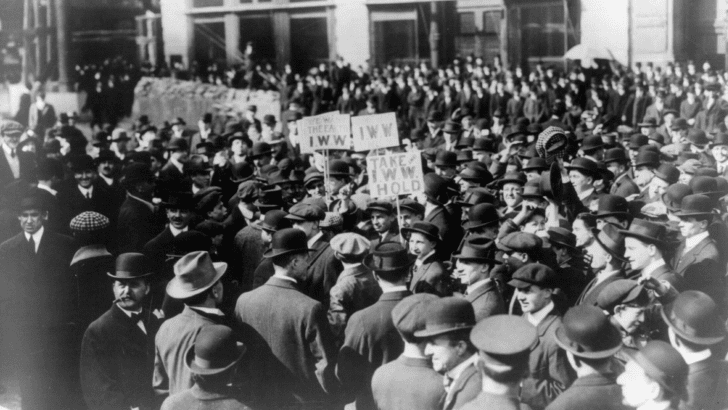
IWW Demonstration. New York (1914)

IWW Demonstration. New York (1914)

October 13, 2016

BY JASON PRAMAS @JASONPRAMAS

In a month featuring a couple of significant labor actions in the Boston area—the Harvard University dining hall workers strike for better pay and benefits, and the Boston Carmen’s Union’s recent civil disobedience action against privatization at the MBTA—it’s worth reflecting on the difference between unionized workers and other workers in the US. Which can be summarized as follows: Union workers fight.

One can criticize them for not fighting hard or effectively enough, and I certainly do from time to time, but when push comes to shove union workers will push back. Collectively. Putting them in a stronger position than the rest of working people in this era. Nearly 90 percent of whom have no representation on the job. Tens of millions of workers who are unprotected “employees at will” that can basically be fired at any time for any reason other than open discrimination. And chances are, you’re one of them.

Yet the reaction by many ununionized workers to their unionized fellows can be puzzling. Egged on by conservative ideologues, the common refrain on social media and in bar rooms from coast to coast is that union workers are “greedy” for wanting more than their bosses give them. Even as billionaires control ever more vast sums year by year. And deploy that wealth to influence politics to make themselves richer by the day.

This leaves union critics caught in a rather obvious contradiction. On the one hand, under capitalism we’re all supposed to applaud people who get rich for constantly demanding more, more, and still more. For themselves alone.

But when union workers demand more as a group, that’s somehow bad. Resulting in the spectacle of anti-union working people arguing that fellow working people in unions need to start acceding to less. Advancing the ludicrous claim that there’s not enough money and stuff to go around in our tremendously wealthy society for anyone but the rich.

Conservative critics—some working people among them—actually think it’s better for such union workers to disband their unions and be satisfied with whatever their bosses feel like giving them. Or, as they typically put it, to accept what “the market” will bear. To join ununionized workers in the war of all against all. Racing each other to the bottom of the economic pyramid, until a new feudalism grips humanity. Where “the multitude,” as Antonio Negri and Michael Hardt put it, are dominated completely by “the one percent” named so accurately by the Occupy movement.

To prevent such a dystopia from ever coming to pass, it’s time for ununionized, and therefore unorganized, workers to draw a proverbial line in the sand at every workplace in America—including right here in Boston.

In place of the culture of fear that reigns at most every job—the fear of being fired for promulgating even the slightest appeal for justice—there must be a culture of democratic resistance. Workers must start organizing together wherever they are to demand more. More money, better benefits, better working conditions. And critically, more control over their workplaces.

This organizing can involve joining traditional unions where possible, but that is not a necessary precondition to starting to fight back. It can begin as simply as holding meetings after work, discussing problems with the way things are going day-to-day, looking into how workers in similar situations have dealt with their problems on the job, and deciding how to fight for redress.

Some will say that such conflict is old-fashioned and counterproductive, and that it’s far better to work together with owners and bosses to come to some kind of accord on the job. From a position of permanent weakness. Leaving power in the hands of the monied elites. In your workplace and in the larger political realm. I would counter by quoting the preamble to the constitution of the storied democratic union of the turn of the 20th Century, the Industrial Workers of the World (IWW), “The working class and the employing class have nothing in common. There can be no peace so long as hunger and want are found among millions of the working people and the few, who make up the employing class, have all the good things of life.”

As the horrendous presidential race approaches its climax, it’s important to keep this in mind. If you’re wondering why both major party candidates are terrible, and why neither of them are standing up for the interests of working people—for your interests—the old language of radical democracy, plainly expressed by the IWW preamble, provides the beginnings of an answer. The rest of that answer—at your job and in world that surrounds it—is up to you. And all of us in the multitude.

HORIZON LOGO TRIMMED

Apparent Horizon is syndicated by the Boston Institute for Nonprofit Journalism. Jason Pramas is BINJ’s network director.

Copyright 2016 Jason Pramas. Licensed for use by the Boston Institute for Nonprofit Journalism and media outlets in its network.

Check out the Apparent Horizon Podcast on:

iTunes

Google Play Music

Stitcher

YouTube

PLAY TO WIN: UK LABOUR PARTY LEADER SHOWS THE AMERICAN LEFT HOW TO MOVE BEYOND SYMBOLIC POLITICS

jeremy-corbyn-labour-can-win-a-snap-general-election-video-interview-politics-the-guardian

September 29, 2016

BY JASON PRAMAS @JASONPRAMAS

Last week—as is the case many weeks every fall and spring in Boston—notices of small scripted protests by an array of area progressive nonprofits, unions, and student groups got me thinking about the rut the anti-corporate American left has been stuck in for decades. Most especially about the damage done by the habit of ineffectual symbolic political action on a host of important issues. Combined with tailing after a corporate-dominated Democratic Party establishment. Which, time and time again, ignores or actively betrays its base on key issues like jobs, education, healthcare, global warming, and military spending. As it’s done during the current presidential race.

But what if there was a way to change the whole political game for the oppositional left? After all, we almost saw such a tectonic shift happen this year with the Bernie Sanders campaign. There have also been glimpses of a more vibrant, creative, and successful progressive politics from the Occupy and Black Lives Matter movements over the last five years. What if left activists could get back to a mass politics that can really win solid victories for working families?

The way forward, it seems, is not yet to be found on our shores. However, it might be on view in the United Kingdom … where Jeremy Corbyn just won yet another vote to remain the leader of the Labour Party.

Who is Jeremy Corbyn?  Think of him as the Bernie Sanders of the UK. But one who has gotten a good deal farther politically than the original Sanders has to date. In his context, being the leader of the Labour Party is kind of like being the head of the Democratic National Committee. Except that the levers of actual power are more built into the Labour Party structure than the Democratic Party structure. And the party sits within a parliamentary political system where its leaders have a lot more control over what their elected officials do than their American counterparts. At the same time, Labour members get to vote directly for their party leaders—unlike Democrats. So when a socialist like Corbyn wins leadership elections twice in under a year and a half, it means that he has the power to help spark changes in his party of the type that Sanders can only dream of presently.

Since Corbyn first ran for Labour Party leader last year—on a platform well to the left of Sanders that calls for an end to austerity policies that hurt working people, renationalizing the once-public UK rail system, unilateral nuclear disarmament, and refusal to support Clinton-style “bomb diplomacy” (sorry, “humanitarian intervention”) in the Syrian war—he has increased the number of voting party members and supporters from 200,000 to over 600,000. Even while fighting a running battle with the corporate-backed acolytes of the neoliberal warmonger Tony Blair for full control of the party. Many of those new members are disenfranchised young voters of the same type that supported Sanders.

What Corbyn is doing with those young folks is fascinating. Upon winning his second leadership election by 61 percent last week, he didn’t talk about beating the ruling Conservative Party in the next general election. Instead he’s planning to deploy the growing militant grassroots of his party to win political victories in advance of the next election. Which looks like a completely different strategy than the one Sanders is taking post-primary—so far focusing his new Our Revolution organization on electing more progressive Democrats to office. Even as that party remains in full control of its Clintonite corporate wing. [Although in recent days, Our Revolution is starting to sound more like Corbyn’s similar Momentum organization—which is all to the good, and perhaps unsurprising given that the two insurgencies have long been in touch.]

And what issue is Corbyn focusing on? Public education. Namely stopping the Conservatives from increasing the fairly small number of UK public exam high schools known as “grammar schools.” He is calling for the large socialist camp coalescing around Labour to defend the egalitarian tradition of quality public education for all in Britain. Rather than allow the grammar schools to continue cherry-picking middle and upper class students, and helping them get into elite universities over the heads of working class students. Thus attempting to perpetuate the ancient British system of class privilege in education long after it was formally constrained. The Labour left is also likely to push to end the charter school-like “academy” (or “free school”) system that is allowing corporations to run many public secondary schools in Britain. Lining their pockets, threatening unionized teachers, and further limiting opportunity for working class students in the process. The Conservatives, for their part, plan to expand the academy system to 100 percent of secondary schools and many primary schools besides. If allowed to proceed unchallenged.

Street protests are absolutely part of what the reviving Labour Party and its allies are doing to challenge the corporate wing of their own party and the Conservative Party. Plus, Corbyn supporters have the possibility of leading their party to victory in a future general election, and starting to implement significant democratic socialist reforms thereafter. Echoing their predecessors in Labour leadership at the conclusion of World War II. Reforms like massive public jobs programs, building lots of good public housing, expanding government-funded lifelong educational opportunities for all, deprivatizing the still-impressive UK national health system, rolling back the assault on unions—while cutting the military budget and raising taxes on the rich and the corporations to pay for it all.

So their protest campaigns against conservative policy initiatives are not limited to small numbers of people waving signs and chanting slogans at the wealthy and their minions in business and government like latter-day Don Quixotes. Corbyn and his supporters are taking control of the Labour Party away from its discredited neoliberal leadership and using it to build a democratic socialist movement in the UK. That very project has been attempted in the Democratic Party before by movements like the Rainbow Coalition – and has been crushed every time. Based on that kind of experience, some American leftists feel that the structure of the party precludes such maneuvers from succeeding. A position potentially strengthened by Sanders’ dispiriting loss in the primary—after what was arguably the strongest attempt to take over the Democrats from the left in history.

Positioning the left—the actual left—for political victory in the US will therefore be extremely difficult. No two ways about it. And it’s not clear whether trying to commandeer the Democrats like Corbyn’s movement is doing with the UK Labour Party or building up small left-wing formations like the Green Party into a national powerhouse or some combination of the two strategies will lead to the desired outcome.

But one thing’s for sure. Corbyn’s success is built on grassroots activism. If we’re going to see similar successes for the American left at the national level, progressive nonprofits, unions, and student groups in cities like Boston will have to do better than calling sporadic underattended rallies, marches, and teach-ins—coupled with desultory lobby days where their peonage to the Democratic establishment is generally on display to their detriment. And start winning real political battles instead of scoring points on phantom targets.

Apparent Horizon is syndicated by the Boston Institute for Nonprofit Journalism. Jason Pramas is BINJ’s network director.

Copyright 2016 Jason Pramas. Licensed for use by the Boston Institute for Nonprofit Journalism and media outlets in its network.

Check out the Apparent Horizon Podcast on:

iTunes

Google Play Music

Stitcher

YouTube

AUTONOMOUS PROFITEERING: CORPORATE NETWORKS ENLIST BOSTON TO HELP THEM SELL SELF-DRIVING CARS … AND ELIMINATE JOBS

self-car-top

September 18, 2016

BY JASON PRAMAS @JASONPRAMAS

When seemingly random things happen in city government, they’re always worth a second look. Which was certainly the case last week when Mayor Marty Walsh announced a new partnership between the City of Boston, the World Economic Forum, and the Boston Consulting Group to test self-driving cars—aka autonomous vehicles—on city streets.

The stated goal is “a year-long engagement focused on creating policy recommendations and supporting on-street testing of autonomous vehicles … to advance the safety, access and sustainability goals identified by the public during the Go Boston 2030 transportation planning process.”

The rationale—“building on prior World Economic Forum research into Personal Mobility and Self-Driving Vehicles, conducted in partnership with The Boston Consulting Group, and the Future of Cities”—is framed primarily in terms of ending urban traffic congestion, reducing carbon emissions linked to global warming, and reducing poverty.

Sounds like a worthy endeavor, right? Perhaps in a better world. But not the way this technology is being rolled out. Or, more precisely, the way it’s being shoved down the public’s throat. Despite being one of the least-mentioned transit options by residents participating in the aforementioned Go Boston 2030 process—appearing with similar frequency to waggish questions like, “When can I fly around the city like the Jetsons?”—it’s suddenly a policy priority.

Put bluntly, this plan has all the makings of yet another corporate boondoggle. This time on an international scale with profound implications at the local level. Think Boston 2024 on steroids. A passing glance at the players tells the tale.

The World Economic Forum is an extremely powerful network of the global capitalist elite. They work hand-in-glove with the leaders of every major industry to ensure that the rich and powerful get ever more rich and powerful—and democracy be damned. The Boston Consulting Group is a multinational “management consulting firm” that is one of the architects of the “race to the bottom.” Where companies are encouraged to move jobs to countries with the cheapest labor costs and worst human rights standards in the quest for ever larger profits. Its recent accomplishments include flacking for charter schools and the privatization of public education worldwide. Then there’s the junior partner, the City of Boston, that takes virtually all of its major policy cues from corporate think tanks and foundations. A pattern established by a series of mayors since the 1950s. Most notably, the late Tom Menino.

Such corporate networks and organizations have the money and connections to turn their priorities into the priorities of hapless government officials like Mayor Walsh—who always seems to be chasing after bragging rights for Boston being a “global city,” or a “city of innovators” or whatever—even when the resulting policy prescriptions directly attack his core grassroots constituencies. As we’ve seen with the GE Boston Deal debacle.

For example, Walsh is known as a labor mayor. Someone who was put into power by local unions. Yet when considering this particular policy issue—self-driving cars—in that light, a number of serious potential problems for Boston area workers immediately present themselves.

To focus on the most obvious one, switching over from our existing fleet of cars and trucks to self-driving cars and trucks—in the service of expected mega profits to the auto, energy, and technology industries—will likely result in massive job loss to a huge number of professional drivers. Many of whom are taxi drivers and limo drivers whose jobs are already under threat of destruction by mostly unregulated “online transportation network companies” like Uber and Lyft. And many people who hold those professional driving jobs—like truck drivers or MBTA bus and train drivers—are members of labor unions like the Teamsters and the Boston Carmen’s Union that are already threatened by technologies being developed for private interests. Not for the public good.

What are the plans to help workers displaced by self-driving cars? Apparently the usual corporate non-plans. A September 2015 report by the Boston Consulting Group put it this way: “Rather than wage a doomed battle against progress, affected incumbents might be better advised to use the current ‘calm before the storm’ to adapt their business models to this new technology and position their businesses to profit from a new era of mobility. That is the key message that [vehicle manufacturers], dealers, and suppliers must convey while they work with governments on good-faith efforts to mitigate the impacts on those most negatively affected.”

The report’s most specific suggestion is that governments should provide: “job-retraining and placement services and compensation for income losses from unemployment.”

Anyone who has ever seen what actually happens in instances of mass layoff knows exactly what will follow in practice. In the best possible scenario, some affected workers—not all—will qualify for extended unemployment, and receive some training for job markets that don’t have enough openings to make up for the jobs being destroyed. After unemployment runs out—and even extended unemployment typically runs out in one-to-two years depending on the program—the displaced workers who have not managed to find new jobs are screwed.

And as shown above, the industries and “consultants” doing the damage to the affected workers will not have to pay a cent for any of the havoc they wreak. The burden of such “externalities” as the immiseration and dislocation of thousands of professional drivers in Boston alone is to be borne by already overwhelmed and underfunded public programs—where they have not already been eliminated by the ongoing corporate onslaught against the public sector led by those same industries and consultants.

On those grounds, the city should pull out of this incipient arrangement and pursue only those future transit options purpose-built to help working people rather than harm them. Self-driving vehicles could be of great benefit to humanity depending on how they’re produced and deployed. But shadowy corporate networks like the World Economic Forum and the Boston Consulting Group—given their long history of looting public goods for private profit—are absolutely the wrong institutions for municipal governments to be partnering with on such a critical project as the introduction of a major new technology.

HORIZON LOGO TRIMMED

Apparent Horizon is syndicated by the Boston Institute for Nonprofit Journalism. Jason Pramas is BINJ’s network director.

Copyright 2016 Jason Pramas. Licensed for use by the Boston Institute for Nonprofit Journalism and media outlets in its network.

Check out the Apparent Horizon Podcast on:

iTunes

Google Play Music

Stitcher

YouTube

STREET FIGHT: STUDENTS DISSATISFIED WITH POLITICS AS USUAL WILL FIND PLENTY OF GRASSROOTS ACTION IN BOSTON

18.36 AH TOP (1)

September 6, 2016

BY JASON PRAMAS @JASONPRAMAS

Are you a student? New to Boston? Want to fight for social justice, but not sure where to plug in? Well, this will hardly be a comprehensive list, but here are some local activist organizations and campaigns that are worthy of your consideration. I’m only including groups that I’ve written about (and that I agree with in broad strokes) for the sake of brevity. But, rest assured, there are activist organizations for people of every political disposition hereabouts.

A few tips are in order for people new to grassroots political activism. Seek organizations that are open and welcoming, have a democratic internal process, play well with other groups, and treat students as equals regardless of age or experience. Avoid organizations that look at students as free labor, seem focused on hitting people up for money, don’t work with other groups, and have a very undemocratic internal process run by a small ruling clique. Also avoid outright cults masquerading as political activist groups. They exist. You’ll know you’ve run into one when you meet people whose entire lives seem to be directly controlled by their organization and who will not stop trying to recruit you even after you say “no.” In general, listen to your gut instinct when checking out an activist organization, and you’ll be fine.

Here’s the list.

Black Lives Matter

One of the most important and vibrant American political movements today. Leading the biggest fight against entrenched structural racism in decades. In the wake of an ongoing series of police shootings of Black people around the country. Different local nodes of the activist network have varying membership requirements. But if you can’t be a core member, BLM periodically calls for allies to join them in the streets. That will be your cue to step up. Just remember to check your privilege. Chapters in Boston and Cambridge.

http://www.facebook.com/BlackLivesMatterBOS/

http://www.blmcambridge.org/

350 Mass for a Better Future

If you’re down to stop global warming, this group has got you covered. It’s organized on the state, national, and international levels and doesn’t shy away from civil disobedience or legislative action. Its current big campaign is the Clean Money for Climate Pledge, asking “candidates running for state, federal and municipal office in Massachusetts [to] commit not to accept campaign contributions from executives, in-house lobbyists and others employed by the top ten climate-disrupting corporations.” Including BP, Chevron, ExxonMobil, and Shell.

http://www.betterfutureaction.org/

Save Our Public Schools

Do you believe education is a right—not a privilege—in a democracy? Do you think that charter schools are a total scam designed to siphon public money into a variety of private pockets, and destroy public schools in the process? Well there’s an active fight against Question 2, an upcoming state ballot measure backed by very well-funded supporters determined to expand the number of charter schools in the Commonwealth. It’s called Save Our Public Schools (a.k.a. the “No on 2” campaign) and it’s spearheaded, as ever, by teachers unions—in this case, the Mass Teachers Association.

http://saveourpublicschoolsma.com/

Make GE Pay

Since the City of Boston and Commonwealth of Massachusetts announced their plans to dump at least $270 million on General Electric—one of the largest and nastiest multinational corporations in the world—in exchange for moving its world headquarters to the Hub, there’s been been a good deal of discontent brewing in communities around the state. Largely in opposition to local and state government handing huge wads of public cash to a tremendously wealthy company with plenty of skeletons in local closets—in a period of savage budget cuts to critical social programs. The Make GE Pay coalition formed last spring to try to stop the deal, and is looking to get in gear this fall after some early public actions.

http://www.facebook.com/makegepay/

encuentro 5

Can’t decide which campaign excites you the most? Why choose? This movement building space right off the Park Street T stop has a mission to get social justice activists “better networked, better resourced, and better organized.” Home to several important nonprofits, and a regular meeting place for dozens of activist groups, if you can’t find a campaign that interests you here then you may wish to reconsider your aspiration to be politically active.

http://www.encuentro5.org/

That’s enough to get you started. Have fun. Fight the power. And be careful out there.

Full Disclosure: 350 Mass is a member of my organization’s Community Advisory Board, and encuentro 5 was launched by colleagues at my former nonprofit, Mass Global Action.

HORIZON LOGO TRIMMED

Apparent Horizon is syndicated by the Boston Institute for Nonprofit Journalism. Jason Pramas is BINJ’s network director. Copyright 2016 Jason Pramas. Licensed for use by the Boston Institute for Nonprofit Journalism and media outlets in its network.

Check out the Apparent Horizon Podcast on:

iTunes

Google Play Music

Stitcher

YouTube

DISSENTING OPINION: SMITH COLLEGE SCHOOL FOR SOCIAL WORK STUDENT PROTESTERS RESPOND TO CRITICAL BOSTON GLOBE EDITORIAL

Copy of NEW WEB HEAD TEMPLATE

August, 29, 2016

BY SMITH COLLEGE SOCIAL WORK STUDENTS

Introductory Note by Jason Pramas, Boston Institute for Nonprofit Journalism: For the growing number of American students who come from “non-traditional” (read “Black, Latina/o, Asian, Native American, immigrant, and/or poor”) backgrounds, getting into a university — let alone graduating— remains extremely difficult. All too many colleges — especially elite Ivy League and Seven Sisters schools — simply were not designed to deal with students who weren’t white, wealthy, and WASP. They were designed to exclude them. Things have changed over the past half century after much struggle by university students, faculty, and staff of good conscience (together with off-campus allies) across the country, but not nearly enough in some important respects. So it was disappointing to read last week’sBoston Globe editorial, “Smith College activists cry wolf over bigotry.” In which the immensely privileged editorial board of a major newspaper told a group of students of color at the Smith College School for Social Work — a co-ed graduate program — that they were out of line for protesting racism at their school. Specifically, letters to the Smith administration written by one of their department chairs and an anonymous group of their adjunct faculty. Both stating that many social work students of color should never have been admitted to the college. Globe reporter Laura Krantz took a more balanced look at the Smith situation earlier this week, but that doesn’t excuse the newspaper’s editors for choosing to call the Smith students out for special disfavor without giving them a chance to respond in print. By way of corrective, I thought it was important to reach out to the Smith College School for Social Work student protesters and let them speak for themselves. They graciously agreed to write a response to the Globe editorial, and I now publish it here in the public interest. Read on … 

Several Smith College social work students drafted this statement addressing recent organizing surrounding issues of race and racism at the Smith College School for Social Work. Our voices are a small part of a larger organizing collective committed to this work.

A recent op-ed in the Boston Globe suggests that student activism at Smith College’s School for Social Work is “overwrought,” and advises us as organizers that “not every dispute warrants a social-justice crusade.” TheGlobe’s editorial writers have not been sitting in classes or common spaces on campus, nor have they been talking to professors or students directly. As students in these spaces, we feel that we must provide context that challenges the Globe’s narrative: our actions have encouraged open dialogue to better our school, community, and the larger profession of social work.

Thus, we agree with the authors of the Globe editorial, who write: “disagreements and problems can only get worse when people don’t talk about them.” It is imperative to bring these issues out from behind closed doors, where professors and administrators are discussing their concerns about students without our input. Our actions this summer follow the actions of many before us, extending far beyond the walls of Smith. They are intended to start public conversations, not shut them down. We encourage our administrators and professors to engage authentically with us, not in private, anonymous forums without giving us an opportunity to respond. Students have been left out of these conversations for decades, and the two letters released were written directly in response to student voices finally being a part of the conversation. This was a result of organizing efforts by students. Our hope has always been to have the opportunity to respond and engage in collective dialogue to improve Smith College.

Further, the Globe editorial mischaracterizes Smith students as individuals who don’t know what real oppression looks like. We do in fact understand the reading of “colonialism and racial oppression” in the two leaked letters. When faculty and administrators decry students “lacking academic qualifications,” call our “competence” into question, and criticize a “tainted” admissions process, we understand that this rhetoric has a history. In academia, as Roderick A. Ferguson writes in his book “The Reorder of Things,” words like “ability,” “competence,” and “efficiency” are used as seemingly “neutral” words that are actually used to surveil, exclude, and measure students of color. As one organizer points out, “these notions are only ever deployed in an attempt to ‘neutrally’ or ‘colorblindly’ exclude members of marginalized communities from gaining access to sites of power.

However, it is critical to understand that as student protesters, we are addressing more than these singular letters. Like students from other institutions of higher learning across the country, we are seeking structural changes in faculty and student diversity, curriculum variety, and an academic review process that has disproportionately harmed students of color at Smith’s School for Social Work. As recently as 1986, there were only 3 students of color in the school’s student body of nearly 300. Even today, the school’s widely-publicized anti-racism commitment fails to bring diversity to its teaching staff, its admissions recruitment and retention, and its assigned readings. In the summer of 2015, students at Smith presented a list of demands similar to the demands presented by students at 51 other institutions across the country, demanding that the school live up to its anti-racism commitment. This work carried over into the summer of 2016, and student organizing on campus has had a history of success in bringing about tangible change. In this work, we are not here to shut down speech or dialogue. We are not here to speak over white members of our community. Faculty, students, and administrators can be able to engage in collective conversation around the ways Smith lives up to its commitment.

We are concerned that the Globe has chosen to characterize us as part of the maligned “college crybully” generation. If aligning ourselves with the standards of social work articulated by the National Association of Social Workers Code of Ethics makes us “crybullies,” then so be it. We seek to “obtain education about and seek to understand the nature of social diversity and oppression with respect to race, ethnicity, national origin, color, sex, sexual orientation, age, marital status, political belief, religion, and mental or physical disability.” We “challenge social injustice.” As students who want to carry our critical thinking skills with us into practice now and in our careers, can we be blamed for our criticisms of Smith’s culture? As Roxane Gay writes in The New Republic, “Whether we agree with these student protesters or not, we should be listening: They are articulating a vision for a better future, one that cannot be reached with complacency.”

As members of the Smith community, we are in pain watching our fellow community-members disproportionately take on the burden of educating peers and professors about their own internalized racist beliefs. We are then saddled with a burden of proof when we engage with professors like the “concerned adjuncts” and Dennis Miehls: individuals who are eager to cast doubt on students of color and our experiences here. And yet, many are not only hesitant to engage in direct conversation with us about our concerns, but consistently invalidate them.

In the words of the “concerned community members” who leaked the letters, “if we are truly to be a leading school for social work with an anti-racism mission, then our faculty must be leading our field to be more inclusive and ever-committed to the pursuit of social justice.” These protests were not simply about the letters; the letters were symptomatic of a culture of latent racist bias at Smith, where students of color are constantly pushed to prove that we belong here, too. We can no longer idly stand by while Smith fails to give us the education we need to be successful social workers.

Readers who would like to communicate with the Smith College School for Social Work student protesters can email them at smithmswforchange@gmail.com.

CABLE JEOPARDY

BEYOND BOSTON COLLAGE

August 22, 2016

BY JASON PRAMAS @JASONPRAMAS

Now that broadband internet is a public utility, both cable companies and telephone companies need to pay for public access television — not try to defund it

Last week, the Boston Institute for Nonprofit Journalism (BINJ) was pleased to welcome the Alliance for Community Media (ACM) 2016 Annual Conference to our mini metropolis. Staff, board members, and volunteers from public access television stations from the around the nation were camped at the Westin Boston Waterfront Hotel — sharing skills, networking, and, unfortunately, discussing the best way to survive in a hostile political climate. Because despite being one of America’s greatest remaining democratic communications resources, public access TV is perennially fighting to preserve its funding. In honor of the ACM conference, I wrote the following commentary for the pilot episode of Beyond Boston — a video news digest that BINJ just launched this month in partnership with several area public access TV stations, including: Brookline Interactive Group (BIG), Cambridge Community Television (CCTV), Malden Access TV (MATV), and Somerville Community Access Television (SCAT). Our aim is to feature news produced at local public access TV stations and link it to news we produce at BINJ. Expanding the reach of all our work by effectively merging our audiences. Check out the show on participating stations and on the new Beyond Boston YouTube channel. And read on to get some perspective on the crisis facing a vital community media resource.

Public access television is one of greatest innovations of the grassroots movement for media democracy in the last half century. Also known as community television,  it has helped cities and towns nationwide to have their very own cable TV channels. Allowing residents to keep up with local news and views while enjoying a wide variety of arts and entertainment programming — most of which is produced by their family, friends and neighbors. Filling the gap in local nonprofit media options left by PBS and NPR.

One of the best things about public access television is the way it’s funded. Community media pioneers like noted filmmaker George Stoney helped craft regulations back in the late 1960s that made everything go. They were based on the principle that cable companies should pay an annual franchise fee to cities and towns in exchange for being able to build out their systems on municipal rights-of-way. In other words, companies like Comcast have to pay local governments for stringing their cables along public streets. That money can then be used to equip and sometimes staff public access stations. And those stations get used by the local population to celebrate their culture. Expanding free speech in the process.

That funding mechanism worked pretty well — despite a bunch of political speed bumps there’s no time to discuss today — until the telephone companies joined cable companies in offering broadband internet service about a decade back. Soon people in many places were getting all the content carried over the old cable systems and much much more from both telephone companies like Verizon and cable companies like Comcast. This created a problem for funding public access stations because cable companies offering broadband still had to pay the franchise fee to local governments that is used to finance those stations. But telephone companies that now also provide broadband don’t have to pay that franchise fee.

This has potentially provided the cable companies an opening to get rid of the franchise fee by stating that it’s unfair that they have to pay when the telephone companies don’t. Putting public access funding in extreme jeopardy. However, last year, the Federal Communications Commission ruled that broadband internet service is a public utility. Raising the possibility that both cable companies and telephone companies could be mandated to pay a franchise fee to cities and towns in exchange for stringing their broadband wires on public land.

The FCC is still figuring out how to proceed on that front, and they are under intense pressure from cable companies and telephone companies to free them from all responsibility for funding public access stations. So it is critical that everyone who supports public access media gets together with other interested folks in your community and starts building a new grassroots movement to demand the FCC apply the franchise fee to both cable companies and telephone companies. A win on this issue will keep public access stations funded for decades to come. And that’s a big win for democracy.

HORIZON LOGO TRIMMED

Apparent Horizon is syndicated by the Boston Institute for Nonprofit Journalism. Jason Pramas is BINJ’s network director.

Copyright 2016 Jason Pramas. Licensed for use by the Boston Institute for Nonprofit Journalism and media outlets in its network.

A WORSE FATE THAN GLOBAL WARMING

AH CLOUD

August 9, 2016

BY JASON PRAMAS @JASONPRAMAS

The return of the nuclear arms race requires the revival of the disarmament movement

“It is three minutes to midnight.” Young people reading those words probably won’t know what they mean. Folks who were adults when the Cold War ended with the 1991 collapse of the Soviet Union are more likely to understand. And to be very, very afraid.

The statement refers to the current setting of the Doomsday Clock—announced every year since 1947 by the Bulletin of the Atomic Scientists. Reaching midnight means nuclear war. The clock was first set at seven minutes to midnight when the United States was the only nation possessing nuclear weapons. In 1991, humanity rejoiced as the clock was set to 17 minutes to midnight when the US and USSR signed the Strategic Arms Reduction Treaty resulting in deep cuts in their nuclear weapons arsenals.

Now, a quarter-century later, nuclear weapons are still very much with us, and the Doomsday Clock has been pushed up to three minutes to midnight for two years running. As close to midnight as the clock has been set since 1984—during the nadir of relations between America and the Soviet Union.

The Bulletin of the Atomic Scientists Science and Security Board—consisting of “scientists and other experts with deep knowledge of nuclear technology and climate science, who often provide expert advice to governments and international agencies”—made the decision based on a number of dangerous portents last year that show no signs of abating this year.

Their January 26 announcement stated that in 2015 “ … tensions between the United States and Russia rose to levels reminiscent of the worst periods of the Cold War. Conflict in Ukraine and Syria continued, accompanied by dangerous bluster and brinkmanship, with … the director of a state-run Russian news agency making statements about turning the United States to radioactive ash, and NATO and Russia re-positioning military assets and conducting significant exercises with them. Washington and Moscow continue to adhere to most existing nuclear arms control agreements, but the United States, Russia, and other nuclear weapons countries are engaged in programs to modernize their nuclear arsenals … despite their pledges, codified in the Nuclear Non-Proliferation Treaty, to pursue nuclear disarmament.”

The modernization referred to in the announcement translates to an estimated US investment of nearly  $1 trillion over the next 30 years. Money to be essentially stolen from much-needed social programs. The Obama administration made this commitment even as the President asked nations with nuclear weapons to “have the courage to escape the logic of fear and pursue a world without them” during a historic visit to Hiroshima, Japan—the first of two cities destroyed by atomic bombs dropped by the US in the closing days of WWII. On July 20, eight progressive senators—including Mass Sens. Elizabeth Warren and Ed Markey (plus Bernie Sanders)—called on Obama to “restrain nuclear weapons spending and reduce the risk of nuclear war by scaling back excessive nuclear modernization plans, adopting a policy of no-first-use of nuclear weapons and canceling launch-on-warning plans.”

A fine statement. But a display of not even a fraction of the political muscle that will be necessary to successfully challenge the military-industrial complex to change American nuclear weapons policy for the better. And not a sufficiently strong demand given that the only safe number of nuclear weapons is zero. With the US, Russia, and China all planning to build smaller nuclear warheads that are more likely to be used than traditional larger warheads, and developing hypersonic glide vehicles that are harder to intercept than conventional ballistic missiles, the road from a single “surgical” nuclear strike to an all-out nuclear war will soon become much shorter than it has ever been before.

That’s why it’s imperative for everyone to follow the lead of antiwar organizations like Mass Peace Action—who have just organized a series of local protests for Hiroshima and Nagasaki Week—and international disarmament campaigns like Global Zero in demanding the abolition of all nuclear weapons. Failure to do so will at best consign another generation to the lifetime of fear that earlier generations suffered under, and at worst doom the entire biosphere to death by fire. So, get informed and get involved. We’ve got our work cut out for us. There are currently more than 15,000 nuclear weapons on the planet Earth.

For a better understanding of the terrible destructive power of nuclear weapons, check out the classic 1982 BBC documentary “Q.E.D.: A Guide to Armageddon” on YouTube.

HORIZON LOGO TRIMMED

Apparent Horizon is syndicated by the Boston Institute for Nonprofit Journalism. Jason Pramas is BINJ’s network director.

Copyright 2016 Jason Pramas. Licensed for use by the Boston Institute for Nonprofit Journalism and media outlets in its network.

PARTY POOPERS: BLUE AND RED STALWARTS SHOULD STOP ATTACKING MINOR PARTY SUPPORTERS

AH IMAGE STEIN

July 30, 2016

BY JASON PRAMAS @JASONPRAMAS 

Blue and Red stalwarts should stop attacking minor party supporters for remaining independent—and start debating ideas

The quadrennial whinefest has already begun.

The RNC and DNC pageants are barely over, the presidential election is still over three months off, and yet major party stalwarts are already trying to police the growing margins of their parties and guilt trip them into voting against their consciences. Sadly, this behavior has become a ritual of American politics. One that needs to end if we’re ever going to have a system that offers voters more choices than “Column A or Column B.” Or, as comedian Barry Crimmins once put it: “Do you want to get hit over the head with a hammer or a mallet?”

In the last few days, I have read at least a dozen impassioned pleas from people on the broad political left in my social network begging anyone who will listen to not be “stupid” and “throw their votes away” by backing the Green Party, the Libertarian Party, or any party other than the Democrats this fall. When begging fails, they turn to hectoring—usually based on the Reductio ad Hitlerum fallacy: 2016 is 1933. Trump is Hitler. If you don’t vote Democrat, you’re letting the Nazis win.

When hectoring tanks, they start the insults. Which soon devolve into digital shouting matches. Convincing no one who wasn’t already convinced. But solidifying their belief that they’re the only ones possessing the relevant facts and the “maturity” to take “rational” action. That their political equation is the only political equation. That their choice is the only “sane” one. But that’s incorrect.

People can share some of the Democrats’ stated “progressive” views and still vote for minor party candidates, or for Trump, or for “None of the Above”—an option that many Americans choose on a regular basis.  Because they understand that, in practice, Democratic presidents often back reactionary policies in the interest of multinational corporations and the rich. And they prefer to vote for the best candidate possible, or simply lodge a protest vote. Which they have every right to do.

I’ve also seen similar arguments being made from the political right—if not as vociferously—mostly concerned about the Libertarian Party “stealing” votes from Republicans. (Although, at the moment, it’s looking like Libertarians will woo voters away from both the Democrats and the Republicans. Providing the potential for umbrage from Hillary Clinton and Donald Trump supporters alike, one supposes).

So just a reminder to all major party supporters—including the Boston Globe’s Yvonne Abraham, whose hatchet job on Green Party presidential candidate Jill Stein this week is a textbook example of the behavior in question: people in minor political parties are not in your political parties. They are Greens. They are Libertarians. They are Socialist Party (yes, they’re running national candidates, too), et cetera. And while they certainly have to figure out their relationship to other parties as part of their political strategy, they are not required to do what you want them to do. They are also not “idiots” for hewing to their own political course. Or for failing to fall into line behind the current duopoly.

Even though so-called “third” parties haven’t had a chance at winning major national elections for a longlong time, and even though we don’t have a parliamentary system in the US, that doesn’t mean their efforts are wasted. Or that their votes are “thrown away.”

Small parties run national elections for any number of reasons, but two big ones are to qualify for federal election funding and to earn a slot in the presidential debates. Others include: support for lower level candidates, demonstrating that their party has a national presence, the possibility of forcing one of the major parties to cut a deal on a key policy issue, and gaining visibility for their ideas. Whatever the reason, they are not stealing votes from anybody. They are vying for constituencies like any other party and trying to win them over and gain their support.

That’s politics, folks. It’s real life. The more power that’s at stake, the uglier it gets. As we just saw (and perhaps are still seeing courtesy of Wikileaks) with the highly questionable Clinton victory over Bernie Sanders in the race for the Democratic nomination.

Therefore I suggest that major party backers remember that fact in the coming months and beyond. You all can try to convince minor party members and independents to join your party based on the strength of your ideas. But, given the degeneration of the Democrats and the Republicans into caricatures of their past politics—the social democracy of the former morphing into neoliberalism, and the conservatism of the latter descending into a chaotic stew of faux-populism, racism and nativism—and given that both parties have long stood for militarism, imperialism, and state capitalism, it should be no surprise at all that more and more people are looking for political alternatives.

I certainly am.

EXTRA! EXTRA!

Also, a quick shout-out to Black Lives Matter Cambridge and Somerville allies for organizing this week’s “Setting the Record Straight” counter-demonstration in Union Square. That in response to the protest rally called by the Somerville Police Employee’s Association (SPEA) and the Mass Municipal Police Coalition (MMPC) in support of removing the “Black Lives Matter” banner that Mayor Joe Curtatone—in a welcome turn from his more problematic political stancesrefuses to take down from Somerville City Hall. And replacing it with an “All Lives Matter” banner. A position based on the myth of “seemingly daily protest assassinations of innocent police officers around the country,” according to the original SPEA letter to Curtatone.

Yes, cops are people, too. But the city’s support for Black people’s humanity—and their demands for justice in an unjust and structurally racist political economic system that has historically been defended by police (and their often virulently racist unions)—takes nothing away from that.

More to the point, as the current excellent BLM slogan puts it: “If All Lives Matter, #Prove It!” Let’s see SPEA and MMPC support punishing killer cops and admit that there is literally no comparison between police deaths in the line of duty—which are actually in decline—and the ongoing execution of Black people by cops. Then there will be grounds for some genuine dialogue between area police and Black Lives Matter.

HORIZON LOGO TRIMMED

Apparent Horizon is syndicated by theBoston Institute for Nonprofit Journalism. Jason Pramas is BINJ’s network director.

Copyright 2016 Jason Pramas. Licensed for use by the Boston Institute for Nonprofit Journalism and media outlets in its network.

MEDICINE FOR A MENDICANT MEDIA: Government support can revive American journalism

1-C7RDdBzZVkikDK_24MXGMQ

July 25, 2016

BY JASON PRAMAS @JASONPRAMAS

[Note: This is the full version of this article. A shorter version ran in the print edition of DigBoston— also dated July 25, 2016.]

Journalism is in a tough spot. There are tens of thousands of trained journalists in the United States, but a dearth of funding and the rolling collapse of major news outlets prevents many of us from making a living plying our trade. Even as journalism schools continue pumping out thousands of new journalists every year. According to the annual newsroom census by the American Society of News Editors, we’ve dropped from a high of 56,900 jobs in journalism in 1990 to a low of 32,900 jobs in 2015–3,800 jobs lost in the last year counted alone. That’s just in print journalism. The picture for broadcast journalism is somewhat better, but no broadcast news sector is adding lots of new jobs. And there have actually been layoffs at large digital news companies that are supposed to represent the “future of news.” All this as the population served rose from 249 million to 321 million over the quarter century in question. Meaning that more and more Americans live in “news deserts.” Ignored and abandoned by the dwindling number of robust professional news operations. A very dangerous state of affairs for a democracy that requires an informed citizenry to function properly.

New entrants struggle to replace the old news industry

Two developments helped cause the sharp contraction of the news media over the last few decades. First, the absorption of many news outlets by multinational corporations — which then squeezed them mercilessly for profit. Second, the Internet’s near destruction of the old, flawed, advertising-based commercial model that used to fund the production of the majority of American reporting.

Fortunately, there is another significant media sector that produces news. Government-backed public media. Although woefully underfunded by Congress, it has done a good job of staying afloat for almost 50 years. However, its outlook is far from certain, and its commitment to news is mixed. PBS has never produced much news — especially local news — although it is justifiably famous for its documentaries. NPR and its affiliate stations, on the other hand, are now producing more than ever and are fairly stable economically due in part to popular local news shows and the donations they attract. But they have an aging audience — and only small numbers of young people, urban dwellers using public transit, Blacks, and Latinos tune in. Which doesn’t bode well for the future, despite the inroads the network has made with podcasts and other online content.

Neither service is sizable enough to keep enough journalists in the field to make up for ongoing news industry losses. So, neither can produce the amount of solid coverage that our society requires to remain democratic. And that’s unlikely to change with the federal government providing less than 20 percent of PBS and NPR revenue through the Corporation for Public Broadcasting and other sources. Which annually amounts to only a few dollars per capita while countries like Denmark spend over 100 dollars per capita on public media. Another 20 percent more comes from state and local governments. A figure that has been dropping due to budget cuts since the Great Recession. The rest comes from corporations, foundations, and individual donors that tend to over represent the white, college-educated, suburban, middle and upper classes. Groups that expect certain kinds of programming: garden shows, light opera, and folksy commentary from white guys in overalls. And don’t expect other kinds of programming. Like journalism focusing on the needs of younger, working-class, urban populations of color that live in news deserts.

As the situation has worsened, these factors have led to a wave of new journalism outfits that are attempting to fill the growing holes in local, state and national news coverage. Some are nonprofit, some are for profit, and most are having a hard time making ends meet … let alone flourishing.

Much of my career as a journalist has been spent running such projects. Last year, I co-founded the Boston Institute for Nonprofit Journalism (BINJ) with Chris Faraone and John Loftus — merging my seven year old, community newspaper-sized, online nonprofit Open Media Boston into the new regional investigative reporting incubator. It’s done quite well so far, producing 20 features and over 100 columns, running several community events, and paying good money for work by a couple of dozen area reporters.

But compared to the surviving corporate news outlets — or even alternative metro news publications like the late lamented Boston Phoenix — we’re operating on a shoestring budget. We raised and spent $70,000 in our first year, and just brought in another $25,000 as we enter our second year. Ironically making us incredibly efficient by the standards of the industry. Legions of news startups have tried to make a go of it — mainly online — on even smaller budgets in recent years. Very few of the new entrants started with stable funding. And even fewer have survived to grow into substantial organizations that come anywhere near replacing lost news organizations in their communities.

A study by veteran news executive Alan Mutter said that of 141 digital journalism startups listed by Columbia Journalism Review in 2010 one-quarter had gone under within five years (and he just missed counting Open Media Boston, which I shut down right after his report was released). These were the more established of a universe of hundreds of such startups, but many were still one and two-person operations. I helped launch a network for those online news organizations that same year — now called Local Independent Online News (LION) Publishers. Some of those startups have thrived since then by dint of much hard work, experimentation, and willingness to share ideas with other outlets. Of the success stories, both inside and outside LION, only a fraction of the new online publications have been able to build up a larger staff and become forces in their regional news markets.

The largest of those successes — which are nowhere near the size of traditional newsrooms, but are at least moving in the right direction — have usually managed to find some kind of major donor to bankroll their operations. Often a wealthy person or small group of them.

And that’s a problem. There’s no perfect funding system for news production out there. All have their good and bad points. All affect news content. It’s just a question of degree. Ultimately, it’s always up to ethical journalists to resist pressure from any funding source to censor ourselves. Yet the essentially feudal funding system that’s becoming “The Dream” for many American news organizations, large and small, nonprofit and for profit, is seriously problematic.

When journalists go begging, journalism suffers

Going hat-in-hand to get a rich person to dump money on your news outlet — be it the Boston Globe, the Intercept, or the Texas Tribune — means that one more vital institution in our democratic society, the free press, increasingly exists at the sufferance of private wealth. The caprices of the rich can then more closely dictate what kind of news coverage the various American publics will see. Or not see (as we were just reminded when PayPal billionaire Peter Thiel took down Gawker). With no meaningful public oversight.

There are a number of alternatives to that model. BINJ, like many other news organizations, is trying most of them. Memberships and subscriptions (never an easy option in an era when people expect to get their news for free), crowdfunding, benefits, merchandise sales, sponsorships, and newer forms of (mostly digital) advertising are all in play. Foundation grants are also in the mix. However, fortunately or unfortunately, very few foundations give money for news production. And as BINJ’s Chris Faraone has pointed out, the foundations that fund journalism-related projects prefer to give their money to what they consider to be safe bets like university institutes (or the money pit that is the Newseum). Plus, grant funding is often just another form of feudal giving. If, to paraphrase Balzac, “behind every great fortune there is a great crime,” then the same may undoubtedly be said of the many foundations built on such fortunes.

Will BINJ join other news outlets in seeking money from rich people and foundations? Absolutely. We have to. Even though we aspire to pull in most of our budget from smaller donations by large numbers of people to avoid having to deal with editorial pressure from any one funding source, we would have a very hard time getting to that point without dedicated specialist staff that we can only pay if we can get larger chunks of startup money. As a nonprofit, we can’t go for venture capital, and wouldn’t get much if we could — since we’re an investigative reporting group that is frequently critical of giant corporations. So we do our best to find the coolest funders we can, and to pull in enough money to grow strong enough to chart a more independent growth course.

Even if we succeed and manage to hire 10, 20, or even 50 full-time journalists, and even if 100 other newer entrants to the news market — nonprofit and for profit alike — do the same nationwide, we’re still not going to replace the news ecology that once existed. And most jobs in the industry will remain low-paid, short-term, contract gigs — forcing talented journalists to scrape by as freelancers for a few months or years until inevitably throwing in the towel. So, begging rich people and foundations for our proverbial supper is clearly not a viable economic long-term economic strategy for the news industry. The much-vaunted “citizen journalists” are not going to fill the gap either — winking in and out of existence like so many untrained, unpaid, unaccountable fireflies as they do.

The alternative to mendicant journalism

Is there a better alternative to today’s busted model of mendicant journalism? I think so. The one least discussed in this country in this era, but perhaps the most important. Public funding. Real public funding. Not the anemic version conservatives have stuck us with thanks to ceaseless attacks against PBS and NPR since their formation in 1969 and 1970 respectively. This is the road mostly not travelled in the US. We need a big public fund like the National Endowment for the Arts or National Endowment for the Humanities — a National Endowment for Journalism, as has been periodically proposed — that would dole out grants to organizations like BINJ to produce a broad array of news in the public interest. And allow us to build the large grassroots member base that would make us truly independent. Given the long experience that many democratic nations (including our own) have with such arrangements, there’s every reason to believe that more public support would spark a flowering of journalism akin to the one that resulted from the postal subsidies granted to newspapers at the dawn of the republic. Not create the kind of a censorious Soviet-style news regime invoked by the hard right every time the issue of public funding for news production is brought up.

One key to avoiding such a regime will be running any public funding institution for news production as democratically as possible. Diverse regional boards that are elected by the public-at-large for limited terms could be put in charge of disbursing grants on a regular cycle. Staff could be hired to support the boards and housed in existing public facilities. To qualify for funding, news organizations would have to meet certain professional standards, demonstrate some ability to raise money, and produce content for a reasonable period of time (say, a year). Priority could be given to news organizations set up to cover underserved communities and run by journalists from those communities.

That’s just one possible public approach. There are many others worth considering. Foremost among them, fully funding PBS and NPR — after cutting the ties that bind them to oligarchs like the Koch brothers — and opening their doors to the diverse range of views called for in the Public Broadcasting Act of 1967. Which will allow them to significantly increase the size, reach, and relevance of their news operations.

Where will the money come from for such innovations? A wealthy society like ours can figure it out. Eliminate funding for nuclear weapons. Tax the rich and corporations. And we’ll have a whole new journalism ballgame.


Looking for a good book on the idea of government funding for journalism? Check out “The Death and Life of American Journalism” by John Nichols and Robert McChesney.


This article replaces the July 21, 2016 Apparent Horizon column.

Apparent Horizon is syndicated by the Boston Institute for Nonprofit Journalism. Jason Pramas is BINJ’s network director.

Copyright 2016 Jason Pramas. Licensed for use by the Boston Institute for Nonprofit Journalism and media outlets in its network.