Skip to content

Apparent Horizon

KILL SHOT 2: MASS PUBLIC HIGHER ED STILL ON THE CHOPPING BLOCK

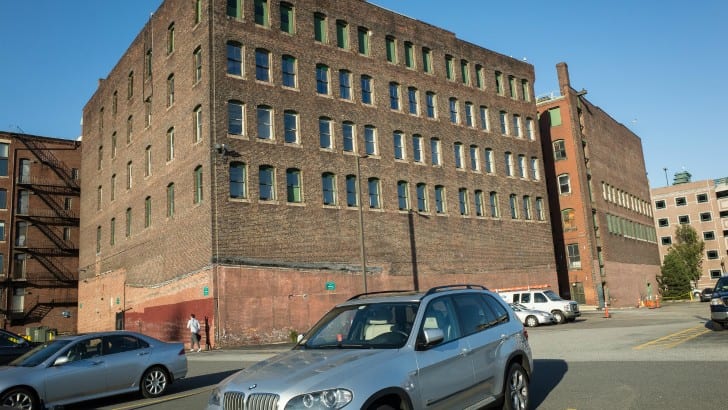
UMass President’s Office at One Beacon Street in Boston Overlooking the Massachusetts State House

UMass President’s Office at One Beacon Street in Boston Overlooking the Massachusetts State House

July 12, 2016

BY JASON PRAMAS @JASONPRAMAS

Will campus advocates spark a rebellion for proper funding or cling to failed politics as usual?

Hot on the heels of the UMass Boston administration issuing pink slips to 400 Boston non-tenure track faculty last month comes this month’s announcement that the entire UMass system will almost certainly face tuition hikes for the second year in a row. Capping a quarter-century of relentless increases in tuition and fees at state colleges and universities that have made the Massachusetts public higher education system the ninth most expensive in the nation.

Locally, according to the Daily Hampshire Gazette, UMass Boston students “will likely see the biggest increase because that campus projects a $22.3 million shortfall in the coming fiscal year.”

The UMass Board of Trustees will vote on the matter on July 14. But given the Commonwealth’s worsening financial position in the wake of the Brexit crisis, and an expected additional deficit of up to $950 million for FY 2017, there will be significant budget shortfalls that UMass leadership plans to deal with by jacking up tuition on already overburdened students.

My basic response to the looming layoff of one-third of the UMass Boston faculty was to call for a rebellion by students, faculty, staff, alumni and parents at that school. So it should come as no surprise that my response to news of this latest tuition hike is to call for a systemwide rebellion at UMass. And at the state universities and community colleges of the Commonwealth’s three-tiered public higher ed system as well.

As to the specific form of the necessary uprising, I cannot say for sure what will be most effective. But something like the campus walkouts that Boston Public School students pulled off this spring, plus a general descent upon the State House and the establishment of an Occupy-style encampment as a base of operations would be an excellent start. Because if the politicians don’t feel major pressure very soon, public higher education will begin to disintegrate in the Bay State as regular budget cuts get worse and worse.

To those who might suggest that a typical lobbying strategy will be more effective than an extra-parliamentary strategy at this moment in history, I would say that the burden of proof is on them to demonstrate how playing nice in a state political arena dominated by monied interests is getting public higher education advocates — or advocates for any public good — anywhere of late.

As it happens, campus activist groups and labor unions have tried that approach for over a decade but no major positive changes have occurred in state higher ed policy. The general political trajectory has been for the legislature to continue decreasing state support for public colleges and universities causing administrators to raise tuition and fees to fill the budgetary gap. Gradually transferring costs from government to individuals — changing higher ed from a right for the many back to a privilege for the few moving forward. A reversal of nearly two centuries of democratic education reforms.

Power accedes to nothing without a demand. But such a demand needs to fit the circumstances. If the problem involves savage budget cuts, big tuition hikes— 5 to 8 percent at each UMass campus and similar amounts at the state universities being currently projected for FY 2017 alone according to UMass President Marty Meehan — and an existential threat to public higher ed then one can’t improve the situation by proposing good but relatively minor reforms that barely begin to touch the crisis at hand.* Including the “fair share” constitutional amendment that may be on the ballot in November 2018 — which will raise taxes on individuals making more than $1 million a year and target some of the estimated $2 billion in resulting funds annually to higher ed.

A lot of damage can be done to state colleges and universities in the minimum of three fiscal years that it will take to see such a millionaires’ tax operationalized — assuming it’s not defeated by the usual business-led coalition of anti-tax voters. And it’s still no substitution for the progressive tax regime that is needed to end the Commonwealth’s financial woes.

So Mass public higher ed activists face a crucial decision. Will they play an inside game that has not worked before and is therefore highly unlikely to work now without the mass support they have been unable to generate with carefully scripted rallies and lobby days? Or will they try something new? Something bold that might generate the required popular support. Something that will inspire all the tens of thousands of students and alumni being sentenced to a lifetime of debt bondage by short-sighted politicians that refuse to raise taxes on corporations and the rich — even when the very things that have traditionally made Massachusetts a great state, like our public higher ed system, are in danger of being destroyed. All while emboldening faculty and staff to fight for their jobs with the fury a deteriorating political economic situation demands.

That remains to be seen.

*On July 11, the Boston Globe reported that community college tuition would be increasing as much as 10 percent in FY 2017.

HORIZON LOGO TRIMMED

Apparent Horizon is syndicated by the Boston Institute for Nonprofit Journalism. Jason Pramas is BINJ’s network director. 

Copyright 2016 Jason Pramas. Licensed for use by the Boston Institute for Nonprofit Journalismand media outlets in its network.

WELFARE KINGS: BAKER MOVES TO MAKE CORPORATE GIVEAWAYS EVEN SWEETER

1826 APPARENT HORIZON

June 28, 2016

BY JASON PRAMAS @JASONPRAMAS

If you think that the Commonwealth of Massachusetts and the City of Boston lavishing $270 million in tax breaks and direct aid on General Electric in exchange for moving their world headquarters to the Hubis unconscionable, you should realize that the deal is only a more extreme example of the existing government gravy train for corporations hereabouts. In fact, to focus on but one of several programs that give public money away to businesses for dubious reasons, the state government is already able to dole out a total of $30 million in Economic Development Incentive Program (EDIP) tax credits each year to all approved corporate applicants.

But that’s apparently not enough for Charlie Baker. The governor sponsored an economic development bill in January (H.4413, formerly H.3983) that will allow the EDIP cap to be boosted to $50 million a year whenever another big GE-style deal is in the offing. And with the House expected to vote on it this week and the Senate next week, the proposed legislation is well on its way to passage.

The tax credits in question are approved by the Economic Assistance Coordinating Council (EACC)—a14-member board consisting of seven gubernatorial appointees (representing six regions of the Commonwealth and one institution of higher education) and seven high-level state government officials (one of those seats being currently vacant). The EACC meets quarterly to approve EDIP credits, and local Tax Increment Financing (TIF) credits proposed by qualified municipalities.

Interestingly, as reported in the Boston Business Journal, General Electric did not go for EDIP tax credits to help finance its new world headquarters in Boston. “It’s not necessarily that GE did not want EDIP credits or that the state felt infrastructure grants alone were the most attractive package, according to [Mass Secretary of Housing and Economic Development Jay] Ash. It’s that the state’s options for GE under the current incarnation of EDIP were limited.”

Baker’s economic development bill would make things significantly less limited for companies like GE —or, as the press buzz would have it, for the “next General Electric.” Because the already undemocratic EDIP process, overseen as it is by unelected staffers and appointees on the EACC, would be made even more undemocratic in the case of what the bill calls an “extraordinary economic development opportunity.” In a manner that CEOs on the make will find most advantageous.

And what exactly is an extraordinary economic development opportunity? It’s the situation that arises when a giant corporation like GE wants extraordinary amounts of state money to site facilities in the Commonwealth. To paraphrase the bill, if the secretary of the Executive Office of Housing and Economic Development and the secretary of the Executive Office for Administration and Finance agree that a corporation is going to build or rehabilitate a significant facility in Massachusetts, or relocate a business to Mass from a facility outside the Commonwealth—and either create at least 400 new jobs, or create at least 200 new jobs in a “gateway municipality” (state government speak for an economically depressed city) or in an adjacent city or town that is accessible by public transportation to residents of a gateway municipality—then it can be declared an extraordinary economic development opportunity and become eligible for much bigger EDIP tax credits than have been allowed heretofore. So large that the EEAC will be allowed to extend the total amount of EDIP credits it’s allowed to hand out in a single year from $30 million to as much as $50 million.

To clarify, let’s say that there are 29 companies each getting $1 million in EDIP tax credits in a particular year. Then a big company like GE comes along, and also qualifies for $1 million—which means that the EEAC has given out the $30 million in tax credits it’s allowed to disburse annually. Under H.4413, the big company can then be declared an extraordinary economic development opportunity and qualify for up to another $20 million. Reaching the special new cap of $50 million in EDIP credits for that year.

Two points to consider here:

  • First, the above bill language is clearly aimed at enticing large companies like GE to move major facilities here from another state. And perhaps GE is planning to go back to the public trough and apply for the newly expanded EDIP tax credits if the bill passes. One might even surmise that this language was written just for GE.
  • Second, such a move cannot be stopped by normal means. According to the bill, the “decision by the secretaries to designate or not to designate a proposed project as an extraordinary economic development opportunity shall be a decision that is within the sole discretion of each of the secretaries, and may include such conditions as the secretaries shall in their discretion impose.  Such decisions shall be final and shall not be subject to administrative appeal or judicial review under chapter 30A or give rise to any other cause of action or legal or equitable claim or remedy.”

Thus vast sums can be given away to big business by the Baker administration and its successors to favored corporations with no easy possibility of reversal.

Shocked? Outraged? Good. There’s still time to stop H.4413. Make GE Pay, the grassroots coalition that’s working to stop the GE Boston deal, has announced that they are working with Sen. Jamie Eldridge (D – Acton) and other legislators to remove—or at least improve—the EDIP cap section of the bill. Contact coalition coordinator Eli Gerzon (eligerzon@gmail.com) for details. And follow Make GE Pay on Twitter (@makeGEpay) and on their Facebook page (facebook.com/makeGEpay) to keep up with all the latest.

HORIZON LOGO TRIMMED

Apparent Horizon is syndicated by the Boston Institute for Nonprofit Journalism. Jason Pramas is BINJ’s network director.

Copyright 2016 Jason Pramas. Licensed for use by the Boston Institute for Nonprofit Journalism and media outlets in its network.


ADDENDUM

Since the list of current Economic Assistance Coordinating Council members is not on the Economic Development Incentive Program website, EDIP staff was kind enough to provide a copy upon request:

CY 2016 EACC Board Members

Director of the Office of Business Development (or Designee) – Co-Chair
Ms. Carolyn Kirk (Ex Officio)

Director of Department of Housing and Community Development (Designee) – Co-Chair
Mr. Louis A. Martin (designee) (Ex Officio)

Director of Career Services (or Designee)
Mr. Ken Messina (designee) (Ex Officio)

Secretary of Labor and Workforce Development (or Designee)
VACANT (designee) (Ex Officio)

Representative of MOBD designated by the Director of Office of Business Development
Mr. Nam Pham (Ex Officio)

Representative of MOBD designated by the Director of Office of Business Development
Ms. Annamarie Kersten (Ex Officio)

Director, Commonwealth Corp. (or Designee)
Ms. Rebekah Lashman (designee) (Ex Officio)

WESTERN REGION REP.
Ms. Kathleen Anderson (Governor)

CENTRAL REGION REP.
Mr. Paul F. Matthews (Governor)

EASTERN REGION REP.
Mr. Drake Behrakis (Governor)

SOUTHEASTERN REGION REP.
Ms. Jennifer Menard (Governor)

CAPE & ISLANDS REGION REP.
Mr. David Keator (Governor)

MERRIMACK VALLEY REP.
Mr. Joseph J. Bevilacqua (Governor)

Representative of Higher Educational Institute
Dr. Michael D. Goodman Ph.D. (Governor)

GE BOSTON DEAL: THE MISSING MANUAL, PART 8

 Photo by Jason Pramas. Copyright 2016 Jason Pramas.

Photo by Jason Pramas. Copyright 2016 Jason Pramas.

June 21, 2016

BY JASON PRAMAS @JASONPRAMAS

Problems with GE Fort Point arrangement show need for democratic economic development planning

A new wrinkle surfaced earlier this month in the plan to use a big chunk of the $270 million in public aid and tax breaks being shoveled at General Electric to buy two of the three buildings that are slated to make up its new headquarters in Boston’s Fort Point neighborhood.

In part 5 of this ongoing series of columns on the GE Boston deal, I mentioned that said scheme called for the Boston Redevelopment Authority (BRA) to purchase the two former Necco company buildings from Procter & Gamble—along with part of the big parking lot outside its Gillette plant—and lease the buildings back to General Electric. Soon after, it emerged that while GE would pay up to an estimated $100 million to refurbish the buildings and build a new third structure on the site, it would not be paying rent. At all. For the entire 20 years of the lease. And that the terms of the agreement struck with the City of Boston and the Commonwealth of Massachusetts only put the vast multinational on the hook for “annual operating expenses, property taxes not abated or subject to a PILOT [Payment In Lieu of Taxes] agreement, and interior renovations costs.”

John Barros, Boston’s chief of economic development, subsequently insisted that despite the agreement making no mention of rent payments for the former Necco buildings, by gum there would be some kind of payments! Yet there has been no further news on what those payments might look like. Or if the company will, in fact, ever be asked to make any payments in exchange for using the buildings at all.

Key to the plan was BRA ownership of the buildings—because that allowed GE, a corporate behemoth infamous for making huge profits and paying very little in taxes, to use the part of the promised $120 million in state grants that wasn’t used by the BRA to purchase the buildings to rehab them and make other site improvements. Since the state money in question cannot be used on private property.

Now it turns out that the BRA won’t be involved in the deal at all. Instead, according to the Boston Business Journal (BBJ), the state’s economic development arm MassDevelopment will own the Necco buildings and the $120 million in state funds “would be used in [its] acquisition of the Necco buildings as well as to improve utilities at the site, create a public park and improve the existing Harborwalk.”

As regards the lack of rent, a rather uncritical April 1 BBJ piece, “Of course GE won’t pay rent in Boston, so stop bellyaching,” noted that “the revitalized site could generate roughly $1.75 million in annual gross tax revenues to the city.” An estimated $35 million over 20 years. The next day, the Boston Globe quoted a higher estimate using “City Hall” figures indicating that a “comparably sized office property in that part of the city” would pay $48 million in taxes over 20 years—which a later Boston.com piece interpreted as the city pocketing $23 million over its $25 million in tax abatements to GE.

But when WGBH’s Jim Braude had interviewed Boston Mayor Marty Walsh a few days prior, hizzoner agreed there had been no discussion of GE paying taxes to the city to that point. After first putting it as an evasive double negative, “There’s been no discussion of not paying taxes.”

All that said, it comes down to this: The City of Boston and the Commonwealth of Massachusetts are giving millions of public dollars to a mind-blowingly wealthy conglomerate that doesn’t need it. To engineer the public purchase of two out of three headquarters buildings on which it will likely not pay much, if any, rent. Nor will GE likely pay significant taxes on the parts of the complex it is to own outright—if its past record as one of the biggest tax scofflaws in history is any guide.

The terms of the essentially secret deal that led to this situation—brokered by high public officials and GE leadership with no public oversight whatsoever—are already being violated. The place of the BRA in the complicated and highly questionable real estate transaction at the heart of the accord has now been taken by MassDevelopment. Once again with no opportunity for public comment or oversight.

Things just happen. Politicians and CEOs cut backroom deals. Much of the press lays down on the job. And the public gets shafted.

But what if the public didn’t have to bow down to private interests? What if we didn’t have to get shafted on deals like this? Imagine a Boston and a Massachusetts in which the public good—rather than short term gain for a few privileged actors—was the guiding political economic motivation.

Let’s say that the same city and state money being lavished on General Electric was put into something that many people have said was important—like strengthening and expanding the arts sector in Fort Point in ways that go much further than anything proposed in the city’s new arts plan. A sector that, after all, was largely responsible for making what the BRA likes to call the “Seaport District” attractive to big developers and corporate interests to begin with.

In that alternate Boston, the city and state would pull out of the GE deal. The state would buy the Necco buildings directly from P&G. Perhaps it would pick up the adjacent 253 Summer Street building as well. And it could even buy some of the available P&G parking lot and build desperately needed public housing—following the mixed-use zoning ideas for the area in the 2006 BRA “100 Acres Plan” a good deal more closely than that agency is at the moment. City and state money would refurbish the space as a creative industries incubator with an emphasis on new businesses run as worker-owned co-operatives. The focus of the project would be twofold. Create good arts jobs, and help Fort Point remain a major arts hub. That would be a much better use of public money than dumping it on GE. Especially because the entire development process would be transparent and subject to democratic oversight.

A robust popular movement will be required to make this kind of vision a reality. And such movements rarely appear on cue. But it sure would be nice if one did this time around.

HORIZON LOGO TRIMMED

Apparent Horizon is syndicated by the Boston Institute for Nonprofit Journalism. Jason Pramas is BINJ’s network director.

Copyright 2016 Jason Pramas. Licensed for use by the Boston Institute for Nonprofit Journalism and media outlets in its network.


KILL SHOT: YEARS OF STATE AUSTERITY BUDGETS PUT UMASS BOSTON IN JEOPARDY

UMASS TOP

June 10, 2016

BY JASON PRAMAS @JASONPRAMAS 

Community needs to join Faculty Staff Union movement for a return to full funding

There is only one appropriate response to the looming layoff of 400 unionized non-tenure track faculty at UMass Boston. Rebellion.

We are well past the era of shots across the budgetary bow of public higher education in the Commonwealth. We are now in the era of kill shots. It is not possible to eliminate roughly one-third of the faculty of a major research university without destroying that university. One cannot run a school without teachers, after all. Teachers who are already denied the possibility of secure, properly-paid, full-time, tenure track faculty jobs—as has become the dominant practice at colleges across America.

So, the threatened faculty, the remaining faculty, the staff, their Faculty Staff Union (Mass Teachers Association), the other campus unions, the alumni, and—most importantly—the students and their families have to essentially declare war on state government. Now. The entire UMass Boston community needs to demand proper funding for the school. Or risk losing everything that generations of Bostonians have fought for. A public university of our own with an “urban mission” to provide a top flight education to its residents with as little expense to them as possible.

The proximate cause of the crisis is a combined $22.3 million deficit that the UMass Boston administration recently announced for this fiscal year and next. Their unfortunate response is to propose: increasing class sizes, raising tuition (yet again), and savagely cutting faculty jobs.

But the ultimate cause is the long term starvation of the public higher education budget by the Mass legislature. According to the Mass Budget and Policy Center, state funding for public higher education has fallen from $1,339,713,711 in FY 2001 to $1,187,476,006 in FY 2016 (numbers adjusted for inflation)—an 11.4 percent drop. Yet it’s worse than that statistic makes it seem since the budget was well below the FY 2001 figure every year between then and now. Meaning that the system has lost more than a billion dollars over the last decade and a half.

Put another way, the ultimate cause is ideological. And that ideology has a name: neoliberalism. Its central precepts of fiscal austerity, privatization, deregulation, and union busting in the service of making the rich richer have been followed with near-religious intensity for decades by both major political parties in state governments and in the federal government alike.

In the present context, neoliberalism translates to refusing to fairly tax corporations and the rich—which would allow our public higher education system to be funded to a tolerable standard—trying to run colleges like for-profit businesses instead of nonprofit services, and transferring once-public costs to individual families. Forcing students to take out increasingly burdensome loans to stay in school. A recipe for disaster, if ever there was one.

Writ large over the entire state government, the neoliberal ideology has led to one crisis after another—in the public health system, in public K-12 education, in the public transportation systems, etc., etc. And will continue to do so until the disastrous course its political partisans have put us on is reversed by popular political action.

All signs point to a small increase (1-1.5 percent) in state spending on public higher ed in the final FY 2017 budget, but nowhere near enough to make up for the years of cuts. Or even to keep up with inflation, let alone forestall the crisis at UMass Boston.

Saving UMass Boston—and the Mass public higher ed system—is going to take a real struggle. The Faculty Staff Union and its allies are doing a fine job of protesting the cuts. But they need solidarity. Lots of it. The kind of movement required has to be statewide and systemwide. And even that probably won’t be enough. A reform of the necessary scale will need help from outside the public higher ed community. It will need the newly emboldened radicals from the Bernie Sanders campaign, #BlackLivesMatter and other rising social movements to join the fight.

That’s a tall order to be sure. But every journey starts with a first step. Here’s how you can help:

  1. Sign the UMass Boston Faculty Staff Union petition.
  2. Get on the “Stop the Hikes and Cuts” bus at UMass Boston on June 15 and join the UMB community in protesting the upcoming UMass Board of Trustees meeting.
  3. Drop an email to FSU@umb.edu to get more involved.

Pressure on the UMass Boston administration is already mounting. That might explain why UMB Chancellor Keith Motley told the Boston Herald this week that “he has not approved any cuts on campus and that most staff who received pink slips would be called back for the fall.” Cold comfort for the 400 faculty members currently in limbo, unsure of whether they should start preparing for classes as usual—or continue looking for new gigs in a tight academic job market. And with UMass President Marty Meehan guaranteeing that budget cuts are coming to the entire UMass system by July, it doesn’t seem like Motley will be able to avoid finalizing the faculty layoffs for very long.

Unless he proposes cutting the often-outrageous administration salaries across the board to help balance the budget as public higher ed advocates have long suggested. Wouldn’t hold your breath on that one.

For a community perspective on the crisis at UMass Boston, check out the testimonial from recent graduate Cady Vishniac.

Apparent Horizon is syndicated by the Boston Institute for Nonprofit Journalism. Jason Pramas is BINJ’s network director.

Copyright 2016 Jason Pramas. Licensed for use by the Boston Institute for Nonprofit Journalism and media outlets in its network.

AUSTERITY BUDGET, PART 4

Untitled drawing (2)

June 6, 2016

BY JASON PRAMAS @JASONPRAMAS

The Worst of the Senate FY 2017 State Budget Proposal

Continuing to track the worst proposed cuts at different stages of the vicious and dispiriting annual Massachusetts state budget process, it’s time for a look at the full Senate budget proposal.

As with my overviews of the worst cuts in the governor’s,  House Ways and Means Committee’s, House’s, and Senate Ways and Means Committee’s FY 2017 budget proposals, the numbers in this column are based on the analytical reports that the Mass Budget and Policy Center (MBPC) releases on an ongoing basis. In this case, the “Conference Preview: Differences Between the Senate and House Budgets for FY 2017.” For all the details, check out massbudget.org.

Nothing really new to see here. To quote the current MPBC report, “In the end, the House and Senate budgets are very similar. Not only are the budget totals within 0.1 percent of each other (which makes sense since they had essentially the same amount of revenue to work with), but the two proposals are also within half of one percent of each other in every major category.”

And so it goes. There is no protection from the budget ax for programs that benefit huge numbers of Bay State residents. Especially with a $311 million budget deficit looming before the end of the current fiscal year – due to spring tax receipts that are significantly lower than the Baker administration’s rosy increased projections of January. We live in an era when politicians are reduced to spending their days wrangling over which group will get screwed more. With two exceptions: the rich and the corporations they control. The very groups that can no longer be taxed in a political system they have bought and paid for.

Environment & Recreation

The FY 2017 Senate budget proposal would cut $11.4 million (5.36 percent) from current FY 2016 levels. Leaving $201.4 million. A .14 percent smaller cut than the House proposal, after the Senate added back $5.1 million to this line during its full budget debate. Still a horrendous and ill-timed proposed reduction. And this far along in the budget process, one that is unlikely to be reversed.

Public Health

A minor bright spot. The FY 2017 Senate budget proposal would add $2.5 million (.43 percent) to current FY 2016 levels for a total $582.9 million. By adding $5.9 million back to this line during its full budget debate – mostly for substance abuse prevention and treatment – the Senate has now joined the House and Governor in essentially level funding public health spending in the Commonwealth.

Housing (funds for affordable housing, and shelter and services to homeless people)

The FY 2017 Senate budget proposal would cut $38.8 million (7.94 percent) from current FY 2016 levels, after adding back $3.5 million during its full budget debate. Leaving $450.0 million. $3.8 million more than the House proposal. As the MBPC report points out, “the Senate’s budget, like the House budget, is about $40 million lower than FY 2016 current spending for the Emergency Assistance (EA) program that provides shelter to low-income, homeless families. If this lower funding level is included in the final FY 2017 budget, it is likely that the Legislature will be required to provide supplemental funding for the program because the cost of providing shelter for those who are homeless and eligible for shelter will probably exceed the amount appropriated.”

Transitional Assistance (aka welfare, funds for short-term help for poor individuals and families)

The FY 2017 Senate budget proposal would cut $26.7 million (3.84 percent) from current FY 2016 levels. Leaving $667.1 million. Although the MBPC report doesn’t say it, this represents a $5.5 million cut from the Senate Ways and Means Committee budget proposal. So unlike the other lines reviewed here, the full Senate debate actually took more money away from its original proposal rather than adding any back. The poorest of the poor have few defenders in the legislature. And it shows.

Economic Development (funds for programs that, among other things, help unemployed people find work)

The FY 2017 Senate budget proposal would cut $14.1 million (9.2 percent) from current FY 2016 levels, after adding back $8.8 million during its full budget debate. Leaving $139.1 million.

CORRECTION
In his Apparent Horizon column of June 6, entitled “Austerity Budget, Part 4,” Jason Pramas did not properly reflect some changes in numbers used by the Mass Senate between their Senate Ways and Means and full Senate budgets that were analyzed by the Mass Budget and Policy Center in their “Conference Preview: Differences Between the Senate and House Budgets for FY 2017” report. As a result, the numbers used in the Public Health and Economic Development sections of the column were incorrect. And while Pramas did identify an MBPC typographical error in the Transitional Assistance section of their report, the numbers in that section of his column based on that error were also incorrect. For the correct numbers, please check the updated MBPC report at
www.massbudget.org. The Boston Institute for Nonprofit Journalism regrets the errors — which do not, we hasten to add, change the fact of the savage cuts to the budget areas in question in any significant way.

Apparent Horizon is syndicated by the Boston Institute for Nonprofit Journalism. Jason Pramas is BINJ’s network director.

Copyright 2016 Jason Pramas. Licensed for use by the Boston Institute for Nonprofit Journalism and media outlets in its network.

#makeGEpay Budget Amendment Filed in MA Senate; Advocates Encourage Public Support [an Apparent Horizon breaking news report]

1-t5F8STn1aD90PDi1LSUE0g

May 25, 2016

BY JASON PRAMAS @JASONPRAMAS

The #makeGEpay advocacy network — including Jewish Voice for Peace-Boston and dozens of other local community organizations — just announced that Senator Jamie Eldridge (D-Acton) has filed a “Community Benefits for Corporate Tax Breaks” amendment to the Massachusetts Senate’s budget proposal. If included in the final state budget, it would mandate that any part of state government that gives $25 million or more to a corporation “for the explicit purpose of economic development or job creation, shall provide at least 5 per cent of that total expenditure for the purpose of providing affordable housing in communities in the regional planning area where that corporation is located.”

The amendment was filed in response to what critics call giveaways to major corporations like General Electric — which was recently promised over $145 million in state grants and incentives with no public oversight (and over $125 million more from the City of Boston). It’s co-sponsored by Senators Barbara L’Italien (D-Andover) and Mark Montigny (D-New Bedford). Full text is available here.

Advocates are encouraging Mass residents to call your state senator and ask them to “support amendment 836 cosponsored by Senator Eldridge.”

To find out who your rep is and what their number is use this website:http://wheredoivotema.com/bal/MyElectionInfo.aspx/.

They also recommend that people tweet support of amendment 836 using the #makeGEpay and #SenBudget hashtags.


Apparent Horizon is syndicated by the Boston Institute for Nonprofit Journalism. Jason Pramas is BINJ’s network director.

Copyright 2016 Jason Pramas. Licensed for use by the Boston Institute for Nonprofit Journalism and media outlets in its network.

AUSTERITY BUDGET, PART 3

Untitled drawing

May 24, 2016

BY JASON PRAMAS @JASONPRAMAS

The Worst of the House and the Senate Ways and Means Committee FY 2017 State Budget Proposals

A weekly column like this one can only keep up with a limited number of current events. Although committed to tracking the worst proposed cuts at different stages of the often-savage annual Massachusetts state budget process, I had to write about a number of other pressing topics in the weeks after the passage of the full House proposal. So I haven’t covered the House budget until now, and will instead simply roll it in with my review of the more recent Senate Ways and Means Committee (SWMC) budget proposal below.

As with my looks at the governor’s and House Ways and Means Committee’s FY 2017 budget proposals, I’m continuing to base this series on the excellent analytical reports that the Mass Budget and Policy Center (MBPC) releases on an ongoing basis. If you’d like to check out all the details, you can find the latest at massbudget.org.

All proposals to date have been austerity budgets. The many critical services not touched on here are mostly level funded or being given minor increases—neither sufficient to keep up with inflation, and therefore both tantamount to cuts. No new taxes of any consequence have been proposed—as the state government’s financial situation continues to get worse year after year. The rich and corporations remain safe from giving anything like a fair share of their profits to the people of this “Commonwealth.”

Environment & Recreation

House proposal

The FY 2017 House budget proposal would cut $11.8 million (5.5 percent) from current FY 2016 levels—less than originally proposed, after money was added during the floor debate. Leaving $201.0 million.

SWMC proposal

The FY 2017 SWMC budget proposal would cut $16.5 million (7.75 percent) from current FY 2016 levels. Leaving $196.3 million. A .75 percent larger cut than the governor’s proposal. And a 2.25 percent larger cut than the House proposal—making it the worst proposed cut to this vital state government department thus far. According to MBPC’s SWMC budget report, some of the cuts can be explained by shifting responsibilities like human resources from agencies within the Department of Environmental Protection to the Executive Office of Energy and Environmental Affairs, but the SWMC proposal “further reduces funding for several environment and recreation programs that have had significant cuts over the years.”

Public Health

House proposal

The House budget proposal level funded public health, as did the governor’s budget.

SWMC proposal

The FY 2017 SWMC budget proposal would cut $3.4 million (.59 percent) from current FY 2016 levels. Leaving $577.0 million. $7.6 million less than in the governor’s proposal and the House proposal.

Housing (funds for affordable housing, and shelter and services to homeless people)

House proposal

The FY 2017 House budget proposal would cut $42.6 million (8.71 percent) from current FY 2016 levels—less than originally proposed, after money was added during the floor debate. Leaving $446.2 million. $19.2 million below the governor’s FY 2017 proposal.

SWMC proposal

The FY 2017 SWMC budget proposal would cut $42.3 million (8.65 percent) from current FY 2016 levels. Leaving $446.5 million.

Transitional Assistance (aka welfare, funds for short-term help for poor individuals and families)

House proposal

The FY 2017 House budget proposal would cut $14.3 million (2.1 percent) from current FY 2016 levels—less than originally proposed, after money was added during the floor debate. Leaving $679.5 million. $7.3 million (1.1 percent) above the governor’s proposal.

SWMC proposal

The FY 2017 SWMC budget proposal would cut $21.2 million (3.1 percent) from current FY 2016 levels. Leaving $672.6 million.

Economic Development (funds for programs that, among other things, help unemployed people find work)

House proposal

The FY 2017 House budget proposal would cut $9.9 million (6.5 percent) from current FY 2016 levels—less than originally proposed, after money was added during the floor debate. Leaving $143.3 million. $6.4 million (4.7 percent) above the governor’s proposal.

SWMC proposal

The FY 2017 SWMC budget proposal would cut $22.9 million (14.9 percent) from current FY 2016 levels. Leaving $130.3 million.

HORIZON LOGO TRIMMED

Apparent Horizon is syndicated by the Boston Institute for Nonprofit Journalism. Jason Pramas is BINJ’s network director.

Copyright 2016 Jason Pramas. Licensed for use by the Boston Institute for Nonprofit Journalism and media outlets in its network.


IMMIGRANT ADVOCACY GROUP OF CAMBRIDGE PROVIDES MODEL FOR MUNICIPAL HUMAN RIGHTS ACTIVISM

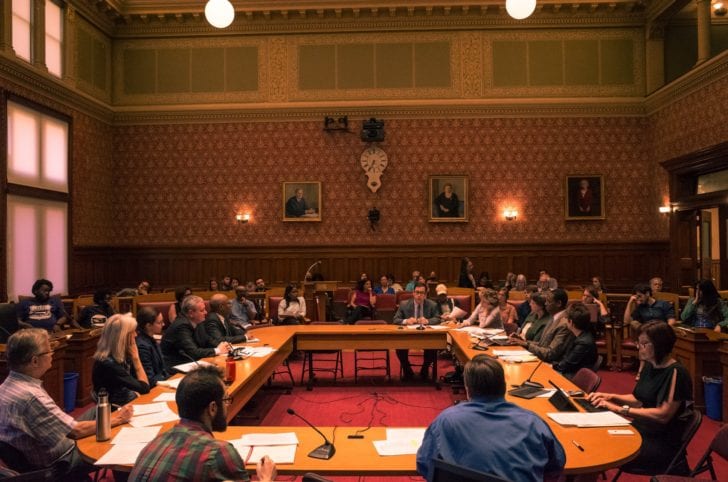
Joint Committee Meeting of the Cambridge City Council to Discuss Immigrant Representation and Resources, May 12, 2016. Photo by Jason Pramas. Copyright 2016 Jason Pramas.

Joint Committee Meeting of the Cambridge City Council to Discuss Immigrant Representation and Resources, May 12, 2016. Photo by Jason Pramas. Copyright 2016 Jason Pramas.

May 23, 2016

BY JASON PRAMAS @JASONPRAMAS

We live in strange times. On the one hand, the United States is a more diverse society than at any other point in its history. On the other, we’re witnessing a presidential campaign where Donald Trump has captured the Republican nomination in part by whipping up hysteria against immigrants. It’s an old game in American politics—with roots stretching back to the Know Nothing movement (originally, and ironically, called the Native American Party) in the mid-1850s and even further to the founding of the Republic. Blame the victim and ignore the actual oppressors. But it’s working quite well with white voters who have every reason to be angry in the ongoing economic downturn. And are casting about for someone to blame.

That’s why it’s refreshing to see an initiative taking shape in Cambridge to expand immigrant rights at the local level. Last week, City Manager Richard Rossi announced that a city Commission on Immigrant Rights and Citizenship that was created at the high water mark of immigrant rights activism nationwide in 2006 is at last searching for candidates to fill its 11 seats. That is an interesting development on its own merits. Especially given the apparent commonplace of dormant municipal committees. But the story of how the commission’s reanimation came to pass is even more interesting.

There are a significant number of immigrants in Cambridge. No surprise, given its world-famous universities, the large population of foreign born scholars they attract, the enterprises that set up shop nearby to avail themselves of those scholars, and the many immigrant service workers attracted to jobs connected to the university-driven economy (although most of them cannot afford to live where they work given a housing market that has become wildly expensive since rent control was defeated by the real estate industry in 1994). Not that a sizeable immigrant community is a new development, as previous generations of immigrants found work in the city’s once-strong industrial sector and put down deep roots that persist today in neighborhoods like East Cambridge and North Cambridge. Still, the percentage of immigrants has been on the rise again in Cambridge for some time.

Looking at the 2010-2014 estimate data from the US Census Bureau American Community Survey for Cambridge, out of a population of 106,844, an impressive 30,075 residents or 28.15 percent are foreign born. Placing the city in the top dozen Massachusetts municipalities for immigrant population, according to a report by The Immigrant Learning Center.  Of that total, the number of voting age non-citizen residents is 17,333 or 18.41 percent. Meaning that close to 20 percent of Cambridge residents have no representation in city politics. A statistic that includes an unknown number of undocumented immigrants—who have all been officially welcomed to Cambridge since it renewed its status as a sanctuary city for refugees and migrants without papers in 2006.

Since the early 1990s, there have been a number of attempts by immigrant advocates and the Cambridge City Council to give documented immigrants a voice in local elections by instituting non-citizen voting in local elections.  Each time, the effort ran into the same problem: it was not possible to enact such a city ordinance without the state legislature passing a home rule petition first. And the legislature has long been conservative on such matters—partially due to the anti-immigrant constituencies of many suburban and rural politicians. As such, no plan for including undocumented immigrants in a Cambridge municipal voting ordinance has ever been floated. Having precisely zero chance of passing muster in the legislature under current conditions.

Despite the difficult political hurdles to surmount at the state level, Councillor Nadeem Mazen has expressed interest in taking a fresh shot at making it possible for documented immigrants that have not yet become naturalized citizens to vote in city council and school committee races. His approach, however, has been somewhat different than that of his predecessors.

Mazen and his aide Daniel Schwartz have organized advocacy groups on several issues—including non-citizen voting. Emmanuel “Manny” Lusardi, a retired retail executive who strongly identifies with his family’s immigrant roots, got involved in the non-citizen voting advocacy group early on, and soon recruited Sylvie de Marrais—a recent Boston University graduate and restaurant server with a passion for expanding immigrant rights—to work with him. Noting what he calls her “exceptional organizational and leadership abilities,” Lusardi encouraged de Marrais to become the group’s leader.

Understanding that it remains difficult to get a home rule petition passed on even documented non-citizen voting, the advocacy group began looking for some stopgap measure that would get more immigrant representation in Cambridge city government sooner rather than later. A few weeks back, they hit upon the idea of organizing a push for a non-voting immigrant representative on the council. While looking into its feasibility, however, they started studying the positive experience of Boston and other cities that had established immigrant affairs offices. Mazen and other city officials liked that approach, and the non-citizen voting advocacy group then started organizing to create a Cambridge immigrant affairs office.

Not long after, they discovered the never-activated Commission on Immigrant Rights and Citizenship, alerted City Manager Rossi, and were gratified last week when he announced a search for the 11 members needed to get it in motion. Later that week, Mazen convened a joint meeting of three city council committees to discuss immigrant representation and resources in Cambridge. It was attended by councillors Dennis Carlone, Jan Devereux, and Timothy Toomey, Vice Mayor Marc McGovern, Mayor Denise Simmons, a number of city officials, and special guest An Le of the Mayor’s Office of Immigrant Advancement in Boston.The arc of the resulting discussion bent towards empowering the new commission to work on a variety of tasks—including better coordination of city services for immigrants, and organizing an annual Immigrants Day at Cambridge City Hall—and ordering a study of an aspect of the non-citizen voting plan that could slow immigrants’ naturalization processes if an agreement isn’t worked out with US Citizenship and Immigration Services. But the various motions agreed upon at the meeting towards those goals will need to be passed by the full council in the coming weeks before they can be operationalized.

The non-citizen voting advocacy group—now called the Immigrant Advocacy Group of Cambridge—will certainly have a tough time getting all of its expanding agenda of reforms enacted in a period of anti-immigrant rhetoric and tight budgets at all levels of government. Even in the so-called “People’s Republic.” But its activists have done a fine job out of the gate. And its working relationship with a sitting politician seems to be an innovation worthy of notice. With the Commission on Immigrant Rights and Citizenship slated to start meeting in the fall, and forward motion on a non-citizen voting ordinance and an immigrant affairs office, the advocacy group offers a political model that both democratizes and humanizes the debate over how our cities and towns should treat immigrants—whether documented or undocumented. A model that other municipalities should think seriously about emulating.

Cambridge residents who would like to get active with the group should check out its Facebook page.

HORIZON LOGO TRIMMED

Apparent Horizon is syndicated by the Boston Institute for Nonprofit Journalism. Jason Pramas is BINJ’s network director. Copyright 2016 Jason Pramas. Licensed for use by the Boston Institute for Nonprofit Journalism and media outlets in its network.


GE BOSTON DEAL: THE MISSING MANUAL, PART 7

GE Housatonic graphic

May 11, 2016

BY JASON PRAMAS @JASONPRAMAS

General Electric tries to cheap out on cleaning up its PCB apocalypse on the Housatonic River

In 1929, Swann Chemical Company began commercially producing polychlorinated biphenyls for industrial use as an electrical insulator and as a coolant. PCBs were immediately a huge success, and Monsanto bought Swann six years later. From 1932 to 1977, the big General Electric plant in Pittsfield, Mass used large quantities of the chemical in manufacturing electrical transformers and other products. According to the Environmental Protection Agency, as much as 600,000 pounds of PCBs was dumped into the adjacent Housatonic River and the surrounding soil over that time. In 1979, the EPA banned PCBs as a definite animal carcinogen and a probable human carcinogen. One which can take hundreds of years to naturally degrade to nontoxic levels.

As GE finished winding down its Pittsfield operation over the next couple of decades—ultimately eliminating 13,000 mostly unionized jobs, and driving a spike through the economic heart of the Berkshires—state agencies and the EPA initiated a number of regulatory actions culminating in a 1997 proposal by the EPA to add the Housatonic site to the Superfund National Priorities List. After long negotiations, the company managed to stop the site from being tarred with the Superfund designation and in 1999 agreed to what the EPA called a “Consent Decree” to cleanup PCBs in the Housatonic from the former site of GE’s Pittsfield plant to a couple of miles downriver in a first phase that has since been completed. And then to cleanup what was termed “Rest of River” in a second phase.

Having spent $100 million on the first phase (as part of the initial Consent Decree settlement), GE is now fighting to be able to cheap out on cleaning up the rest of the river. Mainly by trying to save the estimated $250 million cost of shipping PCB-contaminated river sediment and surrounding soil by rail to a huge toxic waste storage facility in Texas, as demanded by the EPA’s current “Rest of River” plan, via an alternative proposal for three new dumps in Western Mass. Two of which are right near the Housatonic. Yet are somehow expected to store a chemical infamous for its ability to leech out of dumps, spread miles underground—possibly right back to the river it was dredged from—and also evaporate and travel long distances in the air. GE appealed the EPA’s plan last October. A move that could land the whole affair in the US Court of Appeals in Boston, and drag a process that will take at least 13 years to complete out even longer.

Local communities are understandably furious, and river advocates have started holding protests at the proposed GE dump sites. It should be understood that the effects of PCBs on the environment are dire. And that so-called Rest of River cleanup is meant to fix some (but nowhere near all) of the damage done up to 140 miles downstream through Western Mass and Connecticut into Long Island Sound. PCBs—found in the Housatonic at levels far above the EPA safety threshold—not only raise cancer risks in humans and animals alike, but also cause direct immune, reproductive, endocrine, and neurological effects. With children being the most vulnerable human population.

But even the planned EPA approach to Rest of River cleanup on the Housatonic—which activists think is woefully insufficient—is still too expensive for GE’s taste at an estimated $613 million. The corporation won’t rest until it knocks at least $250 million off the top. And damn the environmental consequences.

Meanwhile, it remains to be seen whether—given the buzz coming from Western Mass—there might be a connection between the Housatonic situation and the $270 million in public funds, services, and tax breaks that Gov. Charlie Baker and Boston Mayor Marty Walsh have agreed to lavish on GE to induce them to move their headquarters to the Hub. But one has to wonder—in light of the recent investigation by the International Business Times showing that GE employees and the employees of GE’s lobbying firms donated nearly $1 million to the NY Congressional delegation over last three election cycles—why so many Empire State pols just happened to stand down from the fight to stop EPA approval of GE’s halting its dredging of PCBs in the Hudson River Valley last year? And if a scheme like that could happen one state over, why couldn’t it happen here?

HORIZON LOGO TRIMMED

Apparent Horizon is syndicated by the Boston Institute for Nonprofit Journalism. Jason Pramas is BINJ’s network director.

Copyright 2016 Jason Pramas. Licensed for use by the Boston Institute for Nonprofit Journalism and media outlets in its network.

ECONOMIC VIOLENCE: VERIZON CUTS OFF HEALTH CARE BENEFITS TO STRIKERS AND THEIR FAMILIES

VERIZON PIC

May 6, 2016

BY JASON PRAMAS @JASONPRAMAS

As the Verizon strike enters its fourth week, the 39,000 union members on picket lines up and down the East Coast—and now taking their campaign nationwide—are continuing to hold fast for a better contract than the giant corporation has thus far been willing to offer. But a strike is no walk in the park. Not in the America of 2016. On May 1, International Workers’ Day,  Verizon cut off health care benefits to the strikers and their familiesan estimated 110,000 people overall. And while the two unions organizing the strike—Communications Workers of America (CWA) and the International Brotherhood of Electrical Workers (IBEW)—have socked away millions to pay strike benefits, helped members file for expensive stopgap COBRA health insurance, and even offered to pay medical expenses for members outright in the case of CWA, many people with chronic conditions are being put at serious risk of having their medical care disrupted. With potentially dire consequences.

Yet it’s difficult to find mentions of this vicious move by Verizon in the major American press. Coverage of the issue has been spotty at best. Despite it being a great example of why working families need proper national healthcare. Almost like it was not news at all. Even in centers of strike activity like Boston.

That’s a problem. When there are big layoffs by large companies owned by extraordinarily wealthy people, when wages are slashed, when huge numbers of jobs are outsourced to countries with even worse labor standards than our diminishing protections here in the US, much of the news media treats these tremendous crises for working people as mere footnotes to the much more important coverage of corporate bottom lines.

If any criticisms are raised—usually in passing and rhetorically—they are generally dismissed with easy answers. As with the 12,000 workers currently being laid off by microchip titan Intel. A recent and very typical article in The Oregonian, the Pacific Northwest’s newspaper of record, discusses the 2150 expected layoffs in their state matter-of-factly—explaining that Intel is “Oregon’s largest private employer and pays some of the state’s best wages.” So the loss of so many good paying jobs is really going to hurt the regional economy. But the piece then goes on to say that “Intel is a hugely profitable company—and a growing one.” It has other exciting divisions doing lots of whiz-bang things. Sure, those divisions are not necessarily in Oregon or even in the US—Intel being yet another multinational with robust manufacturing operations in low-wage countries like India—and it’s not at all clear that workers in those other divisions will make money as good as the laid-off American chip workers made. Nonetheless, the basic message of such articles is that “the market will take care of it.” Jobs will be lost here, but gained back elsewhere. Then all will be well and right with the world again.

But “the market” doesn’t take care of working families. It takes care of owners and top executives and big investors. Who use their massive and growing profits in this New Gilded Age to rig the political and economic systems to focus on their interests. Not everyone else’s.


That’s why Verizon’s union workers are on strike. It’s gotten to the point where they have no choice. In large part because the company has been doing its level best to wipe out its unions since its formation in 2000. To remove the last obstacle to allowing its management the freedom to do what so many non-unionized American companies are able to do to their workforces with impunity: ship many once-decent jobs abroad, and turn the rest into part-time, contract and temp jobs. Hiring people when they need them, and getting rid of them with impunity when they don’t. With no promise or expectation of good wages, benefits or job security.

All of these corporate moves are best described as economic violence. Because they destroy lives. And for all the criticism that labor gets for being unreasonable on the still-too-rare occasions that it mounts more than symbolic protests, unions like CWA and IBEW are remarkably restrained in the face of that ongoing violence. Hands tied by decades of anti-labor legislation, they limit their responses to those allowed by law: withholding their labor for as long as possible, picketing Verizon properties, “mobile picketing” (following scabs to worksites and talking to consumers about the strike), encouraging the public to boycott Verizon Wireless, and gamely waging PR battles in an often dismissive pro-corporate press. Trying to win enough hearts and minds to convince Verizon management that settling with the union is cheaper than letting the strike drag on.

Which might work this time as it has in several past strikes. But it’s getting harder for unions like CWA and IBEW as the years go by and their membership continues to shrink at the hands of mercenary profit-hungry companies like Verizon. They’re in a very difficult situation. But there’s one thing that readers can easily do to help expedite Verizon union workers’ herculean task of defending what they have while fighting to expand the labor movement back to some semblance of its former strength: When you hear about economic violence by bosses against workers, spread the word. Tell your friends, family and workmates. Don’t let atrocities like cutting health care benefits on striking workers remain a footnote in the national discourse. Make some noise. Then do the same at your own workplace when things get tough. Learn from Verizon’s unions. Fight back however you can. And in a few years, labor conditions might start finally improving for American workers again.

Readers who would like to support the Verizon strikers should visit standuptoverizon.com

Apparent Horizon is syndicated by the Boston Institute for Nonprofit Journalism. Jason Pramas is BINJ’s network director.

Copyright 2016 Jason Pramas. Licensed for use by the Boston Institute for Nonprofit Journalism and media outlets in its network.