Skip to content

Jason Pramas

WHY ARE SO FEW ‘HIGH SCHOOL QUIZ SHOW’ CONTESTANTS BLACK?

High School Quiz Show Dover Sherborn vs. Lexington YouTube

Image via High School Quiz Show / YouTube

March 29, 2106

BY JASON PRAMAS @JASONPRAMAS

Structural racism is the problem … now what’s the solution?

WGBH’s “High School Quiz Show” is great. So great that adults like me watch it on purpose regularly. And that’s why I’ve noticed something problematic about the show over the past few years.

There are very few Black (or Latino) contestants. Which is really weird. Because there are lots of Black students in Boston. And in a number of other Massachusetts cities as well.

Take a look at High School Quiz Show’s Facebook photos, and Instagram page, and YouTube page. Look for Black students over the seasons that WGBH has documented. Those who you see mainly appear during the program’s annual Super Sunday—where teams from 120 high schools try out for the next season. But the teams with Black students on them generally don’t make the cut for the show.

Why? Structural racism. And how does structural racism determine who shows up on “High School Quiz Show” every year? Because structural racism leads to educational inequality. Let’s take a look in broad strokes.

People with access to good jobs, housing, schools, and social supports have similar outcomes intellectually. But Black families nationwide, and Boston is absolutely no exception to this, continue to struggle more than their white counterparts economically and politically.

Without rehearsing the entire history of racism in America, Black families since World War I did not benefit from the major federal social programs that enabled huge numbers of white families to move up from the working class to the middle class … and beyond. Especially Federal Housing Authority loans that were targeted to new suburban developments that were kept lily white by use of racially restrictive covenants—which said that properties could only be sold to white people. Keeping Black families out of most white neighborhoods, towns and cities into the 1960s.

Suburban towns also passed zoning that stopped the building of multi-family dwellings—that is, apartment buildings—and tried to minimize housing construction of any kind in the richest towns. Making them accessible only to those who could afford to live there, even as major victories by the Civil Rights Movement finally made it possible for Black workers to move into better jobs across all economic sectors and for more Black families to start to move into the middle class.

Today, mainly white suburban realtors, lenders and insurers continue to discriminate against Black renters and homebuyers. With the result that quite a few towns and cities outside of Boston remain almost entirely white. And quite wealthy.

With many large expensive homes, these wealthy—and some middle class—suburban towns also have an impressively robust property tax base from which to fund excellent public schools. And wealthy parents kick in extra money to provide world class facilities for those schools—amenities that are completely absent from urban public schools. Plus they are able to send their kids to special after-school training programs and summer camps. Giving their children opportunities to excel academically that most urban kids simply do not have.

Add to those points the fact that since the 1960s, top students from East Asia and South Asia have been attending Boston universities in significant numbers, finding jobs in the professions here, and making enough money to move to the suburbs opened up to people of color with money by the Civil Rights Movement. Which remain off-limits to the vast majority of Black families that have been kept in redlined urban neighborhoods (even after suburbanites killed rent control), sold subprime mortgages on terrible terms for the houses they can buy there, and are still facing vicious discrimination in the job market. Ensuring they don’t make decent money or build capital as white families have been able to do for decades. And keeping them out of expensive white suburbs.

Forty years later, that’s how you get your typical “High School Quiz Show” team. From elite public and private suburban high schools in towns like Sudbury, Wellesley, Sharon, and Andover. Made up almost entirely of white and Asian students.

Regarding potential remedies for this particular manifestation of structural racism, there aren’t any easy ones. One suggestion, though. The “High School Quiz Show” FAQ currently says: “It is strongly recommended that teams include both male and female students.” Maybe amend that to conclude: “… and be as racially diverse as possible”? That would be a good start.

Apparent Horizon is syndicated by the Boston Institute for Nonprofit Journalism. Jason Pramas is BINJ’s network director.

Copyright 2016 Jason Pramas. Licensed for use by the Boston Institute for Nonprofit Journalism and media outlets in its network.


GE BOSTON DEAL: THE MISSING MANUAL, PART 5

Copy of NEW WEB HEAD TEMPLATE

Image by Kent Buckley 

March 25, 2016

BY JASON PRAMAS @JASONPRAMAS

General Electric’s Boston charm offensive presents dilemma for Boston nonprofits, others

General Electric is back on top of the Boston news cycle again. CEO Jeffrey Immelt made the rounds of pressers in person this week, starting with the announcement of a new 2.5 acre GE headquarters site—to be purchased from Procter & Gamble and carved out of their 44 acre Gillette campus. Right on the Fort Point Channel across from South Station and the main Boston post office. After refurbishing two former NECCO buildings on the site and erecting a new third building in the current parking lot, the company expects to spend $80-100 million on the complex.

However, the plot of the GE Boston Deal has thickened once again. It turns out that part of the promised $145 million in tax breaks and direct aid to the company from Boston and Massachusetts will only be possible because the Boston Redevelopment Authority plans to purchase the NECCO buildings and lease them back to GE. Neat trick for a much-hated neighborhood-destroying planning agency that only just got a six-year lease on life from the Boston City Council on Tuesday. Over the protests of the three councilors with any spine on the issue: Tito Jackson, Ayanna Pressley and Josh Zakim. No word yet about why Boston needs to spend an additional $100 million to repair the Old Northern Avenue Bridge at GE’s behest now that the multinational will be sited right near two perfectly functional bridges further up the channel. Or why the state has to throw in another $25 million to make the area around the new headquarters plot more pretty. But Mayor Marty Walsh and Gov. Charlie Baker will no doubt be able to explain that to us in the near future. Or perhaps not.

On Thursday, Immelt gave a speech to the Boston College Chief Executives Club at the Boston Harbor Hotel. Which raised more questions than it answered. Some of his more noteworthy offerings follow:

  • “This move for GE is all about the next 40 years. What do we want the company to look like, how do we want the company to be challenged?” [Reuters] So does that mean that GE’s HQ will be staying in Boston for at least 40 years? Probably best not to hold your breath on that one.
  • “And we think by the time it’s all said and done there should be, you know, let’s say 4,000 jobs around the ecosystem in Boston.” [WCVB video] OK, so we know that 800 jobs that will be sited in the new headquarters will be almost entirely white collar and many jobs will simply be transplanted from GE’s current headquarters in Fairfield, Conn. So what are the other 3,200 jobs that will be conjured into existence by the company’s presence? To the extent that any new jobs are being created at all, since Immelt is careful not to provide any specifics or make any explicit promises. But let’s think: cleaners, counter staff, delivery people, baristas, clowns, and office temps generally make lousy money and get no benefits. Bartenders, servers, dealers, muscle, and high-class sex workers do rather better financially. But again no benefits. And what with their proposed helipad, many of the GE execs probably aren’t going to stick around at night anyway. So it’s not clear that there are going to be many decent jobs created in this apocryphal “ecosystem” Immelt keeps mentioning. After all, this is a corporation that has destroyed tens of thousands of good working class jobs in Massachusetts in the last few decades. But fingers crossed, one supposes.
  • “More recently we’ve worked on community health and even more recently we’ve focused on employability. We like to do things where it’s more than money. You’ll have hundreds of GE people that are mentoring in schools …” [BBJ] Yeeeeeah … General Electric absolutely does not like to do things where it’s “more than money.” They like to make money. And more money. And screw anyone that stands in their way. Lovely attitude to instill in school kids, right? Ask Connecticut how everything worked out down there to get a good idea of Boston’s future with this deal.

Still, this brings up an interesting discussion. Even before the impressive walkout of Boston Public School students a couple of weeks back, GE must have been perfectly well aware that Massholes across the political spectrum are furious about the millions in free public money being shoveled into their coffers. And they’re also well aware that Boston, where they are just setting up shop, is a city that rose up to smash the deal for the Boston 2024 Olympics—a very similar boondoggle—last year.

So we can be sure that Immelt and his crew are going to start spreading money around to local community nonprofits. Especially social justice organizations that are likely to spearhead the fightback against the GE Boston Deal.

Seems like they haven’t been doing much philanthropic giving in the Boston area in recent years either. Other than money to universities like MIT that are going to produce researchers and upper management for them. Looking at the 2013-2014 annual report of United Way of Massachusetts Bay and Merrimack Valley, GE is listed as giving in the $500,000 – $749,999 category in a region that covers eastern Mass and southern New Hampshire. Yet GE didn’t make the Boston Business Journal list of corporations that donated more than $100,000 to Boston charities for either 2013 or 2014. Meaning Boston wasn’t a place they were trying to buy friends until it lately became necessary.

Given that GE will certainly increase its local donations, that presents a moral dilemma to Boston area nonprofits: Will they take this tainted money? Will they accept funds from a multinational corporation that is quite literally part of the reason that we have such an unequal society with so much poverty and immiseration? Money that many organizations must certainly need badly in these difficult times, but that will merely be a fraction of the PR line for a known corporate criminal with a $117 billion operating budget this year. Are they willing to sell themselves so cheaply?

Moreover, are Boston-area residents willing to continue to work with nonprofits that would be willing to take money from GE?

One way to find out is to shine the light of public attention on the matter and see what transpires. So if you hear about a Boston area nonprofit that knowingly took money from GE—directly, or through a front group—drop me a line at jason@binjonline.org. If your info checks out, I’ll add the organization to a public list. Let’s call it a Naughty List. And then we’ll see how much its community continues to support it. By the same token, if you know about an area nonprofit that did not take money GE offered them, definitely contact me and I’ll put it on a Nice List.

Now that I think about it, I can add politicians to the Naughty List and the Nice List, too. And business leaders. And academics. And journalists. I tell you, it’ll be like Christmas in July. Just not for the collaborators.

Welcome to Boston, GE.

Apparent Horizon is syndicated by the Boston Institute for Nonprofit Journalism. Jason Pramas is BINJ’s network director.

Copyright 2016 Jason Pramas. Licensed for use by the Boston Institute for Nonprofit Journalism and media outlets in its network.

SQUAWK OR WALK: MORE PROTESTERS NEEDED TO SAVE MBTA, PUBLIC TRANSIT STATEWIDE

AH MBTA

Photos by Chris Faraone

March 18, 2016

BY JASON PRAMAS @JASONPRAMAS

Last week, the MBTA Fiscal and Management Control Board—appointed by Gov. Charlie Baker in 2015 to run the transit authority—voted to hike fares by 9.3 percent. Claiming the move is absolutely necessary to stop the T’s perpetual budget crisis from worsening. Which is just pathetic. Because if ever there was a manufactured crisis, our state government’s refusal to properly fund its multiple mass transit systems is a prime example.

In 2000, the Commonwealth reversed its previous “backward funding” policy of simply paying any MBTA costs that fares didn’t cover at the end of each fiscal year. The move to so-called “forward funding” has been a disaster for mass transit in the Bay State ever since. The goal was to make the MBTA function like a for-profit company—which would somehow do more with a restricted budget allotted at the start of each fiscal year—and less like the indispensable public service that it is. The funding policy was later adapted for the other 15 regional transit agencies statewide. But in practice, as is often the case with such privatization moves, it has forced them all to struggle for survival. Leading to endless deficits anddoubling MBTA fares since its introduction.

There is a straightforward solution to this non-crisis. The state must go back to fully supporting the MBTA budget, must increase the mass transit budget statewide, and must raise taxes on the rich and corporations to cover any conceivable budget shortfalls for such an important public good.

But that simple, just and obvious solution isn’t “realistic” to neoliberal legislators, pundits and advocates that prefer to squirrel around the edges of the problem in ways that let the rich and corporations that they serve off the hook. While allowing critical mass transit systems to continue to deteriorate. And I count all five members of the Control Board among the “realists”—including union leader Brian Lang,whose yes vote on the fare hike was especially disappointing. Although he did successfully push some amendments that softened the blow for low-income riders.

The problem is not the lack of solid policy solutions. The problem facing MBTA riders in the Boston area and riders across the other regional transit agencies statewide is a lack of a big enough popular movement to push through such solutions. And therefore a lack of political power.

This is not to say there aren’t transit advocacy groups. There are over a dozen area organizations with solid track records in transit policy. Most are members of the Transportation for Massachusetts (T4MA) coalition—which has made good progress toward the broad goal of properly funding public transit statewide through the passage of initiatives like the 2013 Transportation Finance Act. But even such gains are constantly under threat, and difficult to defend—let alone build upon—without lots of active public support. As we’ve seen with the state reneging on the portion of the act that “guaranteed” that MBTA fare hikes would never be more than 5 percent every two years going forward. So much for that, right?

What’s missing is basically a larger statewide version of the T Riders Union (TRU)—a project of T4MA member Alternatives for Community and Environment. Many of you will already be familiar with TRU because if there’s a media-savvy protest on transit issues in Boston, they’re probably at the center of it.

The problem is similar to the one I outlined last week when discussing the difficulty labor unions have turning their members out for public protest actions in light of the success of the BPS student walkout. Groups like TRU, and their allies in coalitions like T4MA, can turn out dozens to protest key government meetings as they did for the most recent MBTA Control Board meeting and the series of  public hearings on the fare hikes before that. They can occasionally turn out more people, hundreds, for rallies and marches. But they can’t turn out thousands, and tens of thousands, on transit issues.

Yet that’s what’s needed. If a political movement doesn’t have money like big business, then it needs lots of people protesting to have significant effect on the progress of key public debates.

Numbers like the 2,000-plus BPS students that turned out last week—in the right places at the right times—can change what’s politically “realistic” overnight. Smaller, largely symbolic protests generally cannot do that.

Also, smaller organizations and coalitions have a hard time mustering enough troops to deal with the everexpanding number of issues in a broad policy area like mass transit. For example, MBTA advocates don’t just have the fare hike to deal with. There’s also the late night bus debacle. And the unrelentingattacks on unionized transit workers. And the idea of privatizing more services by handing them off to companies like Uber and Lyft (because handing Commuter Rail service off to corporations has beenworking so very well). And the increasingly savage Green Line Extension fight. And that’s just Greater Boston. Start looking at the crises facing the regional transit agencies, and there are dozens of other issues that need more public attention.

That’s why it would be great to see TRU—and all the transit organizations already on the ground—get stronger. And it would be awesome to see groups like TRU sprouting up all over the state wherever they don’t currently exist. The more grassroots, the better. All linked together more tightly than they are today. In every neighborhood, town, and city served by the MBTA and the regional transit agencies. Because that’s what’s ultimately going to make it possible to win the simple, just solutions that will get mass transit out of hock in Massachusetts, and back on the global cutting edge.

The more people in the streets for transit justice, the better the outcome for Massachusetts. A pretty simple political equation.

Think that over. Then act. Before public transit is just a memory.

Apparent Horizon is syndicated by the Boston Institute for Nonprofit Journalism. Jason Pramas is BINJ’s network director.

Copyright 2016 Jason Pramas. Licensed for use by the Boston Institute for Nonprofit Journalism and media outlets in its network.
BPS STUDENTS TAKE TO THE STREETS, MAYOR WALSH FEELING THE HEAT

2016-03-07 14.04.16

Photos by Chris Faraone

March 10, 2016

BY JASON PRAMAS @JASONPRAMAS

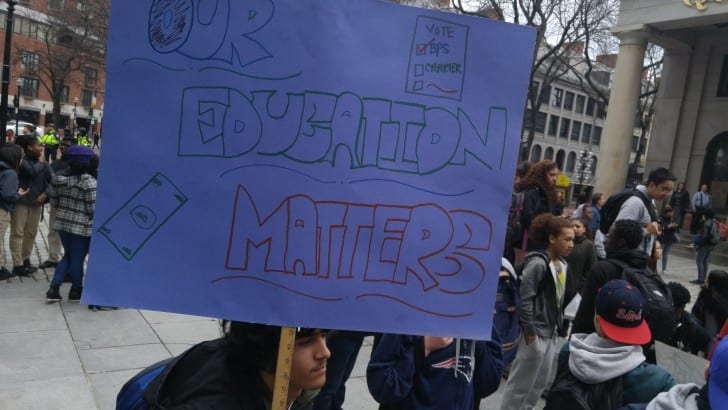
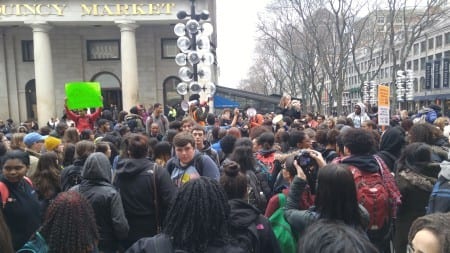
With their schools facing up to a $50 million deficit next year, over 2,000 Boston Public School students from all over the city marched on the Massachusetts State House and Boston City Hall this week to demand that BPS be properly funded going forward.

Clearly the messaging and targeting of the action owed a lot to BPS parents groups and teachers unions who have become more militant of late as the funding situation has grown worse. Thanks to budget-stealing charter schools being pushed by Mayor Marty Walsh and Governor Charlie Baker—and the pair’s shameful recently inked deal to throw upwards of $270 million in public funds and tax breaks at General Electric to move their headquarters to Boston. Resulting in lots of “Million$ for GE, Budget Cuts for Schools” stickers and at least one “Fuck GE” sign being sported by the young activists. Plus at least one other student yelling “One Term Walsh” from a megaphone opposite Boston City Hall during the demo, according to Universal Hub. But no one forced these kids to take to the streets. They know when they’re being screwed. And who’s doing it.

All of which foreshadows the political payback to come. In part from the many BPS student protestors who will be able to vote in the next mayoral election. Leaving Walsh on the defensive at a speech to the Boston Municipal Research Bureau—a business-oriented think tank— the day after the student protest. Trying to explain how the massive giveaway to one of the worst corporate criminals on the planet is a fine idea that will somehow make Boston the first polity that it doesn’t completely screw over.

Which probably explains the Boston Globe subsequently reporting that the mayor was “fuming” about the protest in a piece that went fishing for evidence that the teachers unions were manipulating the students for their own ends. Walsh is running scared. Unfortunately for him, although coming off as rather eager to point the finger at union-led pro-public education coalitions like the Boston Education Justice Alliance (BEJA) and the national Alliance to Reclaim Our Schools, the Globe discovered that the students really did organize the big protest themselves—with coalitions like BEJA playing only supporting roles. The Boston Herald, meanwhile, contented itself with straight union bashing.

2016-03-07 14.02.56

What’s unspoken is that the best proof that the unions didn’t have much of a role in the protest is that historically they’ve shown little ability to mobilize significant numbers of students in the Bay State. Typically, union-backed coalitions like BEJA will pull a few dozen to a few hundred people to such protests. Students or non-students, the story is always the same. The people who turn out will be a mix of union and nonprofit staffers—paid advocates, although often not specifically paid to work on a particular campaign and doing so in their spare time—and dedicated activists from the involved communities. That is, the generally small number of people who are motivated enough to take a stand on any given issue. Even one so important as the future of public education.

For really important actions, unions (and allied nonprofits) will do their best to bus in members from around the region. But even then, numbers will often be disappointing because—right-wing conspiracy theories to the contrary—unions don’t control their members. They can pay for transportation to make it easier for members to turn out to political actions from a broad enough geographic area to bulk up their usual numbers, but they have no way of forcing members to participate. Especially when important local and state hearings are often held at inconvenient times for working people and students alike.

If their control over their members is minimal, union control over K-12 students is nonexistent. This is one reason why last month’s BEJA-led protest drew only a couple hundred activists. A portion of whom were students who had been activated by BEJA member-organizations like the Boston-area Youth Organizing Project (BYOP). Yet it is precisely the ability of groups like BYOP to educate young people on important issues like public education funding over years that was really behind Monday’s action. Students, as human actors, are perfectly capable of looking at the available information on a topic like education reform and making their own decisions. But even the best grassroots political organizers can’t predict when or even if their educational work will ever pay off with mass mobilization on their core issues. Plus with every issue having at least two sides, it’s always possible that students will back the charters—and some definitely do.

In this case, and to their credit, lots of Boston students have decided to back the underdogs in the charter school debate—teachers unions, parents groups, and other advocates for a strong public education system. Rather than the extremely well-funded pro-charter groups. Many students heard about the looming cuts to the BPS budget, on the heels of years of similar cuts, from both the news media, their unionized teachers, advocacy coalitions like BEJA, and youth organizations like BYOP. Then they got angry. Then they got active.

So the big props for this student action go to the young people who turned out their classmates for what was—for many of them—their first protest. From Snowden International School students who sent out an initial call on social media last week to other incipient student leaders from Boston Arts Academy, both Boston Latin campuses, Jeremiah Burke High School, Brighton High School and many more, Boston’s best and brightest young people organized a cross-class, multiracial walkout. On a school day. At significant risk of getting disciplined by their pro-charter administration. To demand redress. To demand that their city and state governments fund their right to a decent K-12 education.

Some of the student protestors, including key youth organizers, were connected to the existing pro-public education coalitions that were inside the State House on Monday morning testifying to the Joint Committee on Education to #KeepTheCap on the number of charter schools allowed in Massachusetts. But it was the existential crisis facing BPS students that impelled so many of them to take action on their own behalf. On their own terms. Making it, without a doubt, one of the best grassroots political demonstrations Boston has seen in quite some time. Much like the Market Basket workers movementtwo years ago. And that’s why the students made such a powerful impression, and immediately won over large swaths of the general public over to their cause. Locally and nationally.

Mayor Walsh may be angry that the students were bold enough to call him out on the charter issue—and related issues like the GE Boston Deal. But he has only himself to blame. He can’t have it both ways: sucking up to the rich and powerful, and being a man of the people. He has to choose. Is he for the students of Boston? Or against them? Right now, it’s looking like the latter.

Apparent Horizon is syndicated by the Boston Institute for Nonprofit Journalism. Jason Pramas is BINJ’s network director.

Copyright 2016 Jason Pramas. Licensed for use by the Boston Institute for Nonprofit Journalism and media outlets in its network.
GE BOSTON DEAL: THE MISSING MANUAL, PART 4

Untitled drawing

February 29, 2016

BY JASON PRAMAS @JASONPRAMAS

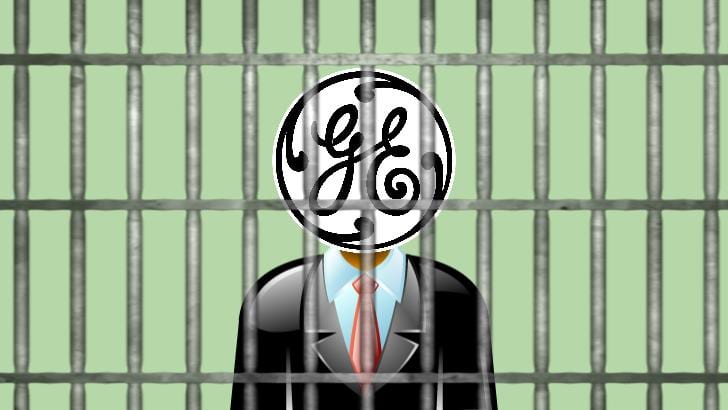
In May 2012, three former GE executives were imprisoned after being convicted on multiple charges of conspiracy to commit wire fraud and defraud the United States. Dominick Carollo, Steven Goldberg and Peter Grimm had all worked for GE Capital—the financial division that operated as a semi-legal “shadow bank,” and that accounted for about half of its parent corporation’s profits until the global financial collapse it helped precipitate began in 2007. Between 1999 and 2006, the trio conspired to skim millions from municipal bond investment contracts. With the full approval of their bosses.

According to Rolling Stone’s Matt Taibbi, the scam worked as follows for the company that Marty Walsh, Charlie Baker and cheerleaders like the Boston Globe have welcomed to Boston with open arms: Municipal governments commonly partner with big banks to sell bonds to pay for significant capital costs—like building schools. The banks invite investors to buy the municipal bonds and deposit the resulting funds in tax-exempt accounts from which all necessary project expenses can be paid. However, since all the bond money does not get spent at once, municipal governments typically hire brokers to find major financial institutions to invest it for them through a public auction process. In general, it is legally required that brokers get bids from at least three financial institutions—and the one that offers the highest annual rate of return wins the contract to invest the spare cash from a given bond fund.

But for GE Capital—and a host of other major financial institutions—the process was rigged from top to bottom. In the case of GE’s Carollo et al, the defendants conspired with executives at the brokerage CDR and financial institutions like Bank of America, JPMorgan Chase, Wells Fargo, and Morgan Stanley to divvy up investment contracts for municipal bond funds. CDR would drum up business with local politicians around the country—often bribing them with various kinds of campaign donations and gifts. The pols would then reward CDR with contracts to invest unspent funds from municipal bond issues, while CDR would work with the GE Capital—in concert with the other major financial institutions—to illegally decide which corporation would win which auction for such investment contracts in advance. The “winner” of each auction would collude with the other bidding financial services companies on the bid rate to ensure that the “winning” bid was as low as possible. The agreed upon rate was usually lower than a fair market rate by just a few tenths of a percent. But that was enough to make a killing.

For example, if a fair bid in an auction might have been that GE Capital would invest a municipal government’s unused bond funds at a 5.04 percent annual rate of return, CDR would coach the company to only offer 5 percent. The other bidders would purposely offer lower rates, losing in exchange for winning future rigged auctions. GE would then pocket the .04 percent windfall. A municipal bond fund that might have $200,000,000 to invest in its first year would return around $80,000 extra to GE in that fashion. Which doesn’t sound like much. But such bond funds would be invested by GE Capital for years until they were spent down fulfilling their original purpose to build schools and the like. And GE Capital and CDR colluded on huge numbers of such illegal arrangements, pouring vast sums into GE’s coffers. While depriving municipal governments of that same money. GE Capital then kicked back some of its take to CDR as “fees.”

Given the complexity and ubiquity of this practice, no one knows exactly how much was stolen. But since fines paid by large corporations to governments at various levels for such crimes tend to be vanishingly small, it’s possible to get an idea of the scale of the crime. According to the Securities and Exchange Commission (SEC), GE paid a $70 million coordinated settlement in 2011 to the SEC, Department of Justice, Internal Revenue Service, and a coalition of 25 state attorneys general. The SEC alleged that “from August 1999 to October 2004, [GE Capital] illegally generated millions of dollars by fraudulently manipulating at least 328 municipal bond reinvestment transactions in 44 states and Puerto Rico.”

GE committed yet another massive crime against the public interest. And got away with it. In November 2013, Carollo, Goldberg and Grimm were freed on appeal. The reason? The government had taken too long—ten years—to build its case against the former GE executives.

Apparent Horizon is syndicated by the Boston Institute for Nonprofit Journalism. Jason Pramas is BINJ’s network director.

Copyright 2016 Jason Pramas. Licensed for use by the Boston Institute for Nonprofit Journalism and media outlets in its network.
AUSTERITY BUDGET: BAKER HITS STUDENTS, HOMELESS, POOR, EVERYBODY BUT THE RICH WITH FY17 BUDGET PROPOSAL

Blend

February 25, 2016

BY JASON PRAMAS @JASONPRAMAS

If you’re a working person, and you want to understand the annual Massachusetts state budget process, the best resource to consult is the Mass Budget and Policy Center (MBPC). It issues timely reports detailing every major budget proposal and wrapping up each final budget. And it keeps the interests of the Bay State’s working families front and center. All while providing much-needed historical perspective to numbers that are often presented ahistorically by state leadership and much of the press corps. Governor Charlie Baker’s most recent budget proposal was released in late January, with MBPC’s report, “Analyzing the Governor’s FY 2017 Budget,” following soon afterwards. Naturally, I’ll be using it as my source for most of this column.

Baker is said to be a nice guy. But he’s also a neoliberal’s neoliberal—handing out millions to giant multinational corporations like General Electric with one hand while cutting critical social spending with the other. So it’s no surprise that MBPC called his budget proposal—known as “House 2” in this second year of the Commonwealth’s two-year legislative cycle—an “austerity budget.” As has become depressingly typical in the United States of the early 21st century, tax increases on the rich and corporations are so far off the table that you have to go to Sweden to even hear the barest rumor of such an idea. Or at least you did until Raise Up Massachusetts started its constitutional amendment campaign to tax the rich and Bernie Sanders started getting serious airtime. The lack of progressive taxation at the state and federal levels leaves the Mass government continually starved for funds, and the annual budget process turns into an exercise somewhat akin to shuffling deck chairs on the Titanic.

The resulting budget proposal is therefore too harsh to break up into the kind of “good, bad” typology that may be appropriate for happier times. I’ll instead employ a more realistic categorization of the main budget lines into The Bad, The Mixed, and The Cops. The last category because one can’t help but notice that budget lines that fund police seem to increase with more regularity than other lines. I’m sure the police forces in question still never think they’re getting enough cash. But I respectfully disagree.

Although the list of budget lines below seems long, it is an extremely basic overview of the Baker proposal—provided here in the public interest. If you have some free time, and you really want to get a handle on the intricacies of the Mass state budget, I highly recommend reading the entire MBPC report. Or going directly to the source and wading through the full proposal.

For the quick and dirty summary, read on …

THE BAD

K-12 Education

To quote a special MBPC report on the FY 2017 K-12 education funding proposal: “The Commonwealth’s Chapter 70 education funding formula aims to ensure that every child in every district can receive an adequate baseline education. […] For FY 2017, the Governor proposes increasing Chapter 70 aid by $72.1 million over last year (1.6 percent).” This is the lowest increase since the 2008 recession. In addition, due to a new method of counting low-income students, the proposal ends up cutting or level-funding Chapter 70 aid for some communities—potentially causing local funding crises. One city under threat is Attleboro—which is slated to see only a .56 percent K-12 budget increase when municipal funds are included. School Finance Director Marc Furtado told the Sun Chronicle that amount is “not enough to cover increased costs in health insurance—never mind salaries, special education, maintenance and other items.” Closing the budget gap could require asking teachers to forego pay raises of 2-3 percent, making all students pay for busing and sports fees, and eliminating after-school programs in the middle schools. Other affected cities and towns will be even worse off.

Higher Education

The public higher education system in Massachusetts includes the University of Massachusetts system, the state university system, and the community college system—all of which have been woefully underfunded for over two decades. Resulting in huge increases in tuition and fees in that period. The governor’s FY 2017 budget proposal cuts $6.3 million (.5 percent) from current FY 2016 levels.

Environment and Recreation

The FY 2017 budget proposal cuts $14.9 million (7 percent) from current FY 2016 levels. This includes a $4.4 million cut (15 percent) from the Department of Environmental Protection, a $2.1 million cut (14.4 percent) from the Hazardous Waste Clean-Up program, and a $9.2 million cut from State Parks and Recreation. In that last case, the budget proposes that the Department of Conservation and Recreation retain $19.2 million that it collects from parking, camping, and entry feels—which lowers the cut to $6 million.

State Employee Health Insurance

The FY 2017 budget proposal tries to shift more state employee health costs onto state workers—increasing the share of health insurance premiums paid by employees hired before 2003 from 20 percent to 25 percent. Baker also wants to increase the share of retired state employees health premiums from 20 percent to 25 percent. The two moves would save $33 million. State retirees are definitely at risk with this plan, and long term current employees will take an effective pay cut.

Housing

The FY 2017 budget proposal calls for a $20.1 million increase (4.32 percent) from current FY 2016 levels. But actual FY 2016 is slated to be higher than planned, making it a $6 million cut (1.29 percent). Most of that cut falls upon the Emergency Assistance (EA) shelter program that serves over 4,000 homeless families with a $36.8 million increase over the FY 2016 budget, but $6 million less than the actual amount being spent on the program in this fiscal year.

Juvenile Justice

The FY 2017 budget proposal calls for a slight decrease in funding for juvenile justice programs run by the Department of Youth Services (DYS) below current FY 2016 levels. Most DYS programs are level-funded or decreased from last year.

Transitional Assistance

These programs help low-income individuals and families meet their basic needs and improve their quality of life when faced with an emergency. They used to be called welfare—rather than the current Orwellian appellation “transitional assistance.” The FY 2017 budget proposal calls for a decrease of $18.2 million in funding below current FY 2016 levels.

Other Human Services

These programs include supports for veterans, funding for the Soldiers’ Homes, and a few particular cross-agency initiatives. The FY 2017 budget proposal calls for level-funding veterans services (including the Soldiers’ Homes) with a $2.3 million decrease in funding for administration at the Soldiers’ Homes. The Massachusetts Emergency Food Assistance Program (MEFAP), a state supplement to federal funding for a network of food banks, is not being funded enough to keep up with inflation—while the demand at area food banks has been increasing.

Economic Development

These programs aim to strengthen the state’s workforce, support community investments, and stimulate economic activity. The FY 2017 budget proposes a decrease to economic development programs of $16.3 million (11 percent) from current FY 2016 levels.

Transportation

To directly quote the MBPC governor’s budget report: “In the Governor’s FY 2017 budget proposal, the most significant change for transportation is a $30.9 million reduction to the Massachusetts Transportation Trust Fund as compared to the current FY 2016 budget. This fund contributes to highways, transit, intercity rail, small airports, the Massachusetts Turnpike, and Motor Vehicle Registry, while also receiving funds from the Commonwealth Transportation Trust Fund, tolls, and federal transportation sources. The proposed FY 2017 amount of $327.7 is 8.6 percent below the current FY 2016 budget of $358.5 million, which itself had been reduced $6.5 million by the Governor’s January 9c cuts.”

THE MIXED

Early Education

These programs prepare children for K-12 education. The governor’s FY 2017 budget proposal calls for a small increase of .8 percent over this year, less than the expected rate of inflation.

MassHealth (Medicaid) and Health Reform

The governor’s budget calls for $15.41 billion for MassHealth programs, and $157.9 million for MassHealth administration and operations, an increase of 5 percent. The proposal does not ask for any cuts to member eligibility or benefits, but has a variety of strategies to control costs—including freezing rates for most providers (with the exception of behavioral health and substance abuse), and directing members to lower-cost health care. However, the proposal does not include insuring an increased number of members. Rather it seeks to maintain enrollment at 1.89 million members and hold MassHealth cost increases to 5 percent. This is problematic because, despite the relative success of the program, there are still too many Mass residents who don’t have health insurance.

Mental Health

The governor’s FY 2017 budget proposes an increase of $12.8 million (1.7 percent) over current FY 2016 levels, barely enough to cover inflation. But there is an increase in funding for residential behavioral health treatment for drug addicts.

Public Health

The governor’s FY 2017 budget proposal increases this line by $7.9 million (1.35 percent) over current FY2016 levels. The main increase is $9.3 million (7.1 percent) more for funding for substance abuse programs in the Department of Public Health. This still level-funds most of the state’s substance abuse programs, but increases funding for the Bureau of Substance Abuse by $9.1 million to support an increased level of prevention and treatment. Most other public health programs are level funded or cut.

Child Welfare

Given the recent scandals in the Department of Children and Families, the governor’s budget proposes a 5.1 percent increase over the current FY 2016 appropriated total for child welfare services. Mainly for more caseworkers, administration, and oversight. However, DCF spending estimates for the remainder of FY 2016 are expected to be $16.8 million more than current appropriations; so a supplemental budget appropriation may be needed this fiscal year.

Elder Services

The governor’s FY 2017 budget proposal calls for a slight increase to funding at $267.9 million. A major part of the plan for Elder Services is to combine some of the major accounts that provide funding for elder home care services—resulting in a slight decrease of about $770,000 for those services. Elder Protective Services—which investigates elder abuse and neglect—would see a $5 million increase. Grants to the Council on Aging—which provides grants to local council on aging centers that provide services to and advocates for elders—would see a decrease of $850,000.

Disability Services

These programs provide a range of services for people with disabilities. The governor’s FY 2017 budget proposal calls for a 2.7 increase from current FY 2016 levels. A number of the programs are being level-funded or cut, including services for people aging with developmental disabilities, people with autism spectrum disorders, and young adults with disabilities during their transition year from youth services upon turning 22.

Pensions

Here I’ll again quote the MBPC budget report: “In his FY 2017 budget proposal, the Governor recommends increasing the state’s contribution to the Pensions Reserves Investment Trust (PRIT) Fund by $226.1 million to a total of $2.20 billion. This represents an increase of 11.5 percent over the $1.97 billion contributed to the PRIT in FY 2016. This annual appropriation is in accordance with the 1988 state law that requires the Commonwealth to set aside money in the present in order to fund the future pension costs of public employees. The specific amounts to be contributed annually to the PRIT are stipulated in Massachusetts General Law, with a five year schedule included therein, running from FY 2012 through FY 2017.”

THE COPS

General Local Aid

These programs help cities and towns fund vital local services such as police and fire protection, parks, and public works. The FY 2017 budget proposes to increase Unrestricted General Government Aid (UGGA) by $42 million (4.3 percent) over current FY 2016 levels.

Prisons, Probation and Parole

The FY 2017 budget proposes to roughly level-fund prisons, probation, and parole services for $1.36 billion. Of special note, the Essex County, Bristol County, Plymouth County, and Norfolk County Sheriffs’ Departments would receive increases of 10 to 20 percent above FY 2016 levels.

Apparent Horizon is syndicated by the Boston Institute for Nonprofit Journalism. Jason Pramas is BINJ’s network director.

Copyright 2016 Jason Pramas. Licensed for use by the Boston Institute for Nonprofit Journalism and media outlets in its network.

GE BOSTON DEAL: THE MISSING MANUAL, PART 3

Untitled drawing

Image by Kent Buckley

February 15, 2016

BY JASON PRAMAS @JASONPRAMAS

Returning to our ongoing look at General Electric’s recent and inconvenient history of violating the public trust, in part 2 of this “missing manual” the corporation got out of the subprime housing loan market just in time to avoid destruction in late 2007. But it could not escape from the consequences of an economy based on selling toxic home loans to poor people who were defaulting in vast numbers by 2008.

That year, everything began to unravel for GE—as it did for all other large interlocked financial services companies that derived a substantial percentage of their profits from predatory loans in the same period.

According to Fortune magazine, after reporting an unprecedented first quarter loss of $700 million, GE’s stock price began spiraling downwards in April 2008. Failing to sell off its light bulb, appliance, and private-label credit card businesses over the summer due to the worsening economic climate stopped the corporation from making typical course corrections to get back on its feet.

In September 2008, GE’s stock price crashed after Lehman Brothers—a financial services titan—collapsed on the heels of Bear Stearns’ disintegration that March. The company became starved for operating funds. But the private credit markets were frozen in terror.

On September 30, GE made two desperate moves. At 7:30 am it sold $3 billion in preferred stock to billionaire investor Warren Buffet’s Berkshire Hathaway Inc. on very bad terms. At 1:44 pm, GE announced its deal with Buffet and said it would sell $12 billion of common stock the next day at prices far lower than it had paid to buy back $15 billion of its own stock over the preceding year. Meaning it was selling the stock at a huge loss in exchange for ready cash.

The next day, the coup de grace: Word spread throughout the markets that GE would be unable to cover billions in regular payouts to holders of its commercial paper. Basically a kind of I.O.U., commercial paper is a kind of short-term promissory note that big corporations like GE are able to issue on an ongoing basis to raise money to cover things like daily expenses. There is no collateral behind commercial paper. Only the good name—and, ideally, top-flight credit rating—of the company issuing it. In normal times, it’s a far cheaper way to borrow money than a line of credit with a commercial bank. But 2008 was not a normal time. At one point that year, GE had over $100 billion dollars out in commercial paper as it tried to stay afloat.

Executives clearly knew their company was doomed unless the government bailed it out. Already on September 30, a GE spokesperson “e-mailed the media with a message that Congress must act ‘urgently’ on the pending financial bailout package.” But the company didn’t wait for congressional action. Since it was not a traditional bank, GE did not qualify for a significant direct cash infusion under the infamousTroubled Asset Relief Program (TARP). So it spent the next few weeks brokering a backroom deal with the Federal Deposit Insurance Corporation (FDIC).

According to the New York Times, on November 12, 2008 the FDIC announced that it would back GE’s commercial paper for up to $139 billion under the Temporary Liquidity Guarantee Program (TLGP). A program that the federal government changed overnight to allow GE to qualify—just as TARP was changed to benefit Goldman Sachs et al—according to Pro Publica and the Washington Post. GE had “joined major banks collectively saving billions of dollars by raising money for their operations at lower interest rates.” The company was able to sell $74 billion in government-backed commercial paper and longer-term notes by Spring 2009.

And how did GE survive the period between its early October 2008 financial collapse—when it was still short on funds despite the precipitous sale of $15 billion of its stock—and its November 2008 bailout by the TLGP program? In 2010, Pro Publica reported that Federal Reserve Board documents released that year showed that GE had effectively borrowed $16 billion more dollars at that time by selling commercial paper through the Fed’s Commercial Paper Funding Facility (CPFF).

So General Electric was saved by two government programs that provided it with upwards of $90 billion dollars of cheap credit. According to the corporation’s own September 30, 2009 10-Q filing to the Securities and Exchange Commission, GE paid only $2.3 billion in fees for its participation in the TLGP and CPFF programs. Meaning that GE got unbelievably good loan terms—the equivalent of a flat 2.56 percent interest rate. Less than the rates that Americans pay on most any other loans. Including the housing loans that wrecked the economy in 2007-2008. And the student loans that could very well lead to another financial catastrophe before this decade is out.

That is how GE got to survive the recession it helped create. By gaining access to a massive pool of public funds totally unavailable to its tens of thousands of subprime housing loan victims. The same company under the same leadership that Massachusetts officials are paying $270 million to bring to Boston. Excelsior!

Coming soon in part 4: GE’s municipal bond scandal and other amusements.

Apparent Horizon is syndicated by the Boston Institute for Nonprofit Journalism. Jason Pramas is BINJ’s network director.

Copyright 2016 Jason Pramas. Licensed for use by the Boston Institute for Nonprofit Journalism and media outlets in its network.
MANCHESTER DIVIDED: SEIU ‘FIGHTS FOR $15’ IN NH WHILE ITS CANDIDATE FIGHTS FOR $12

Republican Debate Night_020616_DSC_3124_Images©2016 Derek Kouyoumjian

Photo by Derek Kouyoumjian

February 8, 2016

BY JASON PRAMAS @JASONPRAMAS

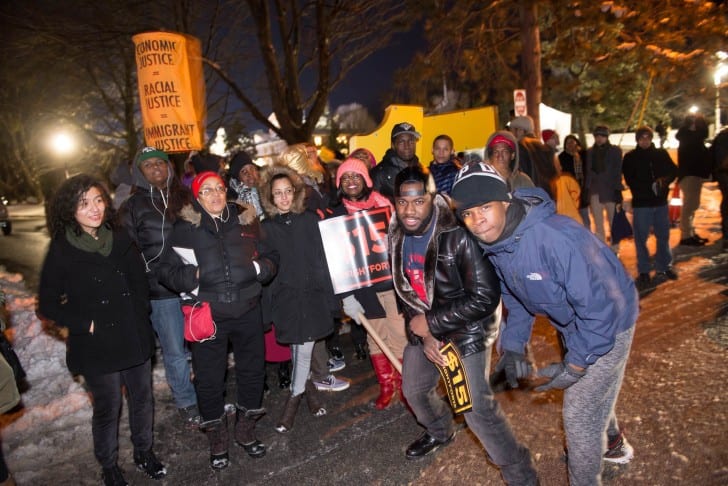
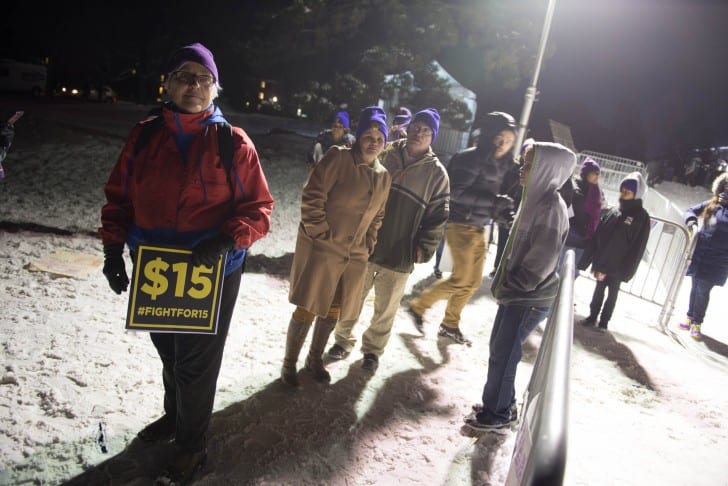
The “protest pit” outside the Republican Presidential Debate at Saint Anselm College in Goffstown, New Hampshire on Saturday evening was a fenced-in area in a field about a quarter mile down the road from the main entrance to the campus.

Bumper to bumper traffic ran in front of the pit. Odd given that NH State Police were letting few cars onto the campus. Most were told to turn around. No one that Republican leadership didn’t want in was getting anywhere near the Carr Center where the debate was taking place.

Powerful lights shone down on the scene from one side—lending it an eerie cast. Behind the fence facing the road were a couple hundred supporters for a few of the Republican candidates. But that was just the first layer. Behind them were about 500 activists with the Fight for 15 campaign—organized andbankrolled for $30 million as of last August by the Service Employees International Union (SEIU). Whose leaders had bused in SEIU staff and members; student activists; and allies from other unions and immigrant organizations from around the region. At least 13 busloads from southern New England overall, according to the campaign’s registration form for the event.

A respectable showing, if not the “massive crowd of underpaid workers” that SEIU’s press release had promised.

So there they were. Supporters of a $15 an hour federal minimum wage. A fairly diverse group. Standing in a snowy field on a back road, enthusiastically waving banners—some quite creative, cylindrical and glowing from within like Japanese lanterns—and periodically trading chants with the mostly white right-wing activists in front of them.

Republican Debate Night_020616_DSC_3138_Images©2016 Derek Kouyoumjian

Photo by Derek Kouyoumjian

Their presence was part of SEIU’s current tactic to raise the profile of the Fight for $15 campaign byprotesting presidential debates and other high profile events like the Super Bowl in recent months. Which makes sense as far as it goes.

What doesn’t make sense is why SEIU pulled out 500 people onto a chilly windswept hill in suburban New Hampshire to protest for a laudable reform that their chosen presidential candidate, Hillary Clinton, absolutely does not support.

Clinton, like Barack Obama, has come out in favor of a $12 an hour minimum wage. Bernie Sanders, the only candidate whose politics are in line with labor unions like SEIU, is also the only candidate who publicly supports the Fight for $15 campaign’s main goal—a $15 an hour minimum wage. Barely a living wage at all in many parts of the country. Hardly the huge ask that opponents make it out to be. Especially given the wage freeze imposed on most Americans by corporations and our political duopoly since the 1970s.

Photo by Jason Pramas

Photo by Jason Pramas

Yet the leaders of the 1.9  million member SEIU backed Clinton last November. Joining the heads of a number of other large American unions in supporting the candidate with a proven record of pushing policies completely antithetical to union demands. Like the insurance industry scam known asObamacare instead of “Medicare for all.” And they have alreadypumped millions to Clinton Super PACs over the heads of their largely voiceless members.

In response, a coalition of progressive unions and activist union members has formed Labor for Bernie to win as many union endorsements for Sanders as possible. Even as Sanders hasamassed a $75 million warchestfrom mostly small donations—without the truckloads of cash that labor unions have traditionally lavished on Democratic candidates over the past few decades.

With Sanders doing very well in the NH polls as of this writing, and clearly capable of staying in the race all the way to this summer’s Democratic National Convention, it appears that SEIU leadership made a serious miscalculation this election. And the fallout from that miscalculation is already playing out in the very state where they organized the standout for their Fight for $15 campaign over the weekend.

Two New Hampshire SEIU locals—560 (Dartmouth College workers) and 1984 (NH State Employees’ Association)—broke ranks with SEIU leadership last fall and backed Sanders for President. Both locals were present in Goffstown on Saturday.

Whether Bernie Sanders wins the nomination and election or not, current SEIU leadership—and the leadership of every union marching in lockstep with the worst elements of the Democratic Party—is going to face increasing pressure from its rank-and-file members to stop supporting pro-corporate anti-labor candidates like Clinton. Likely culminating in major grassroots insurgent campaigns aimed at removing union leaders perceived as sellouts—as has happened on many occasions in labor history. It remains to be seen whether such internal reforms will happen before the major unions collapse under the death of a thousand cuts being inflicted on them by their traditional political enemies and their erstwhile allies alike.

SEIU and less democratic unions like it could forestall the looming civil war in their own ranks—and increase the American labor movement’s chance of survival—by learning from the more democratic practices of the 700,000 member Communication Workers of America (CWA)—whose leadership stepped aside last year and let their members directly decide: a) If they should endorse any candidates for POTUS, and b) Which candidate they should endorse.

CWA members, some 30 percent of whom are Republicans, voted to back Sanders in December.

This article is syndicated by the Boston Institute for Nonprofit Journalism — and stands in for this week’s Apparent Horizon column. Jason Pramas is BINJ’s network director. He has been a member of three SEIU locals (925, 285 and 888) over the past 17 years, and helped lead a successful union drive with SEIU Local 509 last year at the cost of his job.

Copyright 2016 Jason Pramas. Licensed for use by the Boston Institute for Nonprofit Journalism and media outlets in its network.
GE BOSTON DEAL: THE MISSING MANUAL, PART 2

18.04 AH IMAGE GE

Image by Kent Buckley

February 1, 2016

BY JASON PRAMAS @JASONPRAMAS

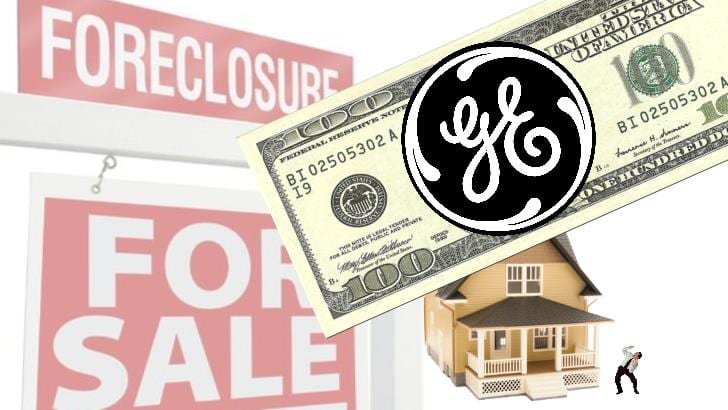
Two weeks after the first installment of this Missing Manual, we now know that GE will receive up to another $100 million of Boston’s largesse in the form of reopening the Old Northern Avenue Bridge and $25 million in state money for work on roads, pedestrian walkways, and bike lanes near the corporation’s new Seaport District HQ. Pushing the total giveaway to over $270 million in public funds.

Gov. Charlie Baker, Mayor Marty Walsh, and boosters like the Boston Globe claim that the investment will be worth it. Yet GE’s record of slashing jobs, despoiling the environment, and evading taxes says otherwise. And their role in the subprime mortgage crisis further repudiates such official optimism.

Back in 1999, the Glass-Steagall Act—a critical piece of Depression-era social legislation that put up a firewall between commercial banks and investment houses—was torpedoed by Congress. One of the excuses for the deregulatory push was the claim that so-called “shadow banks”—institutions that perform banking functions outside of the traditional system of federally-regulated banks—were doing great business with less regulation. The now-diminished GE Capital was then one of the largest shadow banks, since as the finance arm of an industrial concern it was not classified as a bank. Thanks to that fact and the happy coincidence that GE Capital owned a small Utah savings and loan operation, it was allowed to “engage in banking under the lighter hand of the Office of Thrift Supervision.” Rather than the more strict banking regulations overseen by the Federal Reserve—which do not allow banks to engage in commerce—according to a 2009 report by ProPublica and the Washington Post.

Ironically, the deregulation of the banking system proved to be a key factor in the 2007 subprime mortgage crisis and the resulting 2008 financial crisis. And the much-praised practices of shadow banks like GE Capital were precisely the ones that nearly wiped out the US economy. GE had long used GE Capital, equivalent to the seventh largest banking company in the US until 2008, to fatten its bottom line. According to Maureen Farrell of the Wall Street Journal, “GE got into lending decades ago and grew that arm of its business steadily in the years before the crisis, as it was able to leverage its triple-A credit rating for access to cheap capital. Before the credit crisis, GE relied upon lending for around 50 percent of its earnings.”

So in 2004 GE Capital had plenty of ready cash to buy California-based WMC Mortgage Corp.—a company that specialized in foisting subprime housing loans on poor families that couldn’t really afford them, using highly unethical sales tactics—for about half a billion dollars. According to a 2012 report by Michael Hudson of The Center for Public Integrity, even before the purchase, WMC “… was producing $8 billion a year in subprime home loans and boasting profits of $140 million a year.”

Then in 2006, US housing prices declined sharply. Subprime borrowers with no reserve cash were unable to refinance their home loans as their adjustable-rate mortgage payments increased mercilessly. Subprime lenders then began to automatically slap late-paying borrowers with even higher penalty rates. More and more people defaulted on their loans. Lenders like WMC suddenly went from being cash-rich to being cash-poor.

GE Capital was hemorrhaging money by 2007. During the first half of that year WMC lost over $500 million as the mortgage industry “spun into chaos.” By October 2007, the Center for Public Integrity report concludes, “WMC Mortgage was effectively out of business, dead after having pumped out roughly $110 billion in subprime and ‘Alt-A’ loans under GE’s watch.”  

Meanwhile, GE Capital, like many other financial institutions of the period, had rolled packages of subprime mortgage debt into Residential Mortgage-Backed Securities (RMBSs)—which it then sold to investors. Including institutional investors like government-sponsored housing lender Freddie Mac. When the WMC subprime mortgages collapsed in 2007, the GE Capital RMBSs based on them followed suit. And the whole house of cards built on bad mortgages to poor people fell down. GE Capital immediately put hundreds of millions of dollars aside to pay off its investors. But not its mortgage holders. WMC-issued mortgages failed at rates of up to 75 percent in some areas. Ruining the lives of tens of thousands of working families in the process.

GE had gotten out of the subprime racket just in time to stay solvent into 2008. The most significant federal blowback from the episode came in 2011 when the Federal Housing Finance Agency that regulates Freddie Mac sued General Electric for selling them $549 million in subprime-based RMBSs. According to American Banker, they “charged GE’s former mortgage lending unit with presenting a false picture of the riskiness of residential mortgages behind securities that were sold to Freddie Mac.”

GE settled the suit in 2013 for just $6.25 million.

Coming soon in part 3: the 2008 financial crisis and federal bailout of General Electric.

Apparent Horizon is syndicated by the Boston Institute for Nonprofit Journalism. Jason Pramas is BINJ’s network director.

Copyright 2016 Jason Pramas. Licensed for use by the Boston Institute for Nonprofit Journalism and media outlets in its network.

GE BOSTON DEAL: AN ACTIVIST HANDBOOK

NEW WEB HEAD TEMPLATE (1)

Images (from 2012 protest against GE in Boston) by Chris Faraone

January 28, 2016

BY JASON PRAMAS @JASONPRAMAS

Say friend … is a multinational corporation with a terrible reputation, a limitless PR budget, and a penchant for backroom deals with fawning politicians bleeding your state for hundreds of millions of public dollars that would be better spent on virtually anything else? A multinational named General Electric?

Are you afraid of the consequences of such malfeasance for your community and for democracy itself? Want to do something about it? Then look no further. What you need is a corporate campaign. Sourcewatch—a fine resource for journalists and researchers alike—has a concise definition of the term:

Corporate campaigns were developed in the mid twentieth century by activists and organizers such as Saul Alinsky, and honed in recent decades by labor unions and non-governmental organizations in the environmental, social justice and consumer movements. The goal of a corporate campaign is to publicize undesirable behavior or practices by a corporation through various strategies and tactics that can force change upon the company and thus allow the campaigning organization to claim a victory for its cause. At any given time organizations and even individual citizen activists are waging scores of corporate campaigns, some of which last for years, with varying results.

In my own experience, a corporate campaign is a limited strategy. It does not automatically lead to a broader democracy movement in a society, but can be a stepping stone along that path. It is not always a progressive strategy, although progressives probably use it more than any other political current. NIMBY activists in rich towns use it to keep apartment buildings and wind farms out. Right-wing Christians use it to attack companies that publicly support things they oppose—like reproductive rights, gay marriage, and the wheel.

That said, a corporate campaign is still a useful arrow in the proverbial quiver of justice. And here’s how you can run one.

  • First, decide that a campaign is needed. Gather some like-minded friends into a loose organization, and agree to work together towards a common goal.
  • Second, see if there’s already an organization running such a campaign. If there is, check them out. Do they seem to be a real grassroots expression of the needs of some definable community? If they do, then consider joining them or working with them in coalition. Or do they look like what seasoned activists call an “astroturf” group—a fake organization typically set up by some powerful interest or other to help confuse its antagonists and stop them gaining public support. If so, give them a wide berth and spread the word that others should do the same.
  • Third, start researching your target corporation. Talk to librarians, journalists, academics, and experienced campaigners for advice. Find out everything you can about the company —with a focus on their recent activities. Look for proof of bad behavior in their business and political dealings.
  • Fourth, research possible remedies. What have other communities done to reign in the power of your target corporation and corporations like it? Court action, regulation, and legislation are all good avenues to pursue.
  • Fifth, publish your evidence. Papers, articles, broadsides, podcasts, and videos are all good ways to get the word out.
  • Sixth, if you haven’t already, start fundraising. You’ll need money to win a corporate campaign. You might get some small grants from open-minded foundations early on, but your lifeblood will (and should) be donations you raise from your personal network, your new organization’s network, online via crowdfunding using platforms like GoFundMe, and through fundraisers of various types. You’ll never have anything like the money of your opponents. But you’ll have the strength of your convictions, and—if you do your job well—the support of your community. And can therefore overcome any obstacle if you persevere.
  • Seventh, organize your allies. Pull together community organizations, religious groups, non-profits, labor unions, friendly politicians—anyone who is going to aid your campaign and is willing to work with you.
  • Eighth, build a solid social media presence. Make use of widely available free communications technology to make friends and turn them into supporters. Create a page on Facebook, and a central Twitter account—both with your campaign’s name on them. Regularly feed your presence with updates about campaign activities and links to relevant material. Converse directly with your followers as interaction is key on social media.  Keep in mind that you may never have to create a full website for your campaign if you make good use of social media, but it’s usually a good idea to at least launch a blog on one of the many free blogging communities.
  • Ninth, prepare your public relations campaign. Develop contacts in the press. Plan events and actions that will get and hold the public’s attention. Encourage journalists to cover those events and actions.
  • Tenth, hold your events and actions: open forums, lobby days, protests, and boycotts are all good ways to pressure politicians and corporate leaders to change their policies.

Finally, mobilize as many people as you can to support your campaign. Be sure to give them simple things they can do to show their support and attract even more people: like wearing one of your campaign buttons or putting one of your bumpers stickers on their car. If you’ve done your job well, so many people in your community will agree with you that it will become possible to win your campaign goals—whatever they are.

For a useful model, check out the recent successful #NoBoston2024 campaign—which wasn’t a traditional corporate campaign, but that nonetheless had all the elements of one. And it was a slam dunk resulting in a resounding popular victory against putting the City of Boston in hock for decades for a sporting event with a long history of corruption.

Questions? Feel free to contact me at jason@binjonline.org. And for those of you who might launch a corporate campaign against GE: let’s be careful out there.

Apparent Horizon is syndicated by the Boston Institute for Nonprofit Journalism. Jason Pramas is BINJ’s network director.

Copyright 2016 Jason Pramas. Licensed for use by the Boston Institute for Nonprofit Journalism and media outlets in its network.