
Skip to content

national

GO BIG OR GO HOME: TOWARDS A MASS CLIMATE JUSTICE MOVEMENT

Untitled drawing - Copy

Image by Kent Buckley

December 16, 2015

BY JASON PRAMAS @JASONPRAMAS

On Saturday, one important global process ended and another began. The process that ended manifested in the form of the 2015 United Nations Climate Change Conference. The process that began—or more correctly, accelerated—manifested in cities all over the world. Here in Boston, it took the form of Jobs, Justice and Climate—a rally and march to “defend New England’s future.”

Over 2,000 people attended the action last Saturday. A fine turnout by current standards, and the largest regional climate justice rally in recent memory. The organizers—representing a coalition of nearly 150 labor, social justice and environmental organizations —are to be commended. As are their 600,000-plus colleagues across the globe. Including the Paris climate activists who have been harassed and detained by the French security state in the aftermath of the tragic November 13 attacks by supporters of the Islamic State of Iraq and the Levant. As if people exercising their democratic rights to take to the street to stop capitalism from destroying the planet have anything in common with people who slaughtered dozens to push Western states into precisely that sort of undemocratic reaction.

The UN-brokered climate justice process launched at the 1992 Earth Summit in Rio de Janeiro ended in failure. The so-called Paris Agreement that 195 participating countries negotiated this month at best still leaves the door open to the possibility of a real climate pact in the future, and at worst is just an empty PR move by powerful nations and multinational corporations intent on continuing their carbon-burning business as usual at any cost. Built, as it is, on non-binding voluntary commitments without real enforcement mechanisms.

If there is ever to be a real pact to stop global warming, it will only come about if the grassroots democratic process—which started years before the 1992 Earth Summit—makes it happen. That process must take center stage now, and should only finish when its activists come home “with their shields or on them”—to paraphrase an old saying attributed to ancient Spartan women by Plutarch.

That is a tall order to be sure.

Here in New England, in addition to the work by a growing number of climate justice organizations and institutions that goes on day-to-day—collecting solid climate research, conducting popular education, training new activists, reaching out through the media, pressuring climate criminals and lobbying the government at all levels—there must be a constant and ever-larger series of public political actions to demand the swift transition to a carbon-free economy before it’s too late.

It’s important to keep the scale of the task in mind. There were over 14,000,000 people in New England in 2010. There are more now. There will be more still every year until at least mid-century—assuming food supplies remain stable, which we cannot assume as the impact of global warming worsens. A significant percentage of those people need to be mobilized and kept mobilized for years if there is to be a climate justice movement strong enough to overcome the vast panoply of money and political power arrayed against it. Those growing numbers must then be deployed to push through binding local, state, and regional climate agreements that pave the way for binding national and global climate agreements.  

So, a rally of 2,000 is great. But let’s put that in perspective. One can see 2,000 people at the average high school football game. Or at a large religious service. Or at a large nightclub. It’s just not a very large gathering by the standards of our era. Even if each of those 2,000 people directly influenced 10 people to become (or remain) activists—no mean feat—that’s only 20,000 people. Not an unreasonable figure considering the many organizations endorsing the Boston rally. But not enough to fill Fenway Park either. Let alone Gillette Stadium.

It’s true that those 2,000 rally attendees influenced many more through the press coverage they got for the rally. And that 20,000 people can influence many many more with available digital media. But spreading ideas does not automatically impel people to act with the necessary speed, frequency and force to forestall the climate disaster that even now—in this hottest year on record—is starting to take hold as science predicted.

Political organizing is tough work … until it isn’t. Until a movement that dwarfs anything ever seen in human history rises and sweeps through the entire population. Getting to the point where organizing isn’t tough is very difficult indeed. And it’s impossible to predict the arrival of such a mass movement. It will either happen or it won’t. There’s no telling when. Making it all the more important that today’s environmental activists think really really big going forward.

New England is only one small region of the United States with less than 5 percent of its population. And the US has less than 5 percent of the world’s population. But much of its political and economic power. Therefore, the work that climate activists do in this region and nation today is potentially more effective than work their counterparts do outside such centers of power. That is cause for hope. And it should encourage activists in Boston and around our region to redouble their efforts towards a future where New England—and the world—will no longer have to be defended against global warming. Because global warming will have been stopped by human action. As it was started by human action.

Maybe then humanity will be able to survive to the next stage of our evolution … a global civilization built on principles of democracy, equality, social justice, peace, and ecology. Ad astra per aspera. Through hardship to the stars.

It is that vision that has kept me politically active since the 1980s. Perhaps it will inspire some of you, too. If fellow climate justice activists would like to talk in more depth about the issues I’m raising here, I can be reached—as ever—at jason@binjonline.org.

Apparent Horizon is syndicated by the Boston Institute for Nonprofit Journalism. Jason Pramas is BINJ’s network director. He is a longtime climate justice activist.

Copyright 2015 Jason Pramas. Licensed for use by the Boston Institute for Nonprofit Journalism and media outlets in its network.

REMEMBRANCE AND PROTEST: THANKSGIVING THEN & NOW

Brookfield1

November 23, 2015

BY JASON PRAMAS @JASONPRAMAS

The following passage is excerpted from a piece I wrote in 2005. It recounts the story of King Philip’s War—which was fought across southern New England 340 years ago, and started not far from where I attended a Thanksgiving dinner that year at my cousin’s place in North Attleborough. Read it. Think about it. Discuss it with friends and family. And, if you can make it, join the United American Indians of New England and allies for a day of remembrance and protest at the 46th National Day of Mourning on November 26 at noon at Coles Hill in Plymouth. Get all the information, and a more accurate version of the history of  “Thanksgiving” at the UAINE website.

In 1675, a Wampanoag sachem named Metacomet (or King Philip to the English) launched—somewhat reluctantly—a war against English colonists in what is now Massachusetts that came closer than any other war launched by America’s native peoples to ending European domination in at least one corner of the “New World.” It was the last colonial war in which the two sides had relatively equal numbers, and used basically equivalent technology.

Had not disease already decimated the native population of the area decades before, the English never could have won.

The grievances of the faction of the Wampanoags that began the war—and the other nations that joined them including the Narragansetts, Pocumtucks, and Nipmucks—were fairly straightforward. The English unceasingly attempted by foul means and fair to convert the native nations to Christianity. And they continually overstepped the bounds of various treaties and contracts with native peoples in taking land that wasn’t theirs for their own exclusive use.

Two years later, roughly 800 colonists and 6000 Native Americans were dead. Dozens of towns and settlements on both sides were wholly or substantially destroyed. Atrocities were committed by all parties to the conflict—though the English outdid their opposition in that respect, unsurprisingly.

Most of the fighting took place in what are now Plymouth and Bristol Counties in southeastern Massachusetts, in much of Rhode Island, and in the Connecticut River Valley in both western Massachusetts and Connecticut—but it raged throughout modern day New England, and smouldered on for over 100 years with no official end date marked. No treaty, broken or otherwise, was ever signed by either side.

A number of Native American nations were for all intents and purposes destroyed—at least as political entities. The rest were assimilated or marginalized.

The war forever cast Native Americans into the role of “savages”—a subhuman status fit only for subjugation or extermination. For 300 years after the war, most American historians gave short shrift to native justifications for the conflict, and exulted in the glory of a holy war won against the forces of darkness.

After you absorb that Native American history, I recommend you delve into some local Black history that activists at Harvard Law School have unearthed. It seems the school was founded with money from a vile family of slavers by the name of Royall. Making matters worse, Harvard Law then adopted the Royall family coat of arms as its crest. The protesters are calling for the decolonization of their campus, the symbols, the curriculum and the history of Harvard Law School. Readers can find out more by following #RoyallMustFall on Twitter and Facebook.

And a big shout out to the #ConcernedStudents2015 student activists at Brandeis University occupying their administration building for racial justice on their campus as we go to press. Stay strong!

Apparent Horizon is syndicated by the Boston Institute for Nonprofit Journalism. Jason Pramas is BINJ’s network director.

Copyright 2015 Jason Pramas. Licensed for use by the Boston Institute for Nonprofit Journalism and media outlets in its network.

LEFT BEHIND: THE PARIS ATTACKS AND THE NEED TO FUND A MASS INDEPENDENT AMERICAN NEWS MEDIA

Untitled drawing (1)

Image by Kent Buckley

November 17, 2015

BY JASON PRAMAS @JASONPRAMAS

Shortly after the Paris attacks on Friday, I flipped on the TV and saw that Fox 25 was feeding Fox News live during its normal evening entertainment slot. I was not surprised to find that News Corp HQ was taking full advantage of Americans’ understandable outrage about the tragic slaughter of more than 100 innocent people to foment hysteria against immigrants, refugees, Muslims and any other convenient target in the service of a raft of hard-right policy agendas. From calls to shut all European and American borders against people fleeing the horrific Syrian civil war, to demands that government increase surveillance and expand military and police budgets.

All par for the course. Fox will be Fox after all.

But that’s not what bugged me in this case. What bugged me was that the rest of the major American news media was not much better than Fox in its early reportage of the Paris crisis, and that we do not have a mass independent news media representing the positions of the broad left (and much of the populace) in this country: democracy, equality, peace, human rights, and social justice.

There are many interesting “humane and sane” independent news projects around the US—like theBoston Institute for Nonprofit Journalism that I’m helping organize. They’re just not large enough to reach masses of people during periods when global politics is fast-moving and when—as with this latest crisis—reactionary demagogues are given days of constant exposure to rehearse their racist colonialist Islamophobic fantasies unchallenged to audiences of millions on Fox and allied outlets. Which means that News Corp succeeds in pulling public discourse far to the right in the absence of major outlets willing to confront them when it matters most. The comedian journalists of The Daily Show excepted.

The politics of major American news organizations—conservative protestations to the contrary—now generally run from right to center. With editorial lines that are beholden to the rich and powerful. There are a few large outlets like the Boston Globe that lean left in select political economic and cultural debates, but they are slow to challenge powerful government officials and corporate leaders in dangerous moments like this (and the run-up to various recent imperial wars, the railroading of numerous anti-democratic “trade” treaties like NAFTA since the early 1990s, the defeat of several landmark global warming treaties in the same period, etc., etc.).

In many other countries, however, the media spectrum is much broader. There are mass news media of the left, right, and center. The left press is fairly large, influential, and far more likely to be critical of elite responses to political crises like the Daesh (ISIS) orchestrated killings in Paris. And to inspire their audiences to act politically to prevent such crises from being used by the hard right as an excuse to clamp down on civil liberties or rush headlong into armed hostilities. Especially, as with the Syrian civil war, when a multinational conflict and related refugee crisis is already ongoing.

This independent progressive news media has often been funded by donations from trade unions, non-governmental organizations, protest movements and—significantly—by subscribers who are sometimes organized into consumer co-operatives. Employees may also hold a stake in such publications through employee co-operatives. Examples of this kind of progressive mass independent news outlet include Die Tageszeitung in Germany and WOZ Die Wochenzeitung in Switzerland. There are others like Dagbladet Information in Denmark that have more traditional ownership arrangements.

But there has been nothing like these major news publications of the left in the US since the weeklyAppeal to Reason folded in 1922 and the NYC daily PM folded in 1948. Even the smaller city-based alternative weeklies that were founded in the 1960s and 1970s—like the Boston Phoenix—have been in rolling collapse for some time.

Working on BINJ, and having run the left-wing metro news weekly Open Media Boston for seven years before that, I have no doubt that there is more than enough talent in cities like Boston to build the kind of professional mass progressive news operations that this country desperately needs if we are going to remain a democracy in the coming decades.

The question is: Will the remaining progressive institutions with deep enough pockets to bankroll such major news operations step forward while there’s still time? The labor unions, the major nonprofit community organizations, the progressive businesses, religious denominations, foundations and wealthy donors. And will you—the audience that agrees we need such a left news media complex—step forward and donate to projects like BINJ, and to consortia of such projects?

I hope so. At BINJ, we’d like to work with any institution or organization that is forward-thinking enough to see the need for a mass progressive news media. And that is willing to put their money where their aspirations are. Email me at jason@binjonline.org to start that conversation today.

Apparent Horizon is syndicated by the Boston Institute for Nonprofit Journalism. Jason Pramas is BINJ’s network director.

Copyright 2015 Jason Pramas. Licensed for use by the Boston Institute for Nonprofit Journalism and media outlets in its network.
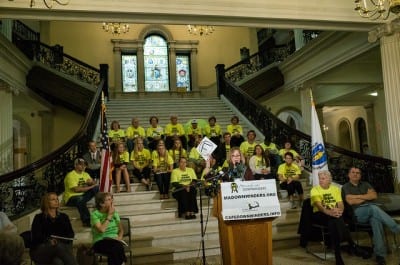
SHUT PILGRIM NOW … AND SAVE MASS FROM NUCLEAR DISASTER

Image by Kent Buckley

October 26, 2015

BY JASON PRAMAS @JASONPRAMAS

About 50 people—most from the South Shore and Cape Cod—held a protest rally last Thursday at the Grand Staircase in the Massachusetts State House to demand the immediate closure of the Pilgrim Nuclear Power Station on a long list of public safety grounds. This in the wake of the facility’s owner, Entergy Corp., announcing it will shutter the plant by 2019 because it’s become too expensive to run.

The demonstrators, led by the several grassroots groups that comprise the Pilgrim Coalition, say that’s an improvement from the 2012 decision, by the industry-friendly Nuclear Regulatory Commission, to allow the plant to remain open until 2032. But every minute that Pilgrim remains open increases the possibility that some calamity could render large swaths of the Bay State radioactive for thousands of years.

It was the kind of event that left me thinking, “We need 50,000 people here, and another 50,000 people surrounding Pilgrim until Entergy shuts it down.” So great is the existential crisis of such a dangerous and aging nuclear reactor being allowed to continue operating far closer to Boston than the now-infamous Fukushima Daiichi nukes are to Tokyo.

Photo by Jason Pramas

Photo by Jason Pramas

Seriously, the Fukushima plant is 141 miles from Tokyo. Pilgrim is only 38 miles from the State House—well within the 50-plus mile distance of the furthest communities that ended up being contaminated by the radioactive plume from Fukushima.

In early 2014, Gov. Deval Patrick confirmed what area activists had been saying for years: there is no viable evacuation plan in the event of a disaster at Pilgrim. Many people living in areas affected by releases of radiation would essentially be told to “shelter in place” by Entergy and the Mass. Emergency Management Association. At the time, Patrick asked the NRC to step in and to close the plant if it failed to comply with regulations. Later that year, the NRC kicked the responsibility for developing real plans back to Patrick. In short: there is still no evacuation plan for communities near the plant, let alone for Boston.

As the protesters pointed out last week, following the 2011 meltdown at Fukushima, the NRC told Americans who were living and working within 50 miles of the plant to evacuate. Given that there are no evacuation plans for the less densely populated communities near Pilgrim, what exactly would we do in Boston if Pilgrim were to suffer a similar disaster? No responsible party has an answer to that very obvious question.

To make matters worse, the Pilgrim nuke is a General Electric Mark I type. Exactly the same type as five of the six reactors at Fukushima Daiichi—including all four of the reactors that suffered catastrophic failures in 2011. Like Fukushima, Pilgrim is situated right on the ocean, and is therefore susceptible to damage from the kinds of super-hurricanes and massive winter Nor’easters that are expected to hit the Massachusetts coast with increasing frequency in the coming decades due to global warming—much like how Fukushima was hit by a tsunami caused by a powerful earthquake.

Pilgrim has already had numerous safety violations over the years—some of which, as with Fukushima, were not properly reported until recently. Nevertheless, the NRC has repeatedly downgraded the safety rating of the plant due to such problems, making it one of the lowest rated plants in the country.

Given these facts, the only sensible thing to do is to shut the plant down immediately. So I join the protestors in calling for Gov. Charlie Baker and the legislature to take all appropriate actions necessary to make that happen now, and for Entergy to think about more than just its bottom line. Rally speakers Sen. Dan Wolf and Sen. Kathleen O’Connor Ives can be looked to for legislative leadership in this fight, though it won’t be their last. Seabrook is only 39 miles from the State House and has similar problems, but that’s a column for another day.

Readers interested in getting involved in this critical campaign can check out the Pilgrim Coalition website.

Apparent Horizon is syndicated by the Boston Institute for Nonprofit Journalism. Jason Pramas is BINJ network director.

Copyright 2015 Jason Pramas. Licensed for use by the Boston Institute for Nonprofit Journalism and media outlets in its network.

SANDERS SHRUGGED

Image by Kent Buckley

October 20, 2015

BY JASON PRAMAS @JASONPRAMAS

One of the marks of what scholars call hegemonic discourse is the assumption that a society’s ruling ideology is considered so “normal” that it does not even need to be named, let alone explained. So it is with the Boston Globe and capitalism.

Most of the Globe’s editorial board, columnists, and reporters,  like virtually the entire mainstream American press corps,  start from the position that capitalism is the best of all possible political economic systems. And, while it may need periodic reform on behalf of “the neediest” in our society (as they like to put it), fundamentally “there is no alternative”—as Margaret Thatcher famously quipped—to capitalism. Understood as free markets, free trade, and corporate globalization. Yet only a handful of Globe staff, like conservative columnist Jeff Jacoby, openly state that position with any regularity.

How then are the Globe’s mainstream capitalist journalists to deal with the increasingly successful Presidential candidacy of Sen. Bernie Sanders, a socialist running as a Democrat?

If recent articles referencing Sanders are any measure, the Globe is choosing to deal with him by setting up straw men about his stated ideology and then knocking them down.

Take Joan Vennochi’s latest column, “When did Democrats become the party of free stuff?” In it she states that “progressive ideology” (whatever that is) “is increasingly about asking government to provide more for its citizens—and more for noncitizens, too.” She juxtaposes that already problematic typification to JFK’s famous call to “Ask not what your country can do for you. Ask what you can do for you country.” She cites that call as being “strongly rooted in the notion of self-reliance,” and in the belief that “government is not there to serve us. We are there to serve it.”

No Bernie Sanders Scandinavia is not a socialist utopia The Boston Globe

She then moves on to paint Sanders and his ideas as essentially a threat to said Kennedy values. The crux of her argument hinges on the definition of socialism that she chooses to use. Which, to get to the point, is incorrect. In this case, Vennochi cites a recent Washington Post blog post that describes socialists “as people who believe ‘that the government should provide a wide range of basic services to its citizens free of charge or at a discount, typically including university education and health care, as well as child care, housing, telecommunications, energy, and more.’ They also believe these services ‘should be available to everyone, not just the neediest.’”

The problem with that definition of socialists and socialism is that it describes a welfare state, not socialism. Welfare states are possible under pretty much any type of modern government. One of the earliest welfare states began under a German emperor in the late 1800s. There have been welfare states in fascist nations, like Italy under Mussolini, in capitalist dictatorships like Singapore under Lee Kuan Yew, and here in the United States to a degree between the 1930s and the present. And yes, also in social democratic (a.k.a. democratic socialist) countries like Sweden—particularly from the 1960s to the 1980s.

So the definition of socialism is not the fact that it allows for a strong welfare state.

Socialism encompasses a broad sphere of ideas, but most socialists share in the belief that human beings should have equal rights (not one set of rules for privileged groups, and another for everyone else), that there should be democratic control of both political and economic institutions worldwide, and that a socialist society must strive to eliminate private control over the means of production. So that the working people of the world—the “99 percent”—can finally control our own destiny.

It’s commonly thought that socialism has to spring from national governments, but elements of socialism can also be introduced by regional and local governments, and critically by trade unions, nonprofit organizations, and co-operatives. Many anarchists are in fact libertarian socialists who believe that networks of very democratic local governments and smaller scale non-governmental organizations should run society— not nation-states, multinational corporations, and huge political parties of the traditional left, right, or center.

There can still be capitalism in socialist societies, but it is typically limited—and kept away from the commanding heights of core economic sectors like healthcare, housing, education, and energy. Also, politics is kept more free from the influence of concentrations of individual and corporate wealth in such societies, helping to ensure that the rich don’t use their funds to seize control over government as completely as they are now doing in the US.

Other articles referring to socialism in the Globe recently have the same flaw as Vennochi’s piece. To the extent they address socialism directly at all, they mischaracterize it. Then dismantle their mischaracterization.

I’ve been watching capitalist reporters take that kind of “ranting at an empty chair’ approach for my entire adult life when it comes to any ideology left of the Democratic Party, and have always thought it to be a cheap tactic and intellectually dishonest. If the Globe was a real forum of ideas, they would at least invite prominent socialist thinkers—of whom there are a number in Boston—to openly discuss and debate what socialism, democratic or otherwise, might mean for America on an ongoing basis.

A good step in that direction would be running the text of the speech that Sanders is planning on the meaning of democratic socialism in its entirety. A better one would be allowing local thinkers across the political spectrum—the full political spectrum, including intellectuals on the anti-capitalist left—to debate the merits of Sanders’ speech in the Globe’s pages. There are several people I could recommend. But why not invite the most famous left thinker on the planet, who lives here in the Boston area, and who theGlobe has resolutely snubbed for the last 50 years: Noam Chomsky.

Here’s his email: chomsky@mit.edu. He answers all communications faithfully. Heck, if the Globe wants, I’ll invite him for them. Globe editors are welcome to flag me at jason@binjonline.org. Anytime. My line, as ever, is open.

Apparent Horizon is the first column syndicated by the Boston Institute for Nonprofit Journalism. Jason Pramas is BINJ network director.

Copyright 2015 Jason Pramas. Licensed for use by the Boston Institute for Nonprofit Journalism and media outlets in its network.