Skip to content

Boston

UMASS BOSTON WILL ALSO BE USELESS UNDERWATER

UMASS-AH-IMAGE

Image by Kent Buckley

October 5, 2015

BY JASON PRAMAS @JASONPRAMAS

This week’s column is a codicil to last week’s column on the need for local policy wonks and politicians to stop proposing major public infrastructure projects in parts of Boston that are going to flood during the increasingly frequent global warming-driven super storms slated to hit us in the coming decades. Which, together with rising oceans, stand a good chance of wiping our city off the map if we don’t begin a “strategic retreat” now.

Despite this very real and looming crisis, hapless Boston Globe columnist Shirley Leung devoted her latest missive to the idea of building dorms for UMass Boston. The wildly unpopular Boston 2024 Olympics she flacked for revived a wildly unpopular plan to build dorms at the campus (in the form of an Olympic Village for athletes), and now Leung is trying to help manufacture a groundswell of support behind the original plan for 2,000 dorm beds — complete with positive quotes from some select bigs who are already on the way to making it a reality.

I’ve long been opposed to dorms at UMB. The school was founded with an “urban mission,” that dictates that its primary purpose is to educate Boston residents. Most residents being working and lower middle class people of color who often can’t even afford one of our increasingly expensive community colleges, let alone one of our increasingly expensive state universities. Not without crushing and criminal lifelong student loan debt.
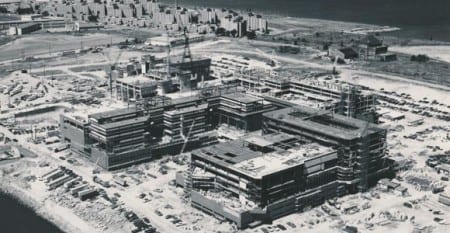
columbiapoint_construction_2014_fall_magazine_usac_news

UMass Boston was specifically created as a commuter school with a mandate to educate and uplift the people of the city. And a commuter school it should stay. Having sat on a campus advisory board for future infrastructure development as a leader of the UMB graduate student union in 2006–2007, I believe that the biggest reason for wanting to build dorms (beyond sadly typical sweetheart deals with private developers) was — and remains — to attract young white upper-middle class suburban students whose families can afford to pay an outrageous sticker price for what should be a free (or at least cheap) school. Thus allowing the UMass Board of Trustees, the Mass. Board of Higher Education, and the state legislature to absolve themselves for their rank irresponsibility in refusing to fight for proper funding for the state public higher education system. All of which primarily benefits big “private” universities like Harvard, MIT, BU, and Northeastern that don’t want public competition for the huge amounts of federal and state money they suck up every year.

That said, there’s another reason why it’s a bad idea to build dorms — or indeed any new construction at the current UMass Boston campus: Because the campus is right on Boston Harbor, and therefore just as much at risk for future super storm destruction driven by global warming as proposed coastal projects like the North-South Rail Link that I criticized last week.

It’s time for UMass Boston and other public institutions to think seriously about the flooded future that climate scientists are predicting for the Boston coastline, and start moving their operations inland to higher ground. A sensible step for UMass and state higher ed leaders would be to start buying up property on hills near the present site of UMB — with an eye toward building a new campus. But having attempted to debate with some of them in the past on this very issue, I’m not holding my breath for any of them to do the right thing until it’s too late.

In the meantime, students, faculty, and staff in the UMass system might also change the conversation by pressuring those leaders to do the right thing. And if anyone gets some campus action going on this critical political front, I’m happy to help publicize the effort. I can be reached, as ever, at jason@binjonline.org.

Apparent Horizon is the first column syndicated by the Boston Institute for Nonprofit Journalism. Jason Pramas is BINJ network director.

Copyright 2015 Jason Pramas. Licensed for use by the Boston Institute for Nonprofit Journalism and media outlets in its network.

A NORTH-SOUTH RAIL LINK WON’T DO ANY GOOD UNDERWATER

UNDER-WATER

Image via ELM Action Fund

October 2, 2015

BY JASON PRAMAS @JASONPRAMAS

When I heard that two former Massachusetts governors — Michael Dukakis and Bill Weld — are both pushing for a North-South Rail Link between North Station and South Station in downtown Boston, my first reaction was, “I guess they didn’t get my memo.”

The “memo” in question was my March 7, 2014 Open Media Boston editorial, in which I criticized a proposed “remediation strategy” by various local think tanks and officials in response to the negative effects of global warming over the next few decades. Said strategy largely involves ignoring the magnitude of the existential crisis facing Boston (and the planet), and sort of squirreling around its edges rather than tackling it head on while there’s still time to do so.

One of my key points was that even level-headed climate scientists are predicting a significant amount of sea level rise by 2100. Couple that with Boston getting slammed by ever more frequent “super storms,” and the net result of these linked disasters makes it a virtual certainty that Boston’s floodplain — which includes much of our present downtown area — will be reclaimed occasionally, and eventually permanently, by the Atlantic Ocean.

Funny thing about tunnels like the proposed North-South Rail Link, and about our famously sketchy Big Dig tunnels … they don’t work if they’re flooded. Much like New York’s subway system didn’t work after Hurricane Sandy.

So proposing any major infrastructure projects — let alone a rail tunnel — on a known floodplain in the age of global warming is a laughably bad idea. Especially when Boston has no real plan to slow the inevitable flooding of low-lying areas. And stopping the flooding is probably beyond our current technology, or any technology we are likely to develop in the coming decades.

But slowing the effects of rising oceans long enough to move key Boston infrastructure to higher ground by pursuing a “strategic retreat” strategy is possible (using tactics like our own version of Holland’s famous dike system). Unless global warming’s other negative impacts render our region uninhabitable within the lifetime of the current generation of children. In which case all bets will be off for our fair city anyway.

Assuming we don’t end up facing one of the absolute worst case scenarios, the best course of action that Boston regional planners and politicians can take going forward is to start strategic retreat projects immediately, avoid building anything significant near the harbor, and gradually develop the hills around the city as the new Boston. Starting with transportation hubs on that higher ground. That’s where the big money needs to go. To the projects that will help our city survive. Not to the rail link that should have been built decades ago.

Check out the full version of this column on Medium at: https://medium.com/apparent-horizon/.

Apparent Horizon is the first column syndicated by the Boston Institute for Nonprofit Journalism. Jason Pramas is BINJ network director and a professor of critical media, visual art and political economy at the Global Center for Advanced Studies.

Copyright 2015 Jason Pramas. Licensed for use by the Boston Institute for Nonprofit Journalism and media outlets in its network.

Why “Apparent Horizon”: This column explained

1-E1VRBTe1YUg74XbNKlf-kA

September 19, 2015

BY 

APPARENT HORIZON: Your Gateway to a Better Universe is the full title of my new column and it was inspired by a somewhat rarefied area of scientific inquiry. Current hypotheses in theoretical physics — notably one recently propounded by Stephen Hawking — discuss the region surrounding a black hole as an “apparent horizon.” Unlike the older model of black holes, Hawking et al propose that they do not contain infinitely dense singularities and that there are no sharp event horizons separating them from the rest of the universe. Matter (plus energy) is captured by the superdense gravity of a black hole, but its constituent information doesn’t make it inside. It stays in the apparent horizon in chaotic form. Where it remains until Hawking radiation, produced as the black hole slowly evaporates, carries it back to normal spacetime. Or possibly to another universe, since Hawking suggests that apparent horizons may be gateways to alternate universes. So this column functions as an apparent horizon for discussions of Boston politics, visual art and other topics of interest. Information gets chopped up, reordered and may transport the reader to another, hopefully better, universe of possibilities. Enjoy.

Apparent Horizon is the first column syndicated by the Boston Institute for Nonprofit Journalism. Jason Pramas is BINJ network director.


Copyright 2015 Jason Pramas. Licensed for use by the Boston Institute for Nonprofit Journalism and media outlets in its network.

LABOR BLUES

Fight-for-15-photo-bw-Jason-Pramas-Copyright-2015-Jason-Pramas

Boston Fight for 15 March, April 2015 — Photo © 2015 Jason Pramas 

BY 

A number of contradictions hung in the air at the Greater Boston Labor Council’s annual Labor Day breakfast on Monday. Foremost among them was that the Democratic Party-dominated Massachusetts legislature has agreed to release the MBTA from the provisions of the anti-privatization Pacheco Law for three years — which will allow Gov. Charlie Baker, a Republican, to start to privatize some of the beleaguered transportation agency’s services.

This unfortunate decision by the Dems spurred hundreds of Boston Carmen’s Union members to stage a protest outside the labor breakfast. With Pres. Barack Obama about to headline inside, the transit workers demonstrated in favor of keeping the T public and saving good union jobs. A worthy goal to be sure. So worthy that Steven Tolman, president of the Massachusetts AFL-CIO, spoke at the rally as well as the breakfast. To his credit. But neither he nor any other labor leader at either event laid out any specific plan to punish politicians who support replacing decent unionized jobs with lousy non-union jobs. Vague warnings were about as heated as things got. And ironically, the rally primarily targeted the Republican governor who proposed the hated privatization move rather than the Democratic legislature that disposed it. Or perhaps not so ironically.

In an ordinary year at an ordinary Labor Day breakfast, the rally and maybe the remarks of the ranking local politician present would have been the biggest excitement of the day. But this year, Obama not onlyaddressed the breakfast, but also used his speech to announce an executive order providing up to seven days of annual paid sick leave to 300,000 federal contractors. Unable — and often unwilling — to push larger versions of this and similar labor reforms through either friendly or unfriendly Congressional sessions, Obama has taken to using executive orders to improve the situation of discrete groups of workers that he can affect directly when it suits his political purposes.

The problem being that any future President can reverse such executive orders upon taking office. And Presidents often reverse their predecessors’ executive orders. So they are a policy tool of only limited usefulness.

The other problem, and certainly the most significant contradiction on offer Monday, is that it has been decades since the Democratic Party has been reliably pro-labor — which means that neither major party genuinely supports American workers in this era.

Despite this monumental political crisis facing American labor, two linked spectacles were on display — for those who cared to look — at Monday’s breakfast that demonstrated the reluctance of current union leadership to break away from the Dems. The first was that the Boston labor establishment hosted Democratic leaders and candidates shortly after the legislature they control handed a new Republican governor a victory on his dangerous agenda to further privatize and destabilize critical public services like the MBTA. As a fellow union held a significant protest against that agenda outside. Some offending pols were then scolded by speakers, but most current labor leaders will not actually follow through on threats. Instead they’ll do what they have grown too accustomed to doing: brag about minor achievements, and remain silent as a tomb about their many failures.

The second was the even larger spectacle of the President of the United States — a Democrat — flying national labor leaders up to Boston in Air Force One, and offering unions an olive branch in the form of adecent (but minor) reform. All the while eliding the fact that he has personally inflicted some of the most bruising defeats on labor in history — including winning fast-track approval authority for a so-called “trade agreement,” the Trans-Pacific Partnership, earlier this summer. An agreement that, among other very bad things, will accelerate the “race to the bottom” among the global workforce by allowing corporations to more easily outsource jobs to countries with worse labor standards than our own. Yet those same labor leaders ate up the President’s very temporary attention with gusto. At least in public.

While it may seem strange that labor continues to cleave to a political party that is openly committed to supporting the very capitalist forces that are ripping this country and planet asunder, it makes sense if one understands that most labor leaders are terrified to let the increasingly feral and triumphalist Republicans gain any more political ground. Yet they have no strategy to break free of the two-party duopoly. And the Republicans are hammering labor mercilessly, it’s true. Because the Democrats not only let them do so, but ally with them more often than not.

This regrettable alliance with the Democrats prevents labor from organizing waves of mass mobilizations and other forms of direct action against corporations and the rich that might actually change the American political scene. Because such mobilizations would be difficult to control. Too much like Occupy, which scared some labor leaders (and some ostensibly left-leaning non-profits) so much that they tried to co-opt it or outflank it on a number of occasions.

By way of example, the Service Employees International Union did lead the latest in a series of marches and rallies Monday for its version of the Fight for 15 campaign following the Labor Day breakfast. But it was a march of hundreds — a good number of whom, as ever, were staffers from participating unions and progressive non-profits. Not the needed march of tens of thousands of enraged and emboldened Boston workers, synced with marches of millions of workers in cities around the country. And thus it presented no challenge at all to a Democratic establishment that has failed to enact needed reforms, even when it has controlled the entire Congress and Presidency (as was the case after Pres. Bill Clinton’s 1992 win, and Obama’s 2008 victory). Or entire state governments, as with Massachusetts under eight years of Gov. Deval Patrick.

Improving this difficult situation for labor will require a number of internal reforms, even as the various external crises are taken on. Highest on the list should be democratizing the more authoritarian unions to allow free, full, and ongoing discussions of key political economic issues. Followed by regular, binding, union-wide referenda on vital questions like: “What politicians, if any, should we support in the next election cycle?” And: “What politicians should we punish?” Such a program of reform is absolutely necessary if labor is going to transform itself into the militant independent force for democracy that it once, at its best, was. And stop the kinds of weak back room deals that have passed for political programs in many sectors of American labor for far too long.

At the end of the day, it’s up to union members to change their organizations from one-stop free money and campaign worker shops for the pro-business Democratic Party into standard bearers for the just society to come.

Will they do so before American labor unions cease to be a meaningful social force? That remains to be seen.

Copyright 2015 Jason Pramas. Licensed for use by the Boston Institute for Nonprofit Journalism and media outlets in its network. APPARENT HORIZON is the first column syndicated by the Boston Institute for Nonprofit Journalism. Jason Pramas is a longtime labor activist and BINJ network director. He recently lost his job as assistant professor of communication after helping lead a successful core faculty union drive at Lesley University with SEIU Local 509. He is currently challenging the Lesley University administration’s refusal to renew his contract at the National Labor Relations Board.